The original currency to charge article processing charge (APC) for more than 50 percent of world open access (OA) journals in 2019 recorded in our study is USD (for documentation of our procedures see Morrison et al (2019), while GBP and EUR are in the second and third place. 5 currencies (USD, GBP, EUR, CHF – Swiss Franc, INR – Indian Rupee) account for over 90% of the journals.
The following table and chart depict the original currency for OA journals in 2019.
When looking at the average APC in each original currency, it could be seen that the journals that their original currency is GBP charge the highest amount of APC. The top 10 most expensive APCs in original currency are listed below (all amount are converted to the USD).
This post features 4 comparisons between publishers and sub-publishers of fully open access journals that are included in our longitudinal APC study. Traditional publisher Wolters Kluwer owns two sub-publishers (or imprints). Wolters Kluwer Medknow journals tend not to charge APCs, and have low prices when they do charge. Wolters Kluwer Lippincott journals tend to charge, and prices are high. Indonesian-based Universitas Negeri Semerang is now one of the world’s largest OA journal publishers by the number of journals and appears to be new to online publishing using open-source software. Very few of their journals have APCs. The traditional Oxford University Press tends to have APCs, and their APCs are more than twice as high as a new UK-based not-for-profit OA journal publisher, Ubiquity Press. MDPI and Hindawi are very similar, both are fairly new, APC based commercial OA journal publishers; but Hindawi’s average APC is 44% higher than MDPIs. To understand the economics of OA journal publishing, it is necessary to take into account the strategies of particular publishers and even sub-publishers.
Research Question: are publishers and sub-publishers of fully open access journals pursuing observably different strategies with respect to publication fees (charging / non-charging, pricing strategies).
Method: 4 pairs of publishers or sub-publishers (imprints) were selected for comparison using the data from OA Main 2019, based on what appear to be differences in approach by publishers that are otherwise similar: Wolters Kluwer’s Medknow (India-based, OA in origin) & Lippincott (U.S. based, traditional subscriptions in origin); university-based publishers Universitas Negeri Semarang (Indonesia) & University of Oxford (U.K.); University of Oxford & Ubiquity (both U.K. based, traditional subscriptions v. OA origin) and MDPI & Hindawi (both commercial, OA in origin based on the APC model). Status of fully OA journals published by each publisher was compared, focusing on the tendency to charge (or not) and the amount of APC for charging journals.
Detail
1.Wolters Kluwer Medknow & Lippincott
Wolters Kluwer is one of the world’s oldest commercial scholarly publishers, having been established in 1836 in the Netherlands, where the company’s global headquarters is still located (Wolters Kluwer,2019a).
After acquiring Medknow in 2011, Wolters Kluwer focuses on develop strategic partnerships and leverage global brand and strengthen go-to-market (Wolters Kluwer,2019a). However, in Wolter Kluwer 2019 half-year financial report says: “Recurring revenues accounted for 80% of total revenues and grew 5% organically (HY 2018: 5%). Recurring revenues include subscriptions and other renewing revenue streams”. In the report, they also publish their major revenue (85.5%) comes from digital and service subscription and open access APC does not show as a certain type of revenues below (Wolters Kluwer,2019b).
Medknow & Lippincott are different sub-publishers (imprints) belonging to Wolters Kluwer.
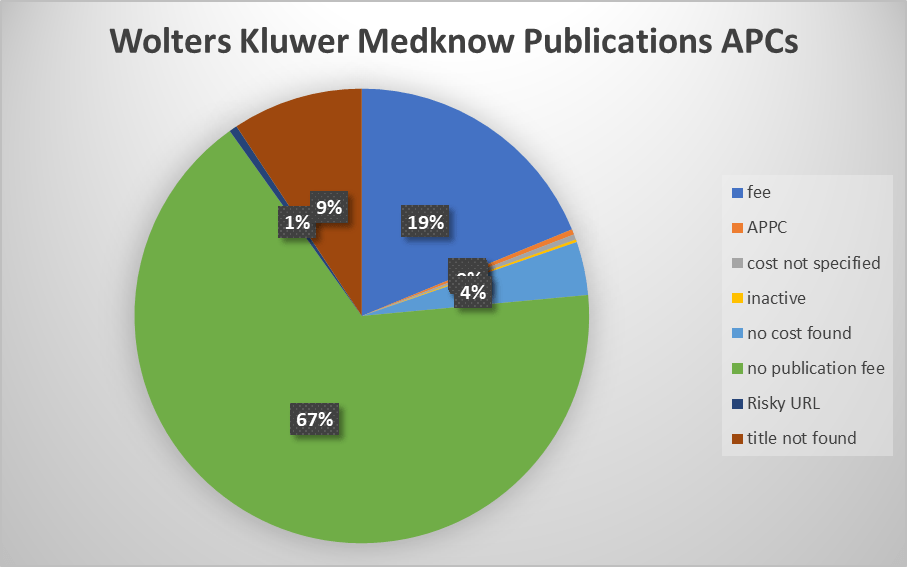
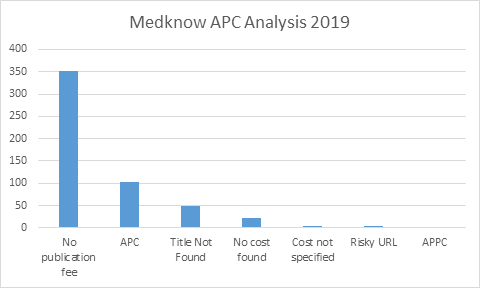
In 2019, Wolters Kluwers Medknow publishes 527 journals among which 99 journals (18.8%) have an APC, over half of journals do not charge a publication fee (66.6%). It is also important to notice that a few journals are redirecting to risky URL which is concerning as there are chances, it has been stolen by some other company (Avasthi, N & Morrison, H, 2019). Among the 99 journals with an APC that were studied, the highest APC is 1,500 USD and the minimal price is 9 USD. The average APC is 200 USD per article and, the most common publication fee (mode) is 150 USD per article.
2019 APC Wolters Kluwers Medknow website
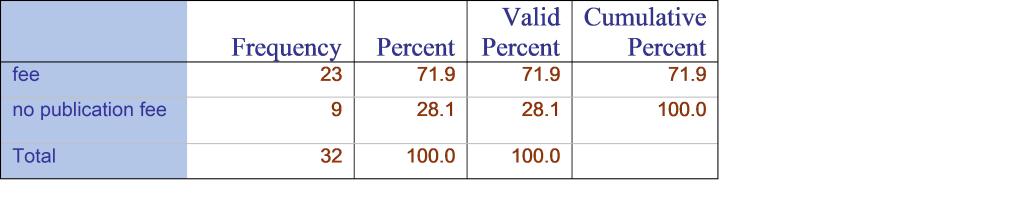
For Wolters Kluwers Lippincott’s fully OA journals, over two-thirds of its journals (71.9%) have a publication fee. Among the 23 journals, the average APC is 1,756 USD per article, the range of APC (article proceeding cost) starts from 1,000 USD to 2,250 USD, and most common APC (mode) is 1,500 USD per article. Compare to Medknow, Lippincott has a much higher average APC. Lippincott’s average publication fee is almost 9 times the average of Medknow which is 200 USD. A lower standard deviation of Medknow indicates that the publication fees tend to be close to the mean (200 USD) of the set, while a high standard deviation of Lippincott indicates that the publication fees are spread out over a wider range.
2019 APC Wolters Kluwers Lippincott website
2. Universitas Negeri Semarang & University of Oxford
Oxford University Press is one of the oldest scholarly publishers officially established in 1668. From the late 1800s, Oxford University Press began to expand significantly and makes most of its revenue from subscription and book sales.
Universitas Negeri Semarang , it appears to be fairly new to online publishing; in DOAJ the first year of online publication is 2009 or later for all the journals (column IO). Most of the journals appear to be published in Indonesian and/or English. The platform used is OJS – open source journal publishing software developed by the Public Knowledge Project. In other words, we have contrasted a very old, traditional, UK-based publisher with a new approach. (Note the size of OA journal publishing by UNS – see Appendix A.)
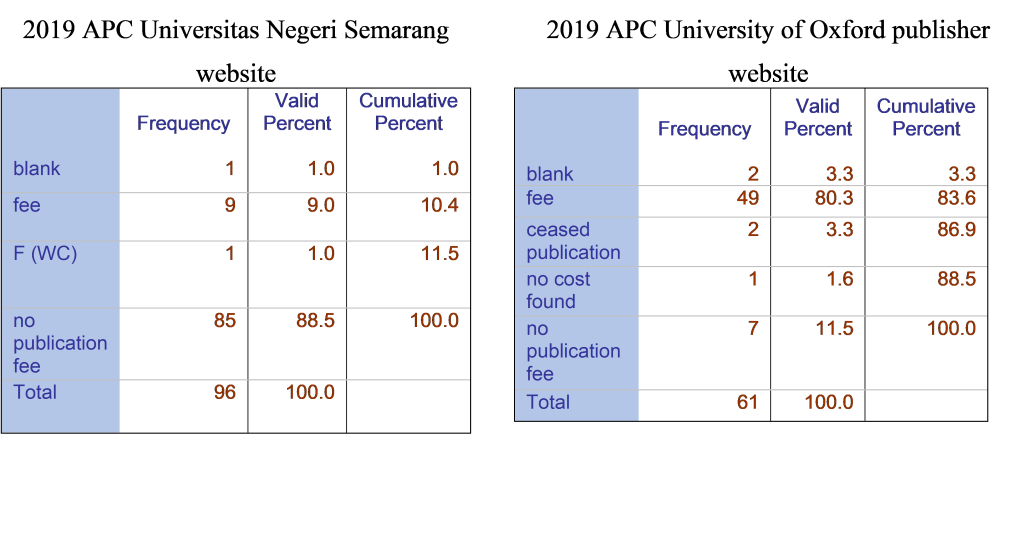
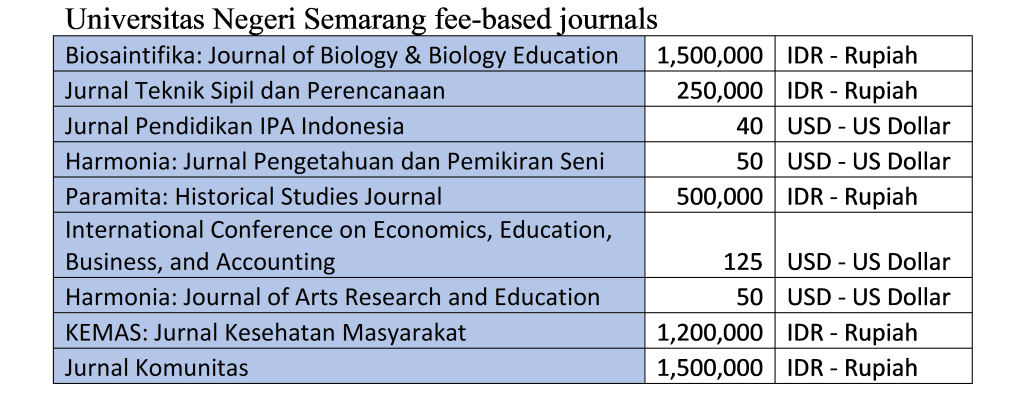
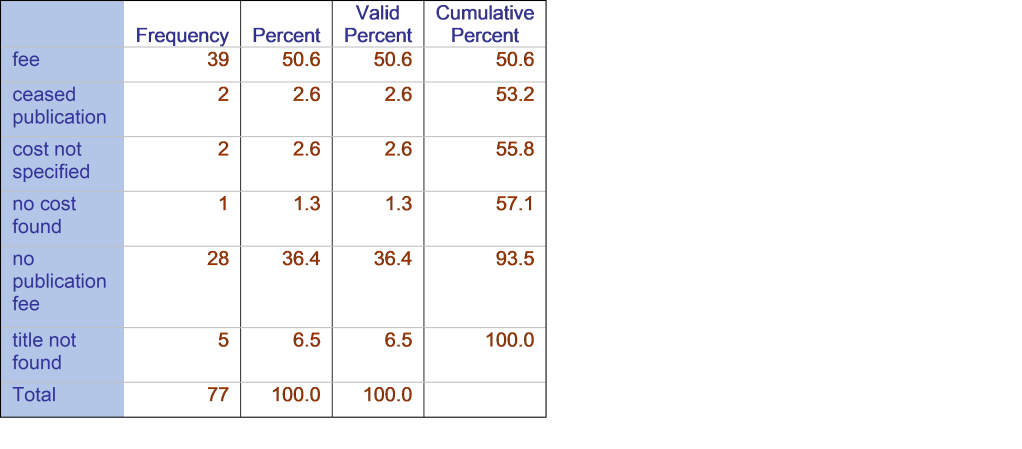
Universitas Negeri Semarang, based in Indonesia, is among the largest fully open access publishers with 96 journals. According to DOAJ webpage, Indonesia becomes the second largest country of publisher by number of journals ( see Appendix B.) and Indonesian rupiah becomes the 6th among all the original currencies for OA journals which accounts for 1.86%. The University of Oxford is a very well-known traditional scholarly publisher. These two university publishers have different approaches to APC. After comparing these two publishers we found Universitas Negeri Semarang has no publication fee for 88.5% of its journals while the University of Oxford has a fee for 80.3% of its fully open access journals.
3. University of Oxford and Ubiquity
As mentioned before, Oxford University Press is one of the oldest scholarly publishers which has a rich history which can be traced back to the earliest days of printing.
Ubiquity Press as an open access publisher of peer-reviewed academic journals and books was founded by researchers at University College London (UCL) in 2012. As a highly cost-efficient press, it provides access to the platform to give universities and societies the infrastructure and services they need to run their own presses through the Ubiquity Partner Network and allow societies to earn income from open access.
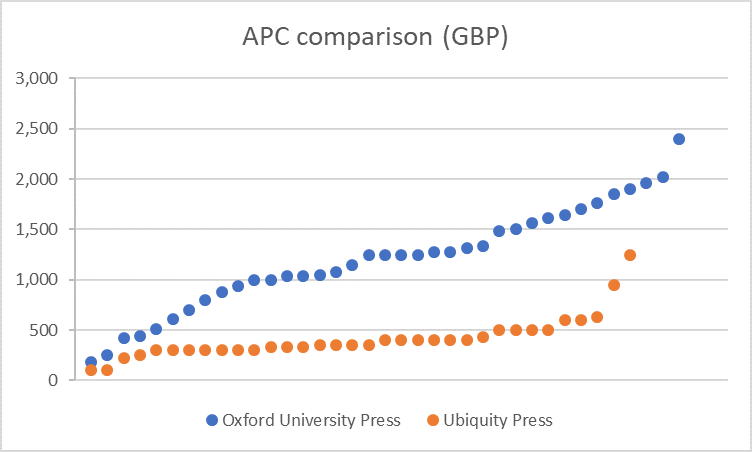
The average price of Ubiquity journals that only charge in GBP is 469 GBP (596 USD) and the most common price among those journals (mode) is 300 GBP (381 USD). The average price of Oxford University Press journals that only charge in GBP is 4543 GBP (5769 USD) and the most common price among those journals (mode) is 1250 GBP (1587 USD). The chart below shows the differences between Ubiquity and Oxford University Press on the APC that charged in GBP.
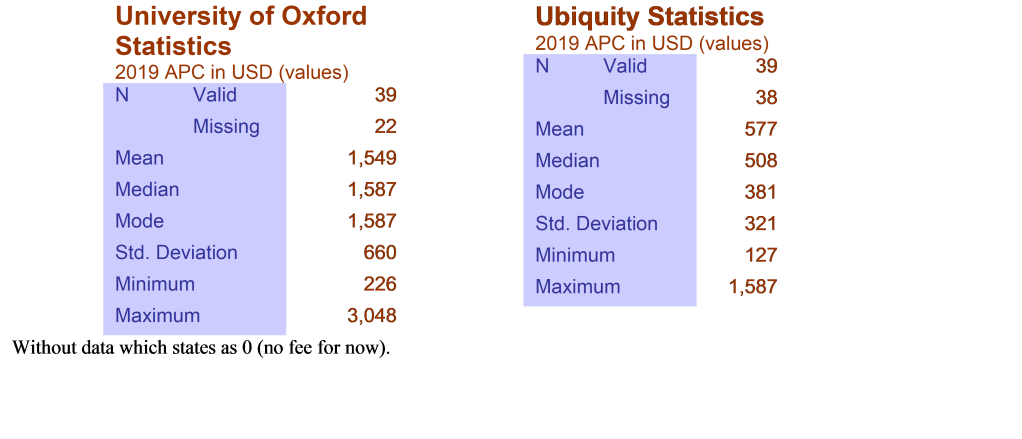
The overall average APC of Ubiquity journals that have a fee is 577 USD while the overall average APC of the University of Oxford is 1,549 USD. The average APC difference between these two publishers is 972 USD.
2019 APC Ubiquity publisher website
4.MDPI and Hindawi
Hindawi is one of the world’s largest publishers of peer-reviewed, fully Open Access journals. Built on an ethos of openness, it works with the global academic community to promote open scholarly research to the world. Based in institutions around the globe, it focuses on serving authors while preserving robust publishing standards and editorial integrity.
MDPI has supported academic communities since 1996 as a non-profit institute for the promotion and preservation of the diversity of chemical compounds. Based in Basel, Switzerland, MDPI has the mission to foster open scientific exchange in all forms, across all disciplines. Mr. Dietrich Rordorf joined MDPI as Dr. Shu-Kun Lin’s assistant in August 2005. As an experiment, a modified version of the online submission and editorial system based on the Open Journals System (http://pkp.sfu.ca/ojs/) was launched by Dietrich for IJMS. Nowadays, MDPI has become the 7th largest publisher in number of articles published in 2018, and the largest publisher of open access articles in DOAJ in 2018.
MDPI and Hindawi charge fees for all the journals they published in 2019. However, their publication fees are different as the charts show below. Even though the highest APC are quite close for both publisher (2,049 USD for MDPI and 2,300 USD for Hindawi), the average APC for MDPI is 822 USD and 1,186 USD for Hindawi. We can also see the difference through mode. The most common price of Hindawi is 950 USD per article (Shi, A., 2019) while the most most common APC for MDPI journals is 350 CHF (359 USD) in 2019.
Publishers in DOAJ in descending order of number of journals
As of Nov. 19, 2019, Universitas Negeri Semarang is the 12th largest publisher by number of journals listed in the Directory of Open Access Journals (DOAJ)
Elsevier (339) BMC (328) Sciendo (326) Hindawi Limited (238) SpringerOpen (202) Wolters Kluwer Medknow Publications (194) MDPI AG (191) SAGE Publishing (165) Taylor & Francis Group (163) Wiley (109) Dove Medical Press (103) Universitas Negeri Semarang (90)
Appendix B
Country of publisher in DOAJ in descending order of number of journals
As of Nov. 21, 2019, Indonesia becomes the second largest country of publisher by number of journals listed in the Directory of Open Access Journals (DOAJ)
United Kingdom (1,609) Indonesia (1,565) Brazil (1,445) Spain (755) United States (741) Poland (619) Iran, Islamic Republic of (511) Turkey (404) Italy (387) Russian Federation (367)
Abstract – Open access journals have been developing in India for several decades for promoting the visibility of research done in various streams. OA to science has been encouraged by government sponsored repositories of student and doctoral proposals, and numerous Indian journals are distributed with OA. There is a need to build mindfulness among Indian scholastics with respect to publication practices, including OA, and its potential advantages, and use this methodology of distribution at whatever point doable, as in openly supported research. This research also showed that a well doing publisher in India gets acquired by European publisher Wolters Kluwer and becomes commercialised. The number of journals with “title not found” or “risky URL”, for example leading to a scam website, is surprising as one might assume that the motivation for this publisher’s society, university and commercial partners is that such partnership would result in high quality services. Most Medknow journals do not charge publication fees. The journals with publication fees are increasing the cost up to 50%. For documentation and a link to the underlying dataset, see Morrison et al. (2019).
According to the Medknow website, Medknow Publications was founded in 1997 in Mumbai, India by Devkumar Sahu. Sahu opted for the open access model of publishing services. Open access publishing means that research outputs and analysis are available online free of cost. In 2006, Medknow had 33 scientific technical and medical journals in its portfolio, at the time, one of the largest open access publishers of medical content in the world. They became the largest open access publishers of medical content till 2006. It was then acquired by Wolters Kluwer in Dec 2011. Medknow now provides publishing services to over 500 medical society journals in over 40 specialties. These are open access journals. Open access increases the visibility and accessibility of the published content. Medknow publishes journals in partnership with societies (affiliations), universities or other commercial partners for the most part. Most of the publications offer free access to the full text of papers immediately. Authors can self-archive articles that have been published. Journals are available freely online but also available through value-added subscriptions.
Chart 1 : Medknow 2019 count of publisher type
Code
Meaning
% of total
C/S
Commercial / society (Medknow publishes in partnership with a scholarly society)
56%
C/U
Commercial / university (Medknow publishers in partnership with a university)
25%
No Partnership
Owned outright by Medknow
10%
C/C
Commercial / Commercial (Medknow publishes in partnership with another commercial publisher
9%
531 Medknow journals were analysed in this research. This is an increase of approximately 7% in the count of journals in 2018. It is a significant growth however lesser as compared to that from 2017-2018. Out of these 531 journals, almost 65% of the journals do not charge publication cost. It is also important to notice that a few journals are redirecting to risky URL which is concerning as there are chances, it has been stolen by some other company. For the analysis I looked at each journal from Medknow’s website on an alphabetical basis. The charges for each journal are mentioned in a different manner. Some of the journals directly states the cost they charge however; few charges are based of the article type as mentioned below:
Short communications
Case Reports
Original Articles
Qualitative Research
Review Articles
Number of words
The below graph shows the representation of charges being taken by Medknow for 2019.
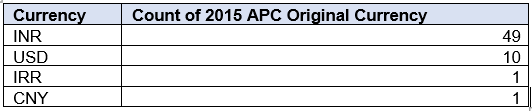
Out of 104 journals that are charging APC, below table shows the distribution of charges based on different currencies for the year 2019.
Most journals are charging in INR and USD. It is to be noticed as the journal originally started from India, but they started taking the publication cost in various other currencies as well which could be confusing for potential authors. Even for INR, there is no fixed cost and it is varying depending on each journal. There are few journals who are not charging for Indian authors but have mentioned publication costs for writers outside India. Have a look at the chart below:
This is a variation and we cannot suggest on a pattern of the publication cost. Below table shows the numbers currency wise:
If we look at the data from 2018, we can see that there has been both increase and decrease in the publication cost for the journals. There has been an increase of 16% in the journals whose title were not found, and this is subsequent to notice as Medknow being one of the well-known publishers does not have websites for so many journals! These journals have not been listed as ceased or nothing specific has been mentioned related to them. There are just 3% journals who showed a price drop but 4% increased the cost. At one side most journals are not charging publication fees but few of them have relatively increased their cost.
Please refer the below table for APC statistics comparison based on different currencies
Looking at the above table, I feel that it is relatively high cost to take for publishing a journal. In todays world, 8000 – 10000 INR would be a week’s salary of a corporate employee in a non metro city. Again, it depends from author to author, but the charge should be in a cap where its not too high. USD, EGP and IRR seem to be balanced as compared to charges being taken in INR globally.
Fernandez, L. (2006). Open Access Initiatives in India – an Evaluation. Partnership: The Canadian Journal of Library and Information Practice and Research, 1(1). https://doi.org/10.21083/partnership.v1i1.110
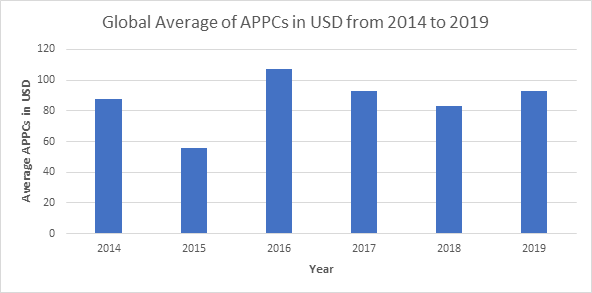
This article summarizes qualitative analysis of APC (Articles Processing Charges) in 2019 and comparison of the central tendencies for APC and APPC (Article page processing charges) of the year 2010 and 2014-2019.
Dataset: Morrison, Heather, et al. 2019, “OA APC longitudinal study dataset 2019”, https://doi.org/10.5683/SP2/0DIPGE, Scholars Portal Dataverse, V1
For the year 2019, we analyzed around 16000 journals that were fully open access in DOAJ (or whose publishers were listed in DOAJ) at some point from 2010 – 2019. More than half of these journals (58%) published had no publication charge.30% of the journals have publications fees. The most frequent model is APC (28% of total) followed by APPC (page charges), under 1%. In a few cases the cost was not specified or an unusual model such as charge per word was used. Of all the journals analyzed, the title of 4% of journals were not found and 3% of journals belonged to ceased publication. It was noted that 53 journals (less than 1%) also had hybrid charges (partially open access) in 2019. The global average APC was 908 USD. From 2010 the global average APC has ranged from 906 – 974 USD. The lack of change in the global average contrasts with variation in mode, reflecting change in the market, particularly ongoing entry of large numbers of new journals, gradually increasing maximum amounts for both APC and APPC, and substantial changes we sometimes observe when recording data for particular publishers. We conclude that continuing to calculate the global average is a less fruitful method of studying the transition to open access and plan to continue this longitudinal study by using the historical data gathered to focus on case studies.
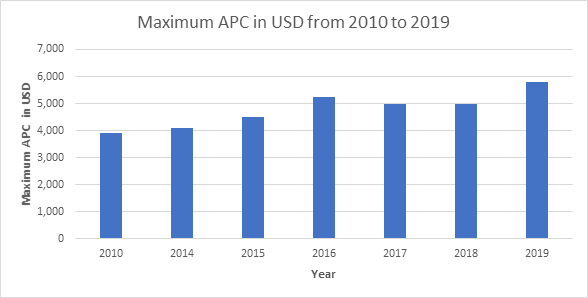
Moreover, the highest value for APC in 2019 went up to 5800 USD whereas the lowest value remained at 0 USD. The SKC team distinguishes between journals that indicate an intention not to charge (no publication fee) and APC-based journals that have not yet begun to charge (identified as APC journals with APC of 0). The mode was noted to be 500 USD.
Abstract
We also analyzed the central tendencies for APC and APPC for over the years of this study. It was observed that there wasn’t much change in the global average of APCs and APPCs from the year 2010 to 2019 and it ranged between 840 to 1090 USD.
The global average of APPC was noted to vary between 50 to 110 USD.
The highest value of APCs observed each year shows a gradual upward trend over the years and the lowest value of APCs has remained between 0 to 8 USD.
For APPC, the highest value shows a steep increase reaching up to 1844 USD in 2019 (for Karger’s, Dementia and Geriatric Cognitive Disorders Extra, 4 times higher than the second highest APPC) when compared to the previous years. The minimum value of APPCs varied between 0 to 5 USD over the years.
It was observed that the mode of APCs between year 2010 and 2019 kept varying from year to year. It was lowest in the year 2014 and 2017 with 0 USD and highest in the year 2016 and 2018 with around 1800 USD.
For APPCs, it reached to a minimum of 30 USD in 2015.Apart from that, it remained between 50 to 90 USD over the years.
Discussion and conclusions
The global average (mean) APC has changed little over the years. In 2010, Solomon & Björk (2012) recorded an average of 906 USD. Our 2014 data yielded an average of 964 USD (Morrison et al., 2015), in 2017, 974 USD (Morrison, 2018), and for 2019 we record an average of 908 USD. This contrasts with variation in mode or most common APC and gradually increasing maximum APC and APPC and the changing prices we observe when studying particular publishers (most often price increases, sometimes a mix of price increases and decreases). For example, Shi (2019) reports a 2019 Hindawi average APC of 1,186 USD, well above the global average and a 14% increase over the 2018 Hindawi APC. As reported by Pashaei and Morrison (2019), DeGruyter is rapidly expanding its collection of open access journal titles, primarily through its new Sciendo imprint. Most of the OA journals of this commercial publisher do not charge publication fees; of those that do, the range of APC prices is much lower for Sciendo than De Gruyter. A focus on the global average APC does not tell the story of what is happening in the transition to open access. We conclude that continuing to calculate a global average APC is less fruitful in understanding OA transition, and for this reason our future research will build on the OA Main dataset for historical context for a series of case studies.
References
Solomon, D. J. and Björk, B. (2012), A study of open access journals using article processing charges. J Am Soc Inf Sci Tec, 63: 1485-1495. doi:10.1002/asi.22673
Crawford, W. (2019). Gold Open Access 2013-2018: Articles in Journals (GOA4), Livermore, CA:2019. Retrieved Oct. 31, 2019 from https://waltcrawford.name/goa4.pdf
Morrison, H.; Salhab, J.; Calvé-Genest, A.; Horava, T. Open Access Article Processing Charges: DOAJ Survey May 2014. (205). Publications 3: 1-16. http://www.mdpi.com/2304-6775/3/1/1
Morrison, H. (2018). Global OA APCs (APC) 2010–2017: Major Trends. Chan, L. & Pierre Mounier. P. , eds. ELPUB 2018, June 2018, Toronto, Canada. <10.4000/proceedings.elpub.2018.16>. Retrieved July 5, 2018 from https://elpub.episciences.org/4604
Thank you to those who provided comments. No changes were suggested for the dataset per se; the documentation has been revised to reflect the comments and the final version is now available here.
This is an invitation to participate in an open peer review of the OA APC Main 2019 dataset, its documentation and the value of research blogposts made possible through this project. While feedback on the OA APC project is appreciated at any time, the formal open peer review period is Dec. 1, 2019 – Jan. 15, 2020. My perspective is that open peer review is in an early phase where experimentation with different approaches could be useful to develop future best practices.
For this reason, reviewers are welcome to submit comments in the format or venue of their choice. Comments on this blogpost are the most convenient approach for the author. Signed comments are preferred. At the end of the formal open peer review period (Jan. 15), I will write a summary of the open peer review process, including all comments and responses where warranted. Comments to date and replies are posted here.
Links:
Dataset: Morrison, Heather, et al. 2019, “OA APC longitudinal study dataset 2019”, https://doi.org/10.5683/SP2/0DIPGE, Scholars Portal Dataverse, V1
Questions to consider in the open peer review process:
The following are meant as guidelines only. Please feel free to focus on one or more specific questions that you find of interest and/or feel qualified to comment on, including questions not asked.
1. Importance and relevance of the research questions: the project’s research question and sub-questions (from the documentation) are as follows:
Research question
What trends can be observed in APCs over time? Subquestions:
Will competition emerge, or will an inelastic market transition or reappear?
Will the percentage of journals that are charging and non-charging remain the same or change?
Will fully OA journals continue to actively publish, cease, change to partially OA (hybrid) or non-OA journals?
What are the OA publishing and charging / non-charging trends and practices of particular publishers? (Note: results of individual research project done sustainingknowledgecommons.org)
Are any of the research questions important, relevant, or otherwise? Do you have any advice for the research team or potential downstream researchers using the dataset about research that you think will be important and relevant in future? Do you have any suggestions for further research?
2. Adequacy of the documentation: is the documentation of the dataset sufficient so that a downstream researcher could continue this research if desired and/or use a subset of the dataset for further research?
3. Limitations: Are the limitations of the dataset sufficiently well described? Is anything missing?
4. Alternative approaches: Are the alternative approaches sufficiently well described?
5. Errors in the dataset: Please note any errors found in the dataset (be specific).
6. Other: please provide feedback on any aspects of the dataset or its documentation not covered in the above questions.
Second update January 8: thanks to Heather Staines from MIT’s Knowledge Futures Group for initiating a conversation on open peer review processes via e-mail and agreeing to publish on the blog. This conversation (which prompted the initial procedural update) can be found here.
Procedural update January 8: there are diverse approaches to data documentation and open peer review. Peer review of an earlier version of this dataset and documentation was published in MDPI’s innovative journal Data, designed for this purpose (Morrison et al. 2017). Tools have been, and are being, developed to provide technical support for new, more open approaches to peer review such as hypothes.is, which facilitates online annotations. I see tremendous potential for open peer review, online annotations, and collaborative online writing. However, I see the process of transformation as in an early stage where experiments (like this one) and open discussion are more important than technical solutions. In other words, my choice of this approach – blogpost and open-ended invitation – is deliberate. Discussion about open peer review process and potential is welcome, although it is a side-conversation to reviewing this dataset designed to facilitate study of longitudinal trends in article processing charges.
Morrison, H., Brutus, W., Dumais-Desrosiers, M., Kakou, T. L., Laprade, K., Mehri, S., … Wheatley, S. (2017). Open Access Article Processing Charges (OA APC) Longitudinal Study 2016 Dataset. Data, 2(2), 13. https://doi.org/10.3390/data2020013
481 Hindawi journals were analyzed. 226 (47%) journals published at some point from 2010 – 2019 have ceased publication, 7 cannot be found on the Hindawi website anymore and 1 has been transferred to another publisher. In 2019, there are 247 journals actively publishing on the Hindawi website. All the journals are charging APCs. The average price is 1186.44 USD, an increase of 14% over the 2018 APC (1040.30 USD). Compared to the US inflation rate for 2018 of 2.44%(“U.S. Inflation Rate 1960-2019” n.d.), the publication fee rises more than 5 times. Among active journals, 17% of the 217 journals did not change in price; 30% journals decreased their price while more than half (53%) of the journals increased price. The amount of price increase starts from 25 USD up to 1350 USD. 14 journals appear to have switched from “no fee” to “fee”, with different APCS from 750 USD to 1350 USD.
Most journals that not found on the website in 2018 now been illustrated ceased on the web page with the specific ceased year and where to find previous publication articles which could be good practice for authors who are trying to find the latest information about specific journals. it also benefits other publishers to follow the lead.
Detail:
Table 1: 2019 Hindawi Journal Publication and APC status summary
Hindawi has 481 journals in 2019. Among these journals, 226 of them were reported ceased on Hindawi’s website. In 2018, most of the ceased journals cannot be found in the website but they have been specified on the webpage about when this journal is ceased and where can readers find previous articles published in the journal. This is a good practice. Here is a example of one of the ceased title.
screenshot from Hindawi website
Price changes 2018-2019
Hindawi has 232 active journals listed on its website in 2018. In 2019, there are 247 journals actively publishing on the Hindawi website. There are 15 journals that cannot be found on the website now can be searched which represents a 6.47% increase in journal numbers of Hindawi.
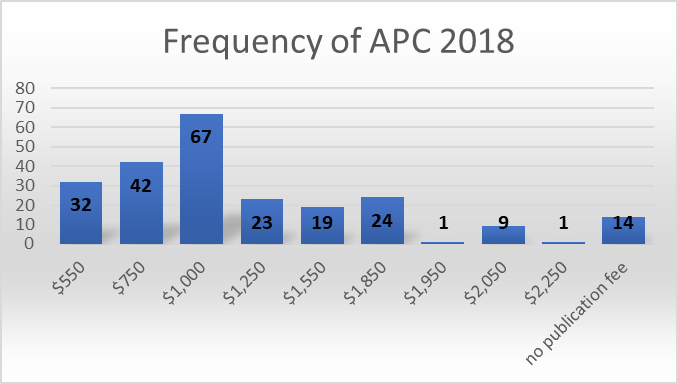
The average publication fee we found from the Hindawi’s website in 2018 is 1040.30 USD. There are 14 journals that had no publication fee in 2018 in contrast with no journals with no publication fee in 2019 and for most journals the publication fee is 1000 USD per article. The range of APC (article proceeding cost) starts from no publication fee which is zero to 2250 USD.
This average takes into account the 15 journals’ APC for the year 2019. This year, the majority of journals have a publication fee of 950 USD per article. Obviously, every journal found on the Hindawi website does have a publication fee from this year. The minimum cost is 650 USD up to 2300 USD. Graph 1 and Graph 2 below shows the frequency of APC for different prices in two years.
Table 2 2018 & 2019 Hindawi active titles APC status summary
Graph 1: price distribution for 2018
Graph 2: price distribution for 2019
Of the 247 journals total:
15 “new” journals are added in 2019 (including in 2019 overall analysis but not 2018-2019 change analysis)
Journals with status: no publication fee coded as 0 in change analysis.
Total journals included in the price change analysis:
2019 overall: 232
2018-2019 comparison: 217
Of the 217 titles, as illustrated in the chart and table below, a majority of these journals (53%) increased in prices in USD from 2018 to 2019, while a third (30%) decreased in price and a few (17%) did not change in price.
For the 116 journals that increased in price, the increases in percentages ranged from 2.22% to 95% (slightly under double in price).
Among the 65 journals with APC price decreases, the drop in percentage ranged from 5% to 24%.
Selected previous posts on Hindawi: Morrison, H. (2018). Recent APC price changes for 4 publishers (BMC, Hindawi, PLOS, PeerJ). Sustaining the knowledge commons. https://sustainingknowledgecommons.org/2018/04/13/recent-apc-price-changes-for-4-publishers-bmc-hindawi-plos-peerj/ In brief: Hindawi April 2016 – November 2017: mixed picture, price increases a bit concerning Brutus, W. (2017). Hindawi: comparaison 2016 – 2017. Soutenir les savoirs communs. https://sustainingknowledgecommons.org/2017/04/22/hindawi-comparaison-2016-2017/ In brief: French – highlights: the mode (most common APC) was $600 USD in 2016, $1,000 in 2017 Salhab, J. (2016). Hindawi publisher: 2016 findings and longitudinal comparison of APC rates. Sustaining the knowledge commons. https://sustainingknowledgecommons.org/2016/04/27/hindawi-publisher-2016-findings-and-longitudinal-comparison-of-apc-rates/ In brief: Hindawi previously used a strategy of rotating free publication in journals, mentioned in this post; the most common APC in both 2015 and 2016 was $600; comparing 2010 and 2016 data, we see a mixed picture with some prices increasing and others decreasing. Salhab, J. & Morrison, H. (2015). Who is served by for-profit gold open access publishing? A case study of Hindawi and Egypt. Sustaining the knowledge commons. https://sustainingknowledgecommons.org/2015/04/10/who-is-served-by-for-profit-gold-open-access-publishing-a-case-study-of-hindawi-and-egypt/ Highlights: as reported by Poynder (2012), Ahmed Hindawi, (from Egypt) founder of Hindawi, confirmed a revenue of millions of dollars from APCs alone – a $3.3 net profit on $12 million in revenue, a 28% profit rate. Hindawi is highly regarded as a leading reputable open access publisher. This commercial Egyptian success story is contrasted with high APC for the most prestigious journals and English-language- only journals that suggest that this approach is not helpful for Egypt’s researchers.
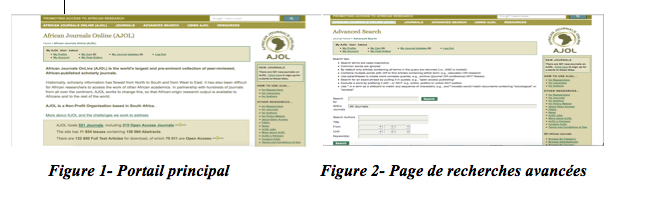
La plateforme publie 524 revues issues de 32 pays d’Afrique. 39 revues sont en français. Malgré ce contenu francophone, Ajol ne dispose pas un filtre pouvant repérer les revues en français. Pour y arriver, il faudrait d’abord reconnaitre ou repérer les pays francophones sur la liste à sa page, Une. De plus l’on remarque que la plateforme est unilingue.
Visité par plus 200.000 personnes par mois, AJOL est une plateforme qui a été créée en 1998 à Oxford en Angleterre. Sa mission est de mettre à disposition du public en ligne une collection de publications des recherches académiques en provenance d’Afrique. D’importants domaines de recherche en Afrique (Biology & Life Sciences, Health, General Science, etc.) ne sont pas connus dans des publications de pays développés. Pour AJOL, Internet est un bon moyen d’augmenter l’accès à ses recherches afin de permettre aux chercheurs du monde entier. Le site de AJOL héberge 524 revues avec169 652 articles en texte intégral de 32 pays. De nos jours, son siège social se trouve en Afrique du Sud (Ajol, 2019). Deux types de frais d’accès qui permettent d’accéder aux articles non open access sont accordés aux chercheurs et aux étudiants d’une part, et un autre aux bibliothèques et cela en fonction du pays où la demande est émise.
Dans ce travail nous présentons les activités de Ajol. Notre démarche repose sur le protocole d’évaluation de The Charleston Advisor. il stipule que l’on que : «As a critical evaluation tool for Web-based electronic resources, The Charleston Advisor will use a rating system which will score each product based on four elements: content, searchability, price and contract options/ features» (The Charleston Advisor, 2019).
AJOL est une plateforme hybride. De ses 524 revues, 262 sont en accès libre. Le système AJOL est entièrement basé sur des logiciels et des technologies Open Source en l’occurrence : Open Journal Systems developed de Public Knowledge Project (PKP) au Canada, Operating System, etc. AJOL n’accepte pas les publications des auteurs de façon individuelle. Il faut passer par une revue pour être publié (AJOL, 2017 (a)).
Options de tarification
Les frais de publication proposés pour le téléchargement des chercheurs, des étudiants, etc. (AJOL, 2017 (e)). Ce sont :
Pour les bibliothèques ont leurs frais qui sont différents de ceux des chercheurs (AJOL, 2017 (d)).
Aperçu du produit / Description
Deux produits sont mis à la disposition à la disposition du public: des publications payantes et non payantes. AJOL publie 169 652 articles en texte intégral dont 110 502 sont en accès libre. Ces articles sont issus de 527 revues, dont 262 en accès libre (AJOL, 2017 (a)). 25 disciplines reparties.
Les disciplines contenues dans leurs publications les suivantes :
L’on constate que 6 nouvelles revues (en gras dans le tableau ci-dessus) se sont ajoutées depuis 2017 au niveau des champs :
– des Sciences environnementales : 29
– de la Sociologie et de l’anthropologie : 42
– de la Technologie, de l’informatique et de l’ingénierie 30
– des Sciences générales : 87
– de l’Économie et du développement : 48
– Sciences humaines : 56
Les champs de la santé (Health (167)) et de (General Science (87)) arrivent en tête du nombre des catégories de sujet et sont toutes évalués par les pairs (peer reviews). AJOL s’adresse spécifiquement aux chercheurs et aux bibliothèques. Selon les auteurs du site Web, AJOL a un PageRank Google de 8. Il est visité par 200 000 personnes par mois à travers le monde. L’onglet «Using AJOL» permet d’accéder la feuille de route qui indique le processus de recherche (AJOL, 2017 (b)).
Interface utilisateur / Navigation / Recherche
La plateforme publie 524 revues issues de 32 pays d’Afrique. 39 revues sont en français. Malgré ce contenu francophone, Ajol ne dispose pas un filtre pouvant repérer les revues en français. Pour y arriver, il faudrait d’abord reconnaitre ou repérer les pays francophones sur la liste à sa page principale. De plus l’on remarque que la plateforme est unilingue.
Une particularité est que son interface donne accès facilement aux produits. La fonctionnalité «Journal» donne directement accès aux différentes catégories de sujets qui sont traités. On peut les obtenir par pays sur une facette où tous les pays sont affichés. Et les facettes par pays permettent de spécifier sa recherche. Toutefois, les informations sur les auteurs et les rédacteurs de la plateforme sont inexistantes. Par exemple, l’on n’a pas les noms et l’organigramme de cette organisation à but non lucratif (The Charleston Advisor, 2019).
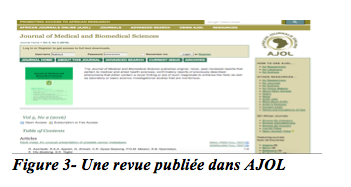
Le site web de AJOL demande une inscription pour naviguer sans restrictions. Au niveau de la principale, 5 onglets permettent de se connecter. «Afriacn Journals Online (AJOL)» est fixé sur la page une. L’onglet «Journals» conduit à la liste des catégories de publication, «Advanced Search» ouvre sur un champ de recherche plus spécifique par facettes. «Using AJOL» permet de trouver des articles en accès libre de toutes les catégories de revues par titre, d’enregistrer le profile de votre revue et de donner une feuille de route pour les recherches. Il indique aussi la liste des frais que chercheurs et auteurs doivent payer. «Ressources» connecte les visiteurs sur d’autres revues hors de l’Afrique. Par ailleurs, une colonne à facette située à droite du site indique les catégories, par ordre alphabétique et par pays où l’on peut télécharger les articles (AJOL, 2017 (a)).
Contenu
Ajol a pour mission de valoriser et de diffuser les publications africaines. Dans ce sens, la plateforme remplit parfaitement ses objectifs. Elle diffuse 524 revues examinées par les pairs, dont plus de la moitié (306) avec des frais pour le téléchargement. Le reste est en accès libre. On remarque que la grande partie est en anglais (497). 39 revues en français. Bien que le contenu soit diversifié, les études sur les Sciences de l’Information et de la bibliothéconomie sont très restreintes (18 revues avec la Communication) par rapport aux sciences de la santé (167).
Tarif
Les revenus provenant des frais de téléchargement de l’article pour les revues d’abonnement sont envoyés au journal d’origine (moins le coût d’amortissement d’AJOL). Par contre toutes les revues en accès libre sont à la portée de tous. Les frais sont fixés en fonction des pays. Les pays pauvres payent moins que les plus riches. Les critères qui définissent ces pays sont basés sur les statistiques de la Banque Mondiale (The World Bank, 2017). Évidemment, les frais des bibliothèques sont plus élevés que ceux des chercheurs et cela en selon les pays.
Par ailleurs, une des compétitions de AJOL est The Sabinet African ePublications (African Journal online archive). Son site publie 500 revues regroupant 64 catégories de sujets, dont 86, en Open Access. Il est créé depuis 2001. Cette plateforme a la particularité de ne pas publier son organigramme comme AJOL. Nous n’avons pas retrouvé ses frais de publication. Par contre, elle publie un grand nombre de revues de l’Afrique du Sud (The Sabinet African ePublications, 2017).
La bibliothèque numérique en ligne africaine (AODL) est un portail de collections multimédia sur l’Afrique. Les auteurs collaborent avec le Centre d’études africaines de l’Université d’État du Michigan, ainsi que des organisations du patrimoine culturel en Afrique pour construire cette ressource (AODL, 2019).
Dispositions d’achat et de contrat
Les revues qui choisissent de publier dans un modèle d’accès ouvert ont leur texte complet en ligne pour le téléchargement gratuit. Les bibliothèques peuvent ouvrir un compte de téléchargement d’articles prépayés avec AJOL pour accéder aux titres des partenaires qui facturent leur contenu. Cela permet aux utilisateurs d’obtenir plus facilement des articles en texte intégral auprès de AJOL. L’accès aux articles d’abonnement est effectué par un mot de passe ou par leur logiciel qui sélectionne automatiquement la gamme d’adresses IP au choix de l’établissement. Des indications expliquent qu’il n’y a pas de restriction de temps pour la remise des articles. Les comptes peuvent être complétés à tout moment. Pour vérifier la catégorie dans laquelle votre pays se trouve, il est demandé de se référer listes de pays de la Banque mondiale. L’adresse suivante : info@ajol.info permet aux revues de se faire créer une installation un compte.
Conclusion
La plateforme AJOL est hybride, certains articles sont payants. Pour gérer le flux de clients, une souscription exige un «username» et un mot de passe pour la navigation sur le site. De plus, l’accession aux documents payants sont soit par abonnement ou directement. Ce qui filtre les visiteurs. Il y a un panier dans lequel tout souscripteur peut collectionner les articles qu’il souhaite acheter. Il n’y a pas d’options qui déterminent un groupe particulier avec des faveurs spécifiques.
Correction Oct. 24: the original synopsis incorrectly stated that HAL is an open archive in Social Sciences. HAL is an open archive for research across the disciplines.
African journals seek to create a space for themselves by disseminating their journals through online platforms and archives. There are multiple possibilities for preservation and publishing on line. One of these is electronic archiving. In this research post Kakou presents the HAL archive and explores the representation of African document. Developed and administered by the Centre pour la Communication Scientifique Directe (CCSD), the platform HAL is an open archive for research across the disciplines. In this post, Kakou presents an overview of the services offered by HAL, including Episciences.org and Sciencesconf.org. Episciences.org offers journal publishing within the archive and supports the innovative peer-review overlay approach to journal publishing. Arima, a journal that has been supported by the North-South coalition Colloque africain pour la Recherche en Informatique et mathématiques appliquées (CARI) for twenty years, is among the 15 Episciences journals. This is « our » platform too ; Morrison’s 2018 ELPUB OA APC survey can be found in Episciences.
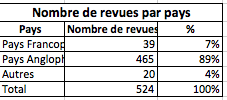
OpenEdition (formerly Revues.org) publishes 21 African journals. Only one of these journals is published in an African country (Kenya). In this post Kakou illustrates a gap in dissemination of African scholarship, particularly francophone African scholarship. For example, of the 524 journals included in African Journals Online (AJOL), 465 (89%) are published in English speaking countries and only 39 (7%) in French speaking countries. Only 12 of the 24 African countries where French is an official or co-official languages are represented in AJOL. This research illustrates the African and particularly Francophone African knowledge gap that is the focus of Kakou’s doctoral research.
Parmi les revues que OpenEdition publie, 21 revues sont africaines. Elles sont localisées dans 5 pays. Seul un pays africain (Kenya) y figure. Ce sont : Nederland (1), Portugal (2), Kenya (1), France (17), Italie (1).
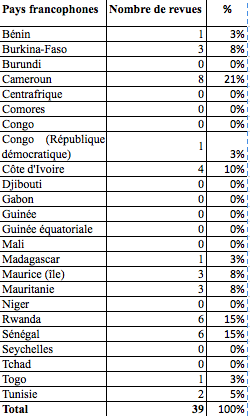
Les universités africaines adoptent les stratégies à suivre pour se développer au numérique. Selon Murray et Clobridge (2014), de plus en plus de revues en ligne sont diffusées sur les plateformes africaines telles AJOL, Sabinet, etc. La plateforme AJOL (African journals online) par exemple, se veut promotrice de la revue africaine en général. Cependant, l’on dénombre sur ce site, 39 revues en français (7%) sur 524 (Ajol, 2019). Ces revues sont reparties entre 12 états sur 24 (voir tableaux ci-dessous) dont le français est une langue officielle ou co-officielle (Université Laval, 2019).
Tableau 1 : Liste en % des pays cités dans Ajol
Tableau 2 : Liste des pays et nombre de revues en % des pays existants et non-existants sur Ajol
18 états anglophones détiennent la majorité absolue des revues avec 465 revues. D’autres pays (arabes (19), portugais (1)) se partage 20 revues. Voir Tableau.
Tableau 3 : Nombre de revues par pays en %
Tableau 4 : Nombre de revues par pays en %
Objectif
Notre objectif est de répertorier les revues africaines sur le Web et principalement sur les plateformes. Dans cette recherche, nous avons sélectionné la plateforme OpenEdition pour connaître les types de publications de revues africaines. Dans un premier temps, nous présentons la plateforme OpenEdition. Dans un deuxième temps, nous indiquons le nombre de documents qui y sont diffusés.
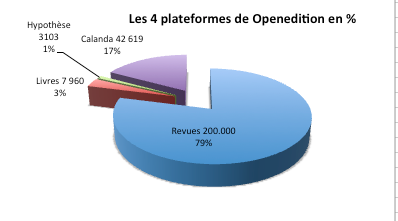
Les quatre plateformes d’OpenEdition
Au sortir de l’analyse de la plateforme Revues.org, nous observons que celle-ci devient: OpenEdition depuis 2017 pour renforcer sa dimension internationale. Elle publie quatre plateformes de publication et d’information sur les sciences humaines et sociales: OpenEdition Journals (les revues), OpenEdition Books (les collections de livres), Hypothèses (les carnets de recherche) et Calenda (les annonces d’événements académiques internationaux) (OpenEdition 1, 2019).
OpenEdition accueille 522 revues sur son portail. Environ plus de 200 000 articles, dont 92% sont accès libre (OpenEdition 2, 2019). Sur la plateforme OpenEdition Books, l’on dénombre près de 7 960 livres en sciences humaines et sociales provenant de 90 éditeurs. L’accès aux ouvrages se fait sur l’espace personnel de chaque éditeur. Ils sont librement accessibles en HTML, et imprimables (OpenEdition 3, 2109).
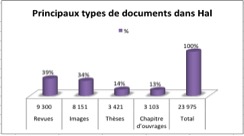
Quant à Hypothèses, 3 103 carnets de recherches sont recensés sous différents types et tous en accès libre. Ce sont : carnet de chercheur, carnet de terrain, carnet de séminaire, carnet de veille, etc. (OpenEdition 4, 2019).
Enfin, Calenda est le calendrier d’annonces scientifiques en sciences humaines et sociales. Il regroupe, plus de 42 619 annonces en libre accès. De plus, Calenda publie dans les actes de colloque, les programmes complets de journées d’études et de séminaires, les cycles de conférences, les appels à contributions en vue de colloques, etc. (OpenEdition 5, 2019). Voir tableau
Tableau 5 : Les 4 plateformes de OpenEdition en nombre d’articles et en %
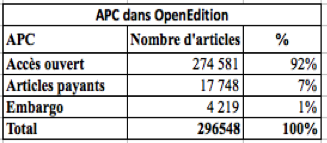
OPenEdition offre aux bibliothèques la possibilité de choisir une politique d’acquisition dans la logique de développement du libre accès. Aucun quota de téléchargement ne s’applique à cet accès (OpenEdition 6, 2019). OpenEdition publie 274 581 en accès libre. 17 748 articles sont payant et 4219 articles sous embargo. «L’abonnement donne accès aux fichiers PDF et ePub de manière pérenne» (OpenEdition 6, 2019). Voir tableau
Tableau 6 et 7 : APC dans OpenEdition en nombre d’articles et en %
Fig:6
Fig:7
Conclusion
OpenEdition publie 4 plateformes (Revues, livres, Hypothèses Calanda) soit un total de 253 682 publications. Les revues représentent 200 000 soit 79%. 274 581 (92%) sur 296 548 articles sont disponibles en accès libre. Parmi ces revues OpenEdition diffuse 21 revues africaines. Seul un pays africain y figure: le Kenya. Nous avons observé que OpenEdition est le nouveau nom de Revue.org.

















 Sustaining the Knowledge Commons / Soutenir les savoirs communs