Hybrids: print plus OA okay with DOAJ, print plus online subscriptions no. Is this fair?

The Directory of Open Access Journals only lists fully open access journals. Hybrids that offer subscriptions as well as an optional OA publication fee are not welcome. However, there are a number of journals listed in DOAJ that offer print subscriptions. Is this fair? Following is language on APCs for Scientia Agricola that make it very clear that this is a hybrid journal. This pricing model suggests a way to retain individual subscriptions, a model that has some similarities and overlap with membership models.

If the first author or corresponding author subscribes to Scientia Agricola:

  • US$ 35.00 per printed page, up to 6th page
  • US$ 70.00 each additional page
  • US$ 85.00 per color page

If neither the first author nor the corresponding author subscribe to Scientia Agricola:

  • US$ 70.00 per printed page, up to 6th page
  • US$ 140.00 each additional page
  • US$ 85.00 per color page

Cite as:

Morrison, H. (2015). Hybrids: Print plus OA okay with DOAJ, print plus online subscriptions no. Is this fair? Sustaining the Knowledge Commons / Soutenir Les Savoirs Communs. Retrieved from https://sustainingknowledgecommons.org/2015/06/20/hybrids-print-plus-oa-okay-with-doaj-print-plus-online-subscriptions-no-is-this-fair/

Open access landscape in mathematics

Walt Crawford has posted an analysis of english language open access journals in mathematics. http://walt.lishost.org/2015/06/the-open-access-landscape-17-mathematics/

Of interest:

  • statistics has the highest number of free journals outside the humanities and social sciences
  • there are more articles published in the fee journals
  • there is a relationship between the size of the journal and whether fees are charged, e.g. both prolific journals have APCs while 71% of medium-sized journals do not have APCs
  • article statistics show robust growth
  • journal statistics show a big jump in growth in recent years, both for fee and free journals

Comment: the correlation between size of journal and whether fees are charged is likely based in part on the need for more prolific journals to have paid staff, office space, etc.

This post is part of the OA article processing charges project.

Citation: cite Crawford’s analysis rather than this post.

Sustaining scholarly societies and society publishers: key challenges for open access transition

A recent editorial by Diane Scott-Lichter in Learned Publishing summarizes nicely some of the primary challenges for scholarly societies to transition to open access that many have written about over the years.

I argue that if we want to see a successful and sustainable transition to open access that prioritizes the public good and scholarship per se it is timely to address some of these challenges. Society publishers have a track record of high quality publishing at relatively low cost. Many scholarly societies rely on publishing revenue to sustain the societies themselves and the important work they do, including support for scholars and advocacy in the public interest. The generally modest surpluses of scholarly society publishers that are used to advance scholarship are not the same as the money that flows through commercial publishers to private parties solely for their private profit.

How can these challenges be addressed? This needs a lot of work – comments, suggestions and research are needed and welcome. Here is one thought: if libraries and other open access activists were to engage faculty in the question of whether the high profit margins of a few large commercial scholarly publishers might be re-directed to more direct means of support for scholarly societies and journals, would this facilitate broadening support for open access – and possibly more radical transformation of scholarly communication – at our institutions? If as a faculty member I had a small fund to spend with spending options including article processing charges or things like society memberships, the benefits to myself and my colleagues of a lowest-possible-cost peer-review overlay publishing system using the institutional repository in order to direct as much money as possible to things like awards, grants, and public advocacy, I could see this being a powerful incentive towards this kind of radical change.

Details

One argument is that scholarly journals have a superior track record for quality in scholarly publishing at an average fraction of the cost of commercial scholarly publishing. As Bergstrom and Bergstrom (2006) reported:

For example, in the fields of economics and ecology, the average institutional subscription price per page charged by commercial journals is about 5 times that charged by non-profit journals. These price differences do not reflect differences in quality as measured by number of recorded citations to a journal. For commercial journals the average price per citation is about 15 times that for non-profit journals. Similar price differentials are found across a wide variety of scientific disciplines.

Many scholarly societies rely on revenue from their publications and sometimes other sources such as meeting / conference revenue and grants to fund the work of the society. The work of these not-for-profit organizations that is supported by publication revenue includes (from Scott-Lichter):

Learned societies are advocates for their disciplines, and its members keep government bodies, funders,and the public aware of the issues relative to their fields. Advocacy areas often focus on funding, policy reform, education, and the workforce”

and

“Society grants, awards, scholarships, and internships supplement the work of funding bodies and schools. Grants support a range of activities from basic research to studying and documenting a discipline’s history. Awards recognize achievements and encourage advancement. They range from student travel awards to attend scholarly meetings to honoring public service or teaching to lifetime achievement for contributions to the discipline. Scholarships and internships support the development of students and faculty and aim both to cultivate qualified individuals working in the discipline and uphold the quality of the discipline. Again, the benefits go beyond the discipline”.

Like open access itself, these benefits from society publishing are in the public interest. We need to figure out how to support both scholarly societies and open access.

References

Bergstrom, T. C., & Bergstrom, C. (2006). The economics of scholarly journal publishing. Seattle: Retrieved August 28, 2011 from http://octavia.zoology.washington.edu/publishing/

Scott-Lichter, D. (2014) Learned societies: Resilience not reliance required (2014). Learned Publishing 27:2, p. 83-84. doi:10.1087/20140201

This post is part of the resource requirements project.

Cite as:

Morrison, H. (2015). Sustaining scholarly societies and society publishers: Key challenges for open access transition. Sustaining the Knowledge Commons / Soutenir Les Savoirs Communs. Retrieved from https://sustainingknowledgecommons.org/2015/06/19/sustaining-scholarly-societies-and-society-publishers-key-challenges-for-open-access-transition/

Library-led journals using Digital Commons: 94% open access, none with article processing charges

A study by Busher & Kamotsky highlights one of the options for sustaining small scholar-led journals. Digital Commons is a software used by library institutional repositories and as a publishing platform, particularly in the United States. In Canada, the Public Knowledge Project’s Open Journal Systems and Érudit are the most commonly used platforms. The authors found that of nearly 700 journals (now 900) using Digital Commons in 2013, “94% were open access, and none relied on article-processing fees”. Other statistics indicate the growth of both library publishing services and journals hosted. The authors suggest the rationale: “The library has been more than willing to support these journals with software, hosting, infrastructure, and often more hands-on editorial services. The investment has proven worthwhile: libraries have been able to expand their publishing programs even while other library budgets are shrinking”. The authors present several case studies of journals successfully using Digital Commons, and suggest that this is a useful model for new and niche journals.

Comment: the usefulness of this model extends far beyond the new and niche. For example, library-led publishing is now an option worth considering for journals that opted for commercial publishing services in the past couple of decades due to the limited options available for online publishing a few years ago. At least in North America, the majority of journal editorial boards could likely find several options for library-led publishing by canvassing editorial board members.

Reference

Busher, C., & Kamotsky, I. (2015). Stories and statistics from library-led publishing. Learned Publishing 2015 28:1, p. 64-68. doi:10.1087/20150110. Open access archived version here:  http://works.bepress.com/cgi/viewcontent.cgi?article=1006&context=casey_busher

This post is part of the resource requirements project.

Cite as: Morrison, H. (2015). Library-led journals using Digital Commons: 94% open access, none with article processing charges. Sustaining the Knowledge Commons / Soutenir Les Savoirs Communs. Retrieved from https://sustainingknowledgecommons.org/2015/06/18/library-led-journals-using-digital-commons-94-open-access-none-with-article-processing-charges/

DOAJ, Impact Factor and APCs

by César Villamizar and Heather Morrison

In May 2015 we conducted a pilot study correlating OA APCs and the journal impact factor, using data from 2010, 2013 and 2014. Here are some early results:

  • about 10% of the journals listed in JCR are DOAJ journals
  • over 10% of the journals listed in DOAJ have an impact factor
  • about 40% of the DOAJ IF journals had an APC as of May 2015 (estimate; higher than overall journals with APC)
  • average APC of IF journals in 2014 more than double overall average APC ($1,948 as compared with overall average of $964)
  • average APCs of IF journals increased by 7% in a 5-month period from 2013 to 2014 and by 16% from 2010 to 2014
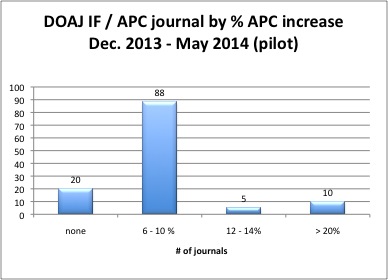
  • over 80% of APC / IF journals increased price by 6% or more in a 5-month period from December 2013 to May 2014
  • about 20% of APC / IF journals increased price by 10% or more in a 5-month period from December 2013 to May 2014
  • 7% of APC / IF journals increased price by 20% or more in a 5-month period from December 2013 to May 2014

Conclusion: about 10% of DOAJ journals have impact factors, and about 10% of impact factor journals are DOAJ journals. Open access journals (or some OA journals) using the APC business model may be exploiting impact factor status as a means to raise prices. Further investigation warranted.

Details

As of May 3, 2015, Thomson Reuters’ Journal Citation Reports (JCR) listed 11,619 journals with impact factor (IF). Of these, 1,146 are listed in the Directory of Open Access Journals (DOAJ). As of May 15, 2015, 10,532 journals were listed in DOAJ. This means that 9.8% of the titles listed in JCR are DOAJ titles, and 10.8% of DOAJ journals have an IF.

The pilot involved selecting half of the DOAJ journals with an IF (572 journals from both sciences and social sciences, selected alphabetically abbreviated title A – J Otolaryngol-Head and looking up the quartile and subject ranking. Of these titles, 169 were included in the May 2014 OA APC sample. For 126 journals data was available for both December 2013 and May 2014, the basis of the 2013-2014 calculations. Assuming that the portion of APC-charging journals would be the same for non-sampled journals, this would result in an estimate of 229 journals with IF and APC, 40% of the total. This is higher than the 26% of journals with APCs as of May 2014.

Stats of the 572 in DOAJ with impact factor (pilot):

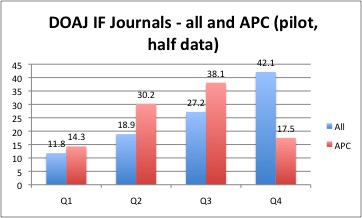
  • 42.1% of the journals are in the quartile four (Q4), 27.2% of the journals are in the quartile three (Q4), 18.9% of the journals are in the quartile two (Q2), and 11.8% of the journals are in the quartile one (Q1)
    • 69% of the journals are in the Q4 and Q3
    • 31% of the journals are in the Q2 and Q1
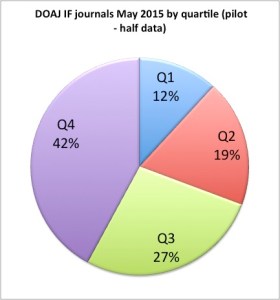
DOAJIFquartile


  • Out of the 572 journals,
    • APC data by year
      • 2010 B&S : 176
      • Dec 2013 SKC : 129
      • May 2014 SKC : 169
  • We have 126 journals with APC information collected in Dec 2013 SKC and May 2014 SKC
  • We have 110 journals with APC information collected in 2010 S&B,Dec 2013 SKC and May 2014 SKC.

Stats of the 126 journals with APC Data (Dec 2013 SKC – May 2014 SKC)

  • 17,5% of the journals are in the quartile four (Q4), 38,1% of the journals are in the quartile three (Q4), 30,2% of the journals are in the quartile two (Q2), and 14,3% of the journals are in the quartile one (Q1)
    • 55,5% of the journals are in the Q4 and Q3
    • 45,5% of the journals are in the Q2 and Q1

DOAJIFallapcs

  • 3,2% of the journals decreased their APC (this is 3 journals; 2 are Hindawi journals. Hindawi as of May 2014 had a practice of rotating free publication. These 2 journals had APCs of 0 in 2014, but have substantial prices today (Bioinorganic Chemistry Applications is now $1,250 and International Journal of Genomics is now $1,500). The third journal with an apparent small price decrease, Experimental Animals, from $200 to $198 USD is likely an anomaly due to a weakening of the main currency, the Japanese Yen, with respect to the USD. In other words, all price decreases appear to be temporary anomalies.
  • 14,3% of the journals maintained their APC
  • 82,5% of the journals increased their APC at least 6.4%
    • 3,1% increased their APC between 6,4% and 7,49%
    • 54,8% increased their APC between 7,5% and 9,49%
    • 15% increased their APC between 9,5% and 13,9%
    • 7% increased their APC between 14% and 25%

The following figure reflects the 123 titles remaining after removing the 2 anomalous 0 APC titles.

DOAJIFAPC201314increasewhite

The following chart illustrates the percentage of journals by price increase from 2013 to 2014.

DOAJIFAPC201314percentincrease

APC 2010 USD APC 2013 USD APC 2014 USD
Max 2,165 2,420 2,650
Min 500
Min greater than zero 500 200 198
Median 1,825 2,060 2,215
Mode 1,825 2,060 2,215
Average 1,637 1,808 1,948
  • Medicine and Biology and Life Science represents 81,1% of the journals categories susceptible to charge APCs
    • 3% of the journals in these two categories increased their APC at least in 6.4%
    • 9% increased their APC between 6.4% and 7.49%
    • 1% increased their APC between 7.5% and 9.49%
    • 50% increased their APC between 9.5% and 13.9%
    • 8% increased their APC between 14% and 25%

Note and references

2010 data courtesy of Solomon, D.J. & Björk, B.C. (2012). A study of open access journals using article processing charges. The Journal of the American Society for Information Science and Technology 2012. Retrieved May 31, 2015 from http://www.openaccesspublishing.org/apc2/ (data unpublished)

2014 data: Morrison H, Salhab J, Calvé-Genest A, Horava T. Open Access Article Processing Charges: DOAJ Survey May 2014. Publications. 2015; 3(1):1-16. http://www.mdpi.com/2304-6775/3/1/1

Cite as:

Villamizar, C., & Morrison, H. (2015). DOAJ, Impact Factor and APCs. Sustaining the Knowledge Commons / Soutenir Les Savoirs Communs. Retrieved from https://sustainingknowledgecommons.org/2015/06/01/doaj-impact-factor-and-apcs/

APC pricing that depends on how much work is involved

A number of the variations on pricing we see at can be summed up as variable pricing depending on how much work is involved (which seems logical when you think about it). The Journal of Venom Research provides a great example of this approach. The basic OA APC (per year) is GBP 475. This covers unlimited publishing for one year for articles within the recommended size limits. There are extra charges for:

  • extra pages
  • “if figures, line drawings or tables are of insufficient quality and standard, and do not conform to the journal style, and have to be re-drawn, re-sized or converted into the correct format by the Publisher (minimum charge GB £25 per item). In multi-part figures each part constitutes one item. Authors are generally notified of this at the time of manuscript revision”.
  • extensive reference formatting “Costs of extensive formatting of references will be passed on to the authors (minimum £50)”.

Comment: I like this approach. It gives authors and funders an opportunity to consider whether a little extra work to keep the cost down is worth it or not. Perhaps some of the extra pages can become supplementary material and deposited in the institutional repository rather than being included in the article. A busy author may find the optional work and charges convenient; a poor author may find it worthwhile to do the extra work to keep the costs down.

This post is part of the open access article processing charges project.

Cite as:

Morrison, H. (2015). APC pricing that depends on how much work is involved. Sustaining the Knowledge Commons / Soutenir Les Savoirs Communs. Retrieved from https://sustainingknowledgecommons.org/2015/05/28/apc-pricing-that-depends-on-how-much-work-is-involved/

OA APCs: no cost found

Similar to what we found last year, there were a number of journals that indicated “has charges” in DOAJ as of May 2015 where we have not been able to confirm that the journal actually has any kind of publication fee. In some cases, there is language clearly indicating that there are no fees. Of the sub-sample of 139 journals published by publishers with 9 or fewer journals using APCs (as of May 2014, we are updating based on this sample to look for trends), for 25 journals (18% of the sample) we either could not identify any charges, or we were able to verify that the journal actually does not charge. The “cost not found” category is separate from the “not specified” category where language on the journal website suggests that there are charges but the amounts are not given. One theory I have that might account for some of the discrepancy is the possibility of misinterpretation of author guidelines details for non-english-language journals. Many journals have a lot of numeric information in their author guidelines (number of words, pages, margin and text sizes). It would be easy for a non-native speaker casually suggesting a journal to DOAJ to assume that some of the numbers referred to APCs.

Here are the details:

no publication fees Montenegrin Journal of Sports Science and Medicine http://www.mjssm.me
no cost found Conflict & Communication Online http://www.cco.regener-online.de/
no cost found Entomotropica http://www.entomotropica.org/
no cost found International Journals of Research Papers (title change 2015) http://gssrr.org/index.php?journal=JournalOfBasicAndAppliedi&page=index
no cost found Journal of Nippon Medical School http://www.jstage.jst.go.jp/browse/jnms/-char/en
no cost found Magister Dixit http://md.islu.ru/
no cost found Métis : História e Cultura http://www.ucs.br/etc/revistas/index.php/metis/index
no cost found Modern Journal of Applied Linguistics http://www.mjal.org
no cost found Pixel-Bit http://www.redalyc.org/revista.oa?id=368
no cost found Revista de la Sociedad Química de México http://www.redalyc.org/revista.oa?id=475
no cost found Revista Lusófona de Educação http://revistas.ulusofona.pt/index.php/rleducacao
no cost found Cuadernos Geográficos http://www.redalyc.org/revista.oa?id=171
no cost found Matemáticas : Enseñanza Universitaria http://www.redalyc.org/revista.oa?id=468
no cost found Revista de Investigaciones Políticas y Sociológicas (RIPS) http://www.redalyc.org/revista.oa?id=380
no cost found Bulletin of Materials Science http://www.ias.ac.in/matersci/
no cost found Journal of Genetics http://www.ias.ac.in/jgenet/
no cost found Revista Brasileira de Administração Científica http://www.arvore.org.br/seer/index.php/rbadm
no cost found Academia Journal of Agricultural Research http://academiapublishing.org/ajar/index.htm
no cost found Academia Journal of Educational Research http://academiapublishing.org/ajer/index.htm
no cost found Contaduría y Administración http://www.redalyc.org/revista.oa?id=395
no cost found Egyptian Academic Journal of Biological Sciences : Zoology http://zoology.eajbs.eg.net/
no cost found Revista Mexicana de Ciencias Políticas y Sociales http://www.redalyc.org/revista.oa?id=421
no APC, subsidized Magazin erwachsenenbildung.at : Das Fachmedium für Forschung, Praxis und Diskurs http://www.erwachsenenbildung.at/magazin
cost not found Revista CROMA http://www.croma.fba.ul.pt/i_en.htm
cost not found Egyptian Academic Journal of Biological Sciences : Toxicology and Pest Control http://toxicology.eajbs.eg.net/

This post is part of the open access article processing charges project.

Cite as:

Morrison, H. (2015). OA APCs: No cost found. Sustaining the Knowledge Commons / Soutenir Les Savoirs Communs. Retrieved from https://sustainingknowledgecommons.org/2015/05/25/oa-apcs-no-cost-found/

Two-thirds of DOAJ journals do not have article processing charges

Update December 2019: for the most current percentage of non-charging journals, use the DOAJ Advanced Search, limit to journals, then expand the Article Processing Charges tab. As of December 16, 2019, the ratio of the 14,079 journals in DOAJ that are non-charging can be determined from the following result:

No (10,253) (10,253 / 14,079 = 73%, that is, 73% of DOAJ journals do not have APCs.
Yes (3,776)
The following information is retained for historical purposes, and reflects a time of transition from DOAJ, a major change in interface and a required re-application process for all journals.

64% of the journals added to DOAJ after March 2014 do not have article processing charges, while 36% have article processing charges. As of today, the total is 1,123 journals of which 720 do not have article processing charges (based on an ISSN count of journals with no charges supplied by DOAJ) and 403 have charges (from the DOAJ website / advanced search / journals / expand article processing charges). However, this does support the statement that two-thirds of fully open access journals do not have article processing charges.

The difference between the 26% with charges and 5% with conditional charges we found last year (total 31%) and this sub-sample could reflect differences in the samples and should not be considered indicative of a trend. This sub-set of journals includes journals recently added to DOAJ and journals that have gone through the DOAJ re-application process (only a minority of journals have done this, less than 12% the last time I checked). It is possible that journals with conditional charges, or old-fashioned print-based base page charges rather than OA APCs, would be less likely to fill out the new DOAJ form which forces a choice between Yes or No to article processing charges.

The text file supplied by DOAJ staff has been posted to the OA APCs dataverse. The number of journals was calculated using a simple ISSN using the Excel find and replace function. If anyone with a bit of programming skill would like to take the text file and transform it into .csv (or other spreadsheet – manipulable file), that would be helpful. The SKC team may well get around to this, just not sure where this will fit in our priority list.

This post is part of the open access article processing charges project.

Cite as:

Morrison, H. (2015). Two-thirds of DOAJ journals do not have article processing charges. Sustaining the Knowledge Commons / Soutenir Les Savoirs Communs. Retrieved from https://sustainingknowledgecommons.org/2015/05/25/two-thirds-of-doaj-journals-do-not-have-article-processing-charges/

Language editing

Language editing is one of the processes involved in publishing that can take more or less work. Some articles are submitted by writers highly skilled in the language of publication that have taken the time to ensure high quality of their work that require little or no editing. Other articles are submitted by writers that are less skilled, too busy for proofreading, or for whom the language of publication is not their native language.

There are different ways to approach language editing. For example, this service can handled by the publisher, by the author, or a choice can be offered.

The Journal of Prenatal Medicine site offers some interesting language (that follows) on their directions for authors requiring language editing. Guidance is provided to authors on expectations and referral to services; however the journal itself does not take on this work. I see advantages to this author-centric language editing service. Authors who are just busy may decide it’s worth the time to proofread carefully to save a bit of money. Authors who need services can find the best deal economically, and may develop a relationship with a copyeditor who gets to know their work, the terminology used and stylistic preferences. If universities and funders expect authors to publish in international journals with a different language, shouldn’t they provide authors with language editing services? This type of work may fit very well with other types of work that is needed by universities. A copyeditor that gets to know an author’s work could also help with preparing grant applications and university communications services. Food for thought.

From the Journal of Prenatal Medicine site:

Pre-acceptance English language editing service

Authors for whom English is a second language should have their manuscript professionally edited or edited by a fluent English speaker before submission. This service is aimed to:
• improve grammar, spelling, and punctuation;
• improve clarity and resolve any ambiguity caused by poor phrasing;
• improve word-choice and ensure that the tone of the language is appropriate for an academic journal.
Please contact www.serviziscientifici.it if you would like to receive the economic details of such services.
The service is paid for and arranged by the author, and use of these service does not guarantee acceptance or preference for publication.

This post is part of the open access article processing charges and the resource requirements projects.

Cite as:

Morrison, H. (2015). Language editing. Sustaining the Knowledge Commons / Soutenir Les Savoirs Communs. Retrieved from https://sustainingknowledgecommons.org/2015/05/22/language-editing/