Sage in 2019: growing in OA journals, still expensive, complex pricing trends

by Hamid Pashaei and Heather Morrison

Review of Sage Open access database in 2019 shows that the number of their open access journals is growing, they are still following article processing charge model and their payment model is still pricey.

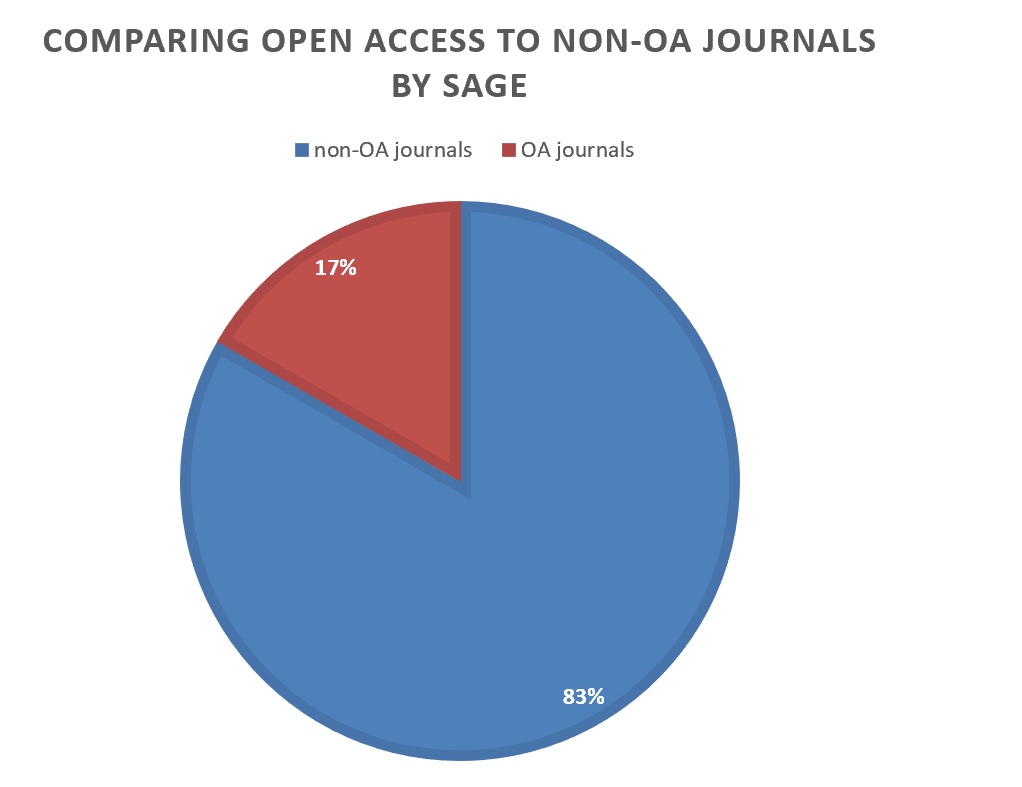
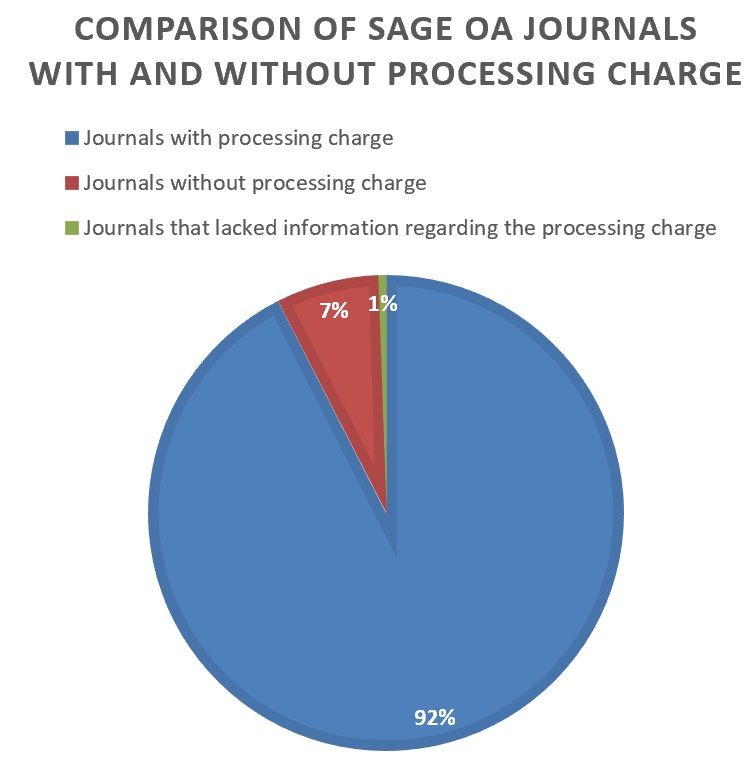
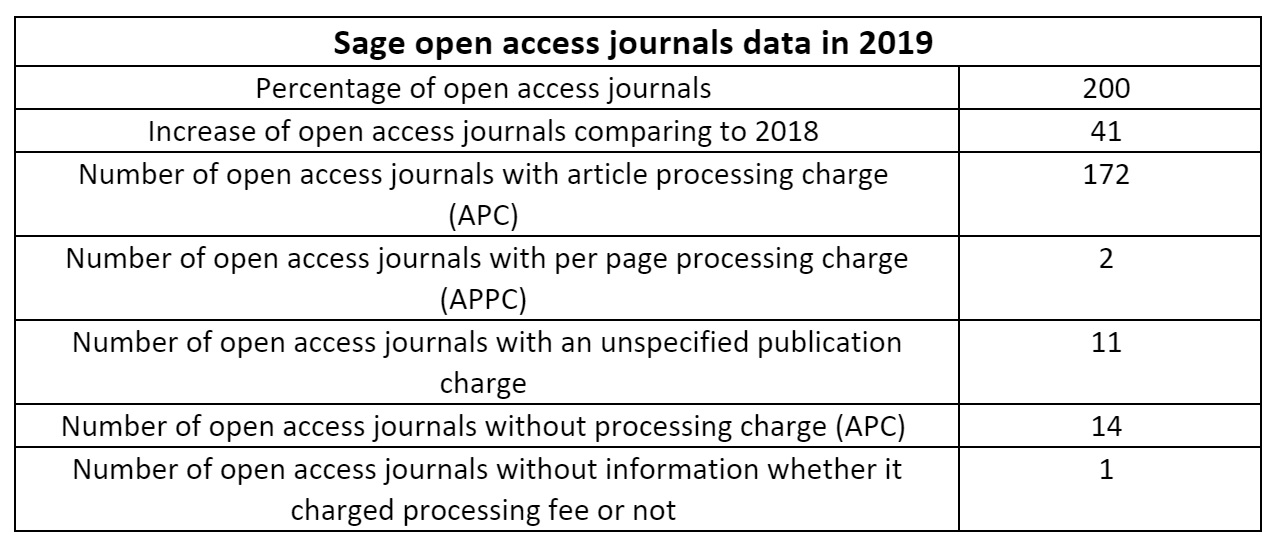
Sage currently publishes 1,200 journals. Of these, 200 journals (about 17%) are fully open access. Compared to the last year’s data, there is a net increase of 41 open access journals (26% increase) published by Sage. Out of all open access journals, 185 journals (92 percent) have publication fees, 14 journals have no publication charges and 1 journal lacks the information whether it has processing fee or not.

Some journals from the previous years ceased publication and Sage has removed them from their database, but only a few of them are accessible through clockss.org archive.

The information regarding the number of open access journals by Sage are summarized into the following table:

Out of the journals with processing charge, 172 journals charge ‘article processing fee’, 2 journals charge ‘per page processing fee’ and 11 articles lack the exact amount and way of processing fee.

Pricing

The average actual price for article processing fee in 2019 is $1475 that indicates a slight decrease comparing to the average price of $1513 in 2018.

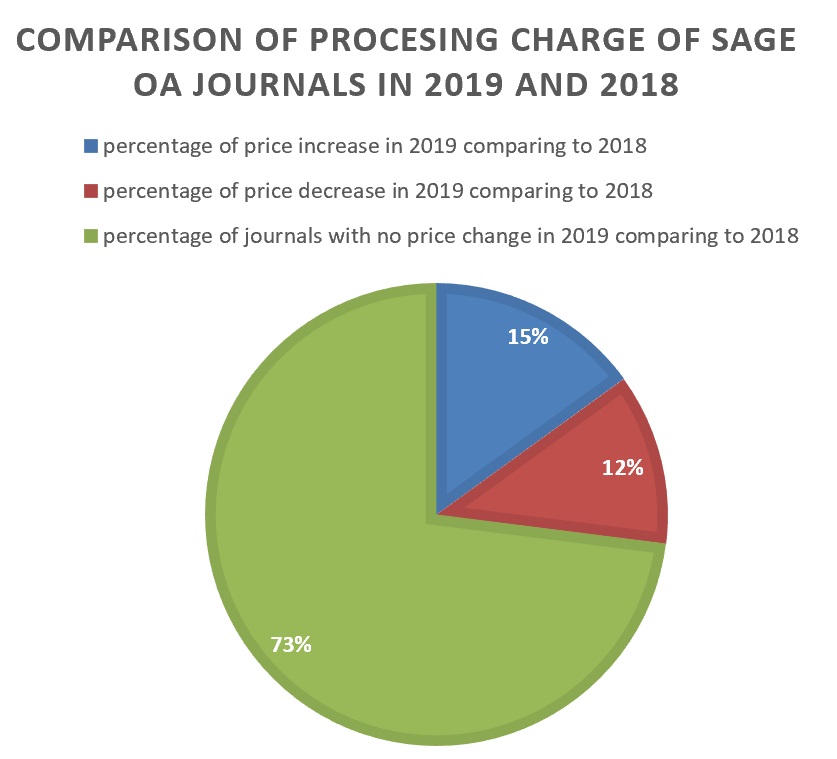
Compared to last year’s data, most journals have no change in article processing charge while 23 journals have an increase and 20 journals have a decrease in the amount of article processing charge. The average increase in price is about $587 and the average decrease in price is $449.

The following pie chart and table summarize the difference between processing fees in 2018 and 2019.

You could download the raw data for Sage 2019 open access journals here:

For more information about the previous years data for Sage publications, see the following links:

Ceased and transferred publications and archiving: best practices and room for improvement

SAGE Publications 2016 & 2017 Data Analysis (including Libertas Academica)

Cite as:

Pashaei, H., & Morrison, H. (2019). Sage in 2019: Growing in OA journals, still expensive, complex pricing trends. Sustaining the Knowledge Commons / Soutenir Les Savoirs Communs. Retrieved from https://sustainingknowledgecommons.org/2019/03/30/sage-in-2019-growing-in-oa-journals-still-expensive-complex-pricing-trends/


Medknow in 2018: growing fast!


by Hamid Pashaei and Heather Morrison

Medknow is a commercial scholarly journal publisher based in India, which was acquired by Wolters Kluwer in 2011. The analysis of Medknow’s journals in 2018 shows that there has been a significant increase in number of their journals, with 23% increase comparing to 2017. It appears that most of Medknow’s journals are published in collaboration with different universities and societies in the field of medical research.

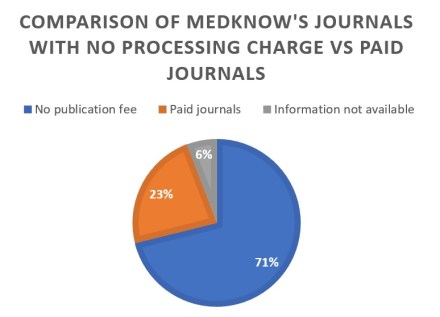
Due to variety of affiliated communities who collaborate with Medknow, finding information and collecting data from Medknow’s website is complex. Some data about the processing charge of journals were not available, and the currency was provided in different units (INR, USD, CNY, …) that could also be confusing for potential authors. From the journals for which data was available, 71% charged no processing fee. While the cost for the majority of paid journals were fixed comparing to 2017 data, there were also an increase in cost for some journals. The processing charge for publishing journals is based on APC (Article Processing Charge), with only a few exceptions that were based on APPC (Article Page Processing Charges).


Cite as: Pashaei, H., & Morrison, H. (2018). Medknow in 2018: Growing fast! Sustaining the Knowledge Commons / Soutenir Les Savoirs Communs. Retrieved from https://sustainingknowledgecommons.org/2018/12/13/medknow-in-2018-growing-fast/

AOSIS: a South African OA publisher with an interesting approach

African Online Information Systems (PTY) Ltd. (AOSIS) is a South African private company (PTY) registered under the number 2002/002017/07. AOSIS is an Open Access publisher with a portfolio of 39 journals as of July 21st, 2018. The journals can be divided under three categories: Fully Sponsored, Partially Sponsored and Non-Sponsored. The partially sponsored journals are interesting for several reasons: 1) unique transparency in explaining that the journals are “sponsored until the money runs out”, a model that creates some uncertainty for authors as to whether they need to pay or not, and how much; 2) differential pricing for members of society sponsors (support for the society as well as OA publishing); 3) and the use of per-page rather than per-article charges. These complexities result in differential pricing for articles for good underlying reasons (sponsorship and its limitations, societies’ needs to provide benefits to members, the variation in work that goes with differences in article length).

AOSIS is using Article Processing Charges by Page (APPC) method for publication in its journals. The APPC varies from a journal to another. Partially sponsored journals receive limited funds from organizations to cover partially the APPC during a calendar year. Authors publishing in partially sponsored journals are responsible for payment of the difference between the APPC full amount and the sponsor’s contribution per page. If the funds allocated by the sponsor for APPC are used before the end of calendar year, authors would have to cover the full APPC. In the case of the Journal of Transport and Supply Chain Management, APPC is listed as R1002.00/page (R = South African Rand, currency code: ZAR) equivalent to USD 76.00/page (Exchange rate Aug. 1, 18 at https://www.xe.com/) while the sponsor contribution is R398.00/page ($30.00) which leaves the author with the responsibility to cover the payment of the difference (R604/page) ($46.00).

The South African Journal of Communication Disorders applies, however, different APPC method: the first author receives full subsidies for APPC if he is a paid member in the South African Speech-Language-Hearing Association (SASLAH), while the second author receive 50% subsidies of APPC. If the author is not a member of SASLHA he would have to pay the full APPC. The subsidy for APCs is valid until the limit of the annual SASLHA sponsorship has been reached. Author wishing to publish after the funds are completely used would have the cover the full APPC.

References

AOSIS (2018). Retrieved July 21st, 2018 from https://aosis.co.za/publishing/

Cite as: Merhi, S. (2018). AOSIS: A South African OA publisher with an interesting approach. Sustaining the Knowledge Commons / Soutenir Les Savoirs Communs. Retrieved from https://sustainingknowledgecommons.org/2018/07/28/aosis-a-south-african-oa-publisher-with-an-interesting-approach/


MDPI pricing (thanks to MDPI CEO Franck Vazquez, PhD)

Thanks to MDPI CEO Franck Vazquez, PhD, for permission to re-post his contributions to a discussion on APC pricing on the SCHOLCOMM listserv and my replies. This is useful information and a good model of how transparency can help to advance our understanding of how to move toward sustainability in open access.

Highlights: this post presents data on MDPI’s APCs and an explanation of MDPI’s business practice: new journals are free to publish in, later APCs and APC increases are based on market value. It is important for publishers and funders to understand that there is an essential conflict with funders of scholarly communication, that is, universities and their libraries, and research organizations. For these organizations,  budgets tend to be based on cost with little or no flexibility to accommodate pricing and price increases based on market value. This incompatibility of organizational strategy is equally relevant whether the revenue model is subscriptions, APC, or other production-based support.


Original e-mails:

Sent to SCHOLCOMM April 16, 2018 (as an addition to the research reported on SKC here):

*Subject:* Re: [SCHOLCOMM] Recent APC price changes for 4 publishers (BMC, Hindawi, PLOS, PeerJ)

Adding up the data summary for MDPI to the picture:

•164 journals with numeric data in 2017 (average APC 438CHF) and 2018
(average APC 533CHF)
•107 journals (65.2%) with no change in APC, including 40 journals free
(average APC 375CHF)
•40 journals (24.3%) with APC increase of 6% – 142% (increase range from
100 – 500CHF; average APC increase 219CHF; average percent increase 27.3%)
•17 journals (10.3%) free in 2017, introduced APC in 2018
(250CHF-550CHF; average APC 370CHF)

Original data can be found here:
http://www.mdpi.com/about/apc
http://www.mdpi.com/about/apc-2017

Some Publishers and Journals statistics can also be found here:
https://www.scilit.net/rankings
Please read the “Disclaimer & Notes”.

Hoping this is useful,
Best wishes,
Franck

Franck Vazquez, Ph.D
Chief Executive Officer, MDPI
St. Alban-Anlage 66, 4052 Basel, Switzerland
Tel. +41 61 683 77 34
http://www.mdpi.com

http://orcid.org/0000-0002-7967-3798
https://www.researchgate.net/profile/Franck_Vazquez
https://www.linkedin.com/in/franck-vazquez-932a96a8/


My reply April 16, 2018

Thank you Franck this is very helpful.

According to this website, the current inflation rate for Switzerland is .8, i.e. less than one per cent:
https://tradingeconomics.com/switzerland/consumer-price-index-cpi

I see that a quarter of MDPI’s journals have an average price increase of 27.3%. It appears that MDPI is not making decisions about price increases based on such factors as consumer price increase or inflation rates.

List members who are interested in supporting OA through paying APCs could benefit from understanding how this works in order to budget for future needs. Can you explain MDPI’s current and/or projected future pricing strategy?

MDPI is one of the publishers who offers “free for now” publishing in order to attract content for new journals. As an author, I have benefited from this as well as from MDPI’s high quality professional editing and peer review. However, if those who pay APCs do not take this practice into account, they will find themselves short of funds in future when established journals start charging APCs, as 10% of MDPI’s journals did this year by your account

Two other notes / questions from MDPI for this year that I wonder if you would like to comment on?

* new pricing coming in July
* partnership with Knowledge Unlatched – on MDPI’s APC price list that
some journals are
“* free for authors; APC funded by Knowledge Unlatched
<http://www.knowledgeunlatched.org>” from: http://www.mdpi.com/about/apc

best,

Heather Morrison
Associate Professor, School of Information Studies, University of Ottawa
Professeur Agrégé, École des Sciences de l’Information, Université d’Ottawa
Heather.Morrison@uottawa.ca
https://sustainingknowledgecommons.org
https://uniweb.uottawa.ca/?lang=en#/members/706

PS: if CHF is not your local currency, you can find both current and historical conversion rates through XE currency converter: https://www.xe.com/currencytables/


Franck’s reply April 17:

Thanks Heather, I am glad you had a good experience publishing in /Publications/ (and /Data/)!

Our decision to introduce or increase the APC of a journal depends on many factors including the field of research, the reputation (visibility,citation, indexing), and volume (=age) of the journal. It is not always possible to cover the cost of our work directly and from the beginning. The newest journals are free for a few years, typically three years; researchers would not be able to raise funding to cover the APC of these journals. Also, some journals which support research fields in which OA funding remains marginal do not introduce an APC, even after Volume 6 or more, as it is the case for the journals /Publications/, /Arts/, or a few others. Therefore the costs associated with publishing in these journals must be subsided by the APC of established journals.

The “average 27.3% APC increase for 40 journals” we talk about here results in a mild increase in the average APC of these journals. Average increase is 219 CHF, from 802 CHF in 2017 to 1020 CHF in 2018 for these 40 titles. This is on the lower end of APC distribution for international publishers: https://treemaps.intact-project.org/apcdata/openapc/#publisher/

Concerning the planned increase in July:
Eight journals which were accepted for coverage in SCIE in November will have their APC increased, following the reasoning explained before. As usual we give a >6 months notice to authors before the APC increase becomes effective.

About the partnership with Knowledge Unlatched:
We are running this as a trial for 9 journals which normally apply the indicated APC. We are exploring this funding model as a viable alternative for our HSS journals. For transparency reasons and to give credit to KU for their initiative, we decided to list the APC on the website with the note “* free for authors; APC funded by Knowledge Unlatched” rather than erasing the APC from the website.

Best wishes
Franck


My reply April 17:

Thank you Franck.

What you are describing is normal business practice. In ordinary everyday terms, businesses of all kinds often start out with below-cost pricing (introductory special offers for example), in order to attract customers, then raise prices. When average people sell their homes or other goods, the default is to seek market value (the most I can get for this), rather than cost-based pricing.

MDPI’s transparency may be helpful to those wishing to support the APC approach (publishers and payers), as it gives us an opening to talk about an inherent conflict that might cause shock and setbacks, giving an opportunity to prepare and consider strategies to minimize or avoid the likelihood of this happening.

The inherent conflict stems from the desire of for-profit publishers to derive the maximum value from their work, in contrast to the cost-conscious, accountability focused customer (universities and funding agencies). In subscriptions publishing for many decades there has been an inelastic market, with publishers expecting to raise prices beyond inflationary rates year after year while university-customers do not have corresponding revenue growth to support this. In North America in the last few decades the trend has been flat or declining budgets. Hence the serials crisis, periodic breakdown such as Germany’s Elsevier cancellations and France’s Springer cancellations, and strong desire to change the system which is one of the drivers behind the OA movement, although not a motive shared by all.

What could easily happen is that those who wish to support a flip to OA via APCs will under-budget based on current spend and/or current list prices, resulting in shock and insufficient funds when publishers move to pricing more accurately reflecting costs and/or market value.

Another way to express this: when your library has to deal with budget cuts, or, at best, a flat budget (typical in North America), you are not likely to have much sympathy for a publisher raising prices by 27%, regardless of how rational this might be as a business practice.

This is what I mean in that Publications article when I describe the APC model as volatile. The market, in my opinion, is not sufficiently stable for systemic budgeting purposes. Support for this approach should be considered experimental at this time.

There are other approaches to supply-side funding to provide for open access, such as sponsorships, library publishing, and cost-based APC pricing as practiced by UK-based Ubiquity Press. Those who wish to support APCs, in my opinion, are wise to do so through consortia. Hence my interest in your partnership with Knowledge Unmatched.

best,

Heather Morrison
sustainingknowledgecommons.org


The original e-mails are available on the SCHOLCOMM listserv archives.

Cite this post as:

Vasquez, F. (2018). MDPI pricing (thanks to MDPI CEO Franck Vazquez, PhD). Sustaining the Knowledge Commons / Soutenir Les Savoirs Communs. Retrieved from https://sustainingknowledgecommons.org/2018/05/16/mdpi-pricing-thanks-to-mdpi-ceo-franck-vazquez-phd/
and/or:

Morrison, H. (2018). Commentary on Vasquez, F. (2018). MDPI pricing (thanks to MDPI CEO Franck Vazquez, PhD). Sustaining the Knowledge Commons / Soutenir Les Savoirs Communs. Retrieved from https://sustainingknowledgecommons.org/2018/05/16/mdpi-pricing-thanks-to-mdpi-ceo-franck-vazquez-phd/
Springer Nature

Springer Nature 2017 APC Report

Springer Nature was formed in 2015 through the merger of Nature Publishing Group, Palgrave Macmillan, Macmillan Education and Springer Science+Business Media. The company is a leading global research, educational and professional publisher. It describes itself as “the publisher of the world’s most influential journals and a pioneer in the field of open research”. It claims to have over 3000 journals and 7 million articles.

The company offers three publishing platforms; SpringerLink.com, Nature.com and open access journals BioMed Central (BMC) and Springer Open platforms.

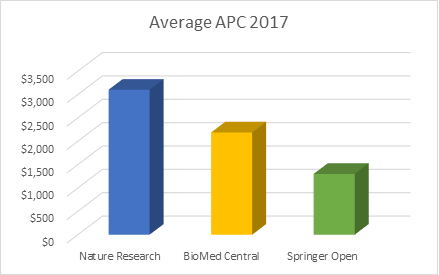
Analysis of 2017 open access journals does not reveals major changes in reported APC, except for Nature Research open access journals where 22 journals saw reduction in APC and one reported an increase. Average APC at Nature Research was $3103.00 a decrease of 11% from 2016. BioMed central APC increased on 4 journals and decreased on two journals, with average APC of $2189.00. Springer Open APC saw an increase on 8 journals and decrease on one journal with average APC stand at $1301.00

Average APC 2017

In 2017, Nature Research added 4 new journals and removed 2 journals. BioMed Central added 15 new journals and removed 17, while Springer Open added 12 new journals and removed 20. Over 40% of Springer Open journals are fully sponsored.

Number of Journal

Nature Research open access journals 2017

(http://www.nature.com/openresearch/publishing-with-npg/nature-journals/

On April 30th, 2017, the webpage listed 87 journals under four categories: Multidisciplinary (3), Nature Partner Journals (25), Academic and Society Journals (20), Journals with hybrid open access options (39). APCs for all journals were posted in US dollar, British Pound and European Euro.

For consistency purpose, we compared journals from the first three categories (48) with journals from the same categories analysed in 2016 (46). Journals with hybrid open access were not compared. Our APCs comparison was based on US Dollar.

Findings:

  • 4 new journals were added in 2017 to Nature Partner Journals category
  • 2 Journals were removed in 2017 from Academic and Society journals category
  • APC increased on one journal in 2017
  • APC decreased on 22 journals
  • APC remained the same for 20 journals
  • Lowest APC:       US$ 1350.00 for Scientific Data (same as in 2016)
  • Highest APC:      US$ 5200.00 for Nature Communications (same as in 2016)
  • Average APC:     US$ 3103.00 (Decreased by 11% from 2016)

The chart below shows a sample of the journals that were compared.

Nature Research OA 2017 APCs

BioMed Central 2017

https://www.biomedcentral.com/journals

On April 4th, 2017, BioMed Central listed 305 open access journals on its website under 14 categories: Biomedicine, Chemistry, Dentistry, Education, Engineering, Environment, Life Sciences, Materials Sciences, Mathematics, Medicine & Public Health, Pharmacy, Philosophy, Physics and Psychology.

The 2017 journals APCs were compared with the 2016 list consisting of 306 journals. APCs were posted in US Dollar, British Pound and European EURO. Our comparison is based on the posted US Dollar.

Findings:

  • 15 New journals were added in 2017
  • 17 Journals from 2016 are removed from 2017 list
  • APC increased for 4 journals
  • APC Decreased for two journals
  • APC remained constant on remaining journals
  • APC for 3 journals were removed in 2017
  • APC for 3 journals were added in 2017
  • APC for 3 journals were increased in 2017 and posted in Euro only
  • One journal posted no APC
  • Lowest APC:       US$ 860.00
  • Highest APC:      US$ 2975.00
  • Average APC:     US$ 2189.00

BMC 2017 APCs

The chart below shows a sample of the BMC journals that were compared.

BMC 2017 APCS in Posted currencies

Springer Open 2017

https://www.springeropen.com/journals

SpringerOpen listed 228 journals on its website under 26 categories: Biomedicine, Business and Management, Chemistry, Computer Science, Criminology and Criminal Justice, Dentistry, Earth Sciences, Economics, Education, Energy, Engineering, Environment, Geography, History, Law, Life Sciences, Linguistics, Materials Science, Mathematics, Medicine & Public Health, Philosophy, Physics, Political Science and International Relations, Psychology, Social Sciences, and Statistics.

The 2017 posted APCs were compared with 2016 APCs. APCs were posted in three currencies; British Pound, US dollar and European Euro. We performed the analysis using the US dollar currency.

Findings:

  • 12 new journals were added in 2017
  • 20 journals existed in 2016 are not included in 2017 list
  • APCs increased for 8 journals
  • APCs decreased for one Journal
  • APCs remained constant on 114 Journals
  • APCs was added to 5 journals in 2017 that had no APC in 2016
  • APCs were removed in 2017 from 3 journals that had APC value in 2016
  • 98 journals are fully sponsored (42.9%)
  • Lowest APC:       US$ 645.00
  • Highest APC:      US$ 2500.00
  • Average APC:     US$ 1301.00

Spinger Open 2017 APCs

Chart below represent a sample of Springer Open 2017 APCs in posted currencies

Sample of Springer Open 2017

Cite as: Merhi, S. (2017). Springer Nature. Sustaining the Knowledge Commons / Soutenir Les Savoirs Communs. Retrieved from

Merhi, S. (2017). Springer Nature. Sustaining the Knowledge Commons / Soutenir Les Savoirs Communs. Retrieved from https://sustainingknowledgecommons.org/2017/07/21/springer-nature/

Elsevier: libre accès et droit d’auteur

Résumé

À partir de la liste des frais de publication (APC) des revues publiées en libre accès complet par Elsevier, nous avons extrait les 282 revues ne chargeant pas d’APC pour en analyser les composantes liées au droit d’auteur. Nous avons établi que 94% de notre corpus était commandité par une société ou une université. Nous avons aussi découvert que dans 76% des cas, les droits d’auteurs revenaient au sponsor de la revue (société ou université), dans 10% à l’auteur, dans 3% des cas à Elsevier. Enfin, nous avons établi que la licence de droit d’auteur la plus revendiquée est la CC BY-NC-ND (201 sur 282).


À partir de la liste des frais de publication des revues publiées en libre accès ou en format hybride téléchargée sur le site d’Elsevier le 11 février 2017 (https://www.elsevier.com/about/our-business/policies/pricing)*, nous avons extrait les revues ne chargeant pas de frais de publication (APC) pour en analyser les mentions de droit d’auteur et leurs implications. Notre corpus est composé de 282 revues.

D’abord, parmi les 282 revues en libre accès complet ne chargeant pas d’APC, 94% (tableau 1) indiquaient, sur leur fiche descriptive, disponible sur le site internet d’Elsevier, une mention claire de sponsorship par une société ou une université. 6% d’entre elles ne portaient pas d’indication portant sur un parrainage par une société ou une université.

Tableau 1

2017-07-04_14-43-29

Parmi les 282 revues en libre accès complet ne chargeant pas d’APC, les entités présumées conservant les droits d’auteur se divisent ainsi (voir aussi tableau 2) :

  • 76% : les universités ou les sociétés (8% autres : possiblement les universités ou sociétés)
  • 10% : les auteurs (les composantes de l’attribution du droit d’auteur aux auteurs d’articles demeurent nébuleuses. Pour plus d’information, voir Morrison, H. (2017). Elsevier: among the world’s largest open access publishers as of 2016. https://ruor.uottawa.ca/handle/10393/35779)
  • 3% : Elsevier (1 revue portait une mention de droit d’auteur conjointe aux commanditaires et à Elsevier)
  • 3% : Information non trouvée, non spécifiée ou incertaine

Tableau 2

2017-07-04_14-44-14

Enfin, bien que la majorité des revues de notre corpus (201) publient les articles sous la licence CC BY-NC-ND (qui est la plus contraignante des licences Creative Commons, voir https://creativecommons.org/licenses/?lang=fr ), certaines revues (4) emploient la plus permissive des licences, la CC BY, alors que d’autres (37) indiquent la mention All rights reserved**. Nous n’avons pas été en mesure de trouver l’information portant sur la licence de droit d’auteur pour 40 revues (non spécifié, non trouvé, incertain). Voir tableau 3.

Tableau 3

2017-07-04_14-45-07

À noter qu’entre le 11 février et le 8 avril 2017, le nombre de revues en libre accès complet compilé par Elsevier sur une liste comprenant aussi les prix des frais de publication a diminué de 38 titres. Nous avons déterminé que dans le cas de 12 revues, ces dernières avaient été transférées de nouveau au détenteur des droits (la société ou l’université). Dans un cas, la revue a été transférée à un autre éditeur, Wolters Kluwer. Une revue n’est plus publiée. Les 12 revues dont le contrôle a été repris par la société ou l’université appuient l’argument de Morrison (2017) indiquant qu’il y a un bénéfice à la rétention des droits pour l’université ou la société. Comme le mentionne Morrison :

« Some OA activists will be disappointed in the society ownership of copyright of many of Elsevier’s Open Access journals. I see this as healthy. The alternative is likely not a vision of pure creative commons licensing with only attribution to the author; the alternative seems to be more likely to be Elsevier copyright retention. Societies and institutions that retain their copyright are free to seek alternative hosts or partners whenever their contracts with Elsevier come up for renewal. »

(H. Morrison (2017). From the Field: Elsevier as an Open Access Publisher. The Charleston Advisor 18(3), pp. 53-59(7) http://www.ingentaconnect.com/content/charleston/chadv/2017/00000018/00000003/art00014)

*Cette liste est modifiée fréquemment sans préavis.

** Nous nous contentons ici d’indiquer les mentions de droits d’auteur retrouvées sur le site internet Elsevier, le site internet Science Direct sur lequel sont diffusées plusieurs revues sous contrat avec Elsevier, et sur les articles publiés par ces revues. La question demeure toutefois beaucoup plus complexe qu’elle n’y paraît.

Citation:

Dumais-Desrosiers, M. (2017). Elsevier: Libre accès et droit d’auteur. Soutenir Les Savoirs Communs. Retrieved from https://sustainingknowledgecommons.org/elsevier-libre-acces-et-droit-dauteur/

Hindawi: comparaison 2016-2017


L’éditeur Hindawi avait en 2016, 406 titres de revues alors qu’en 2017 il y a 339 titres de revues.Il y avait donc 76 revues qui était disponible en 2016 mais qui ne le sont plus en 2017. Cela représente près de 25 % et inclus une série complète

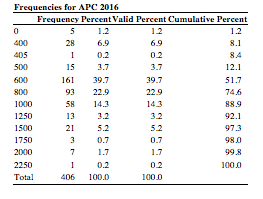
La moyenne des frais de publication en 2016 est de 802$ .Il y a cinq revues qui n’ont aucun frais publication en 2016 et pour la majorité des journaux les frais publication sont de 600 $ par article.

Tableau de la distribution des prix pour 2016

Screen Shot 2017-04-22 at 4.48.31 PM

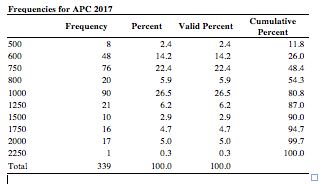
En 2017 on remarque une augmentation de la moyenne des prix à 922$. Cette moyenne prend compte des nouvelles revues pour l’année de 2017 qui sont au nombre de 9. Cette année, la majorité des revues possèdent des frais de publication de 1000$ par article.

Screen Shot 2017-04-22 at 4.50.48 PM

La moyenne des titres qui sont restés inchangés entre 2016 et 2017 est de 910 $ et en moyenne, il y a une hausse de 0.13% des frais de publication.

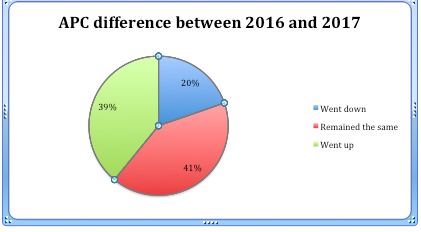
Des revues qui existaient en 2016 et 2017, on peut remarquer que des 330 revues, il y a 65 revues dont les frais de publication ont diminués. Il y a donc près de 20% des publications d’Hindawi. De plus on remarque pour une grande majorité des revues les frais sont restés les mêmes. Soit 41% des titres n’ont pas augmenté. Avec ces chiffres nous pouvons déduire que seulement 39% de titres de cet éditeur ont subit une augmentation de leurs frais de publication.

Screen Shot 2017-04-22 at 4.54.55 PM.png

En conclusion, les prix pour cette maison d’édition ont dans la majorité des cas resté les même et que certaines revues ont même baissé leur frais de publication. Cependant, il faut noter le fais de certaine publication ont tout de meme augmenté puisque le mode en 2016 était de 600$ et qu’il est  passée à 1000$. Le mode est la valeur la plus réprésenter de la répartition. Dans l’ensemble,les prix reste stable.

Citation: Brutus, W. (2017). Hindawi: Comparaison 2016-2017. Sustaining the Knowledge Commons / Soutenir Les Savoirs Communs. Retrieved from https://sustainingknowledgecommons.org/2017/04/22/hindawi-comparaison-2016-2017/

Fréquences des pays et des devises dans: OA 2016 Main Publishers

Fréquences par pays

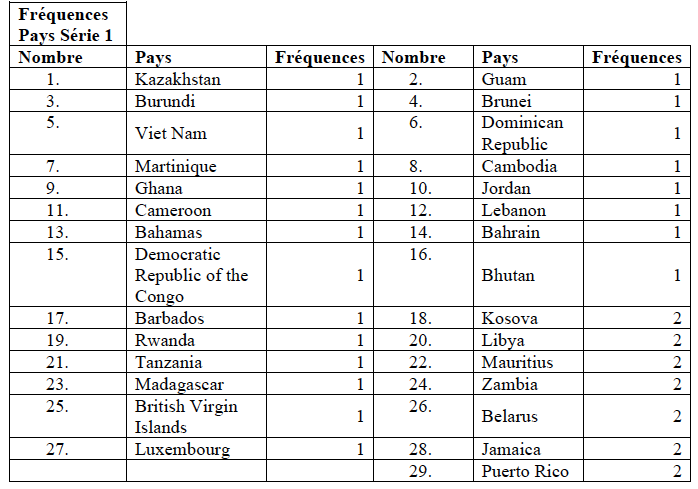
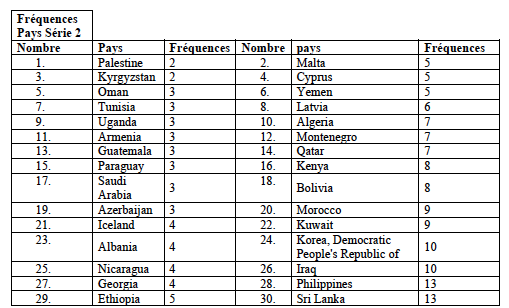
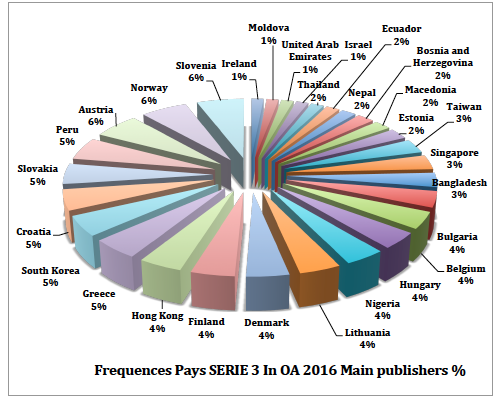
Cet article est le résultat de nos recherches dans la base de données 2016 OA Main DOAJ. Notre objectif est de présenter l’apport au niveau mondial et africain. 125 pays ont fourni 12037 revues. La contribution africaine est de 18 pays africains avec 235 revues. Nous avons calculé la fréquence et le pourcentage que représente chaque pays dans cette base de données. Nous avons aussi analysé les tendances des devises et les frais de publication qui ont été utilisées. De façon aléatoire, nous avons divisé les pays en 4 séries pour faciliter nos analyses. La première série est composée de 29 pays, la deuxième 30, la troisième 29, la quatrième 37. Trois pays arrivent en tête des fréquences (Brazil-1059 ; United States-1043 ; United Kingdom-749). Les plus faibles fréquences apparaissent une seule fois dans la série 1.

Les tableaux et les graphiques ci-dessous présentent les fréquences et le taux de pourcentage de chaque pays.

doc 1

doc1-1

seri2

seri 2

doc3-1

doc 3

doc4-1

doc 4

Frais de publication

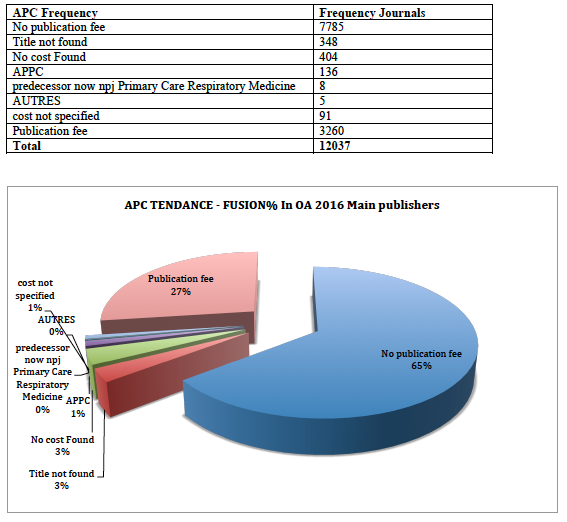
Deux séries de frais de publication présentent notre analyse sur les dénominations attribuées aux frais de publication. Une première est composée de 7 catégories : No cost found, No publication fee, Title not Found, APPC, F(WC), cost not specified et Publication fee. La deuxième est composée de 11 catégories. Cette deuxième série regroupe les qualifications que des chercheurs qui ont exprimé lors de leur analyse de la base de données. Vu que certaines catégories répondent aux mêmes appellations que d’autres, nous avons décidé de les fusionner. Ainsi : See next phase of journal et predecessor now npj Primary Care Respiratory Medicine sont fusionnées pour donner : predecessor now npj Primary… Formula based on work, cannot read (Chinese), cannot confirm due to language (Chinese only), conflicting information et coming in 2017 sont fusionnée pour donner Autres. Ceased publication in May 2016, ceased publication in 2014, discontinued, et active 2015 donne Title not found. Enfin, No publication fee et APPC, F(WC) pour donner No publication fee. Résultat, No Publication fee est le plus fréquent avec 7785 soit 65%. Publication fee obtient 27% avec 3260 fréquences.

Le tableau et le graphique ci-dessous dressent la liste de ces tendances.

Capture d_écran 2017-04-19 à 23.18.35

Tendance des Devises

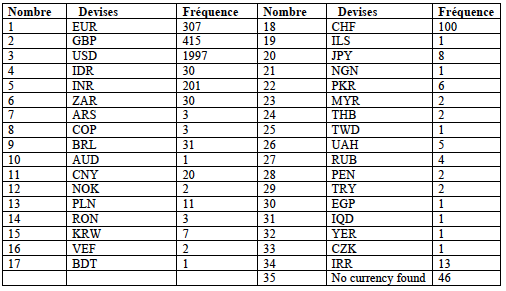
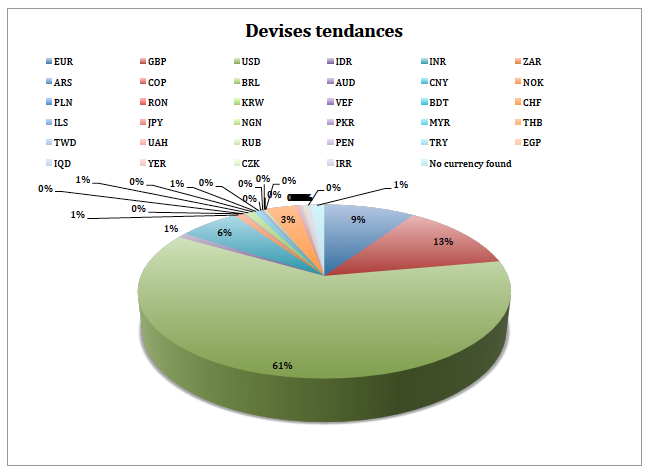
Notre analyse montre aussi que la devise des États-Unis (USD) est la plus fréquente avec 1997 fois citées. Elle est suivie de celle de la Grande Bretagne (GBP) 415 fois. Nous avons trouvé 40 revues qui ont des frais de publication mais dont la devise n’y figure pas.

devies 1

devise-12

II-African Journals In OA Main 2016

Nombre de pays et journaux

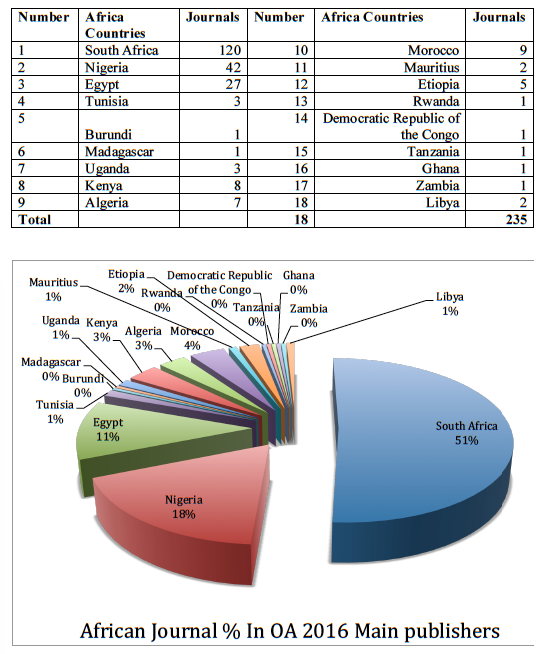
Nous avons compté 18 pays africains dans la base de données de OA Main 2016. L’Afrique du sud possède 120 journaux, le Nigeria, 27 et l’Egypt 27. Nous avons exclu toutes les revues concernant l’Égypte dans la revue Hindawi ne sont pas comprises, parce qu’elles ont une origine autre que l’Afrique.

Les détails dans le tableau et le graphique ci-dessous.

devis 1

Les fréquences des pays qui sont cités sont répertoriées dans le tableau et le graphique ci-dessous.

africa1-2

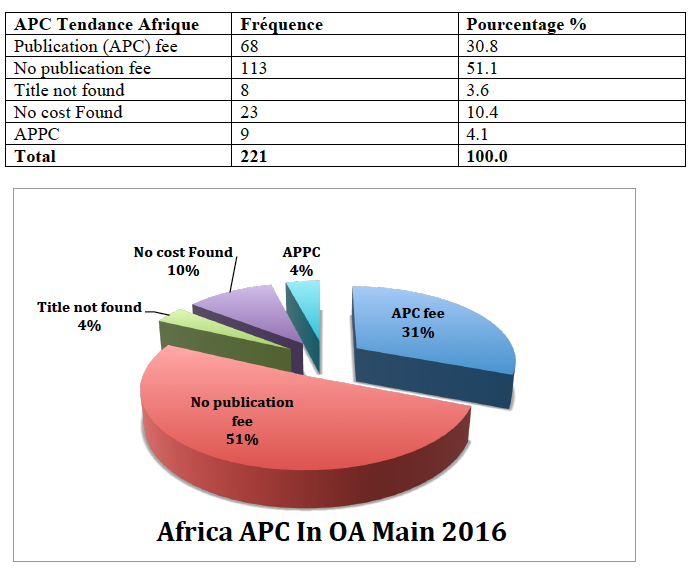
Fréquences APC Afrique

Sur un total de citations de 221 fois. Les fréquences des frais de publication sont les suivantes : No publication fee est cité 113 fois soit 51%. APC fee est cité de son côté 68 fois soit 31%. Title no found 8 soit 3,5%, No cost found 23 soit 10% wt APPC 9 soit 4%.

Le tableau et la graphique ci-dessous décrivent les tendances.

apc afric 1

III-Conclusion

L’examen de la base de données de OA 2016 Main Publishers nous a montré que 125 pays on fourni 12037 revues. Le Brésil est 1059 fois plus fréquent et les États-Unis 1043 fois. L’Afrique a contribué pour 235 revues. Onze catégories de dénominations de frais de publication ont été identifiées. La devise des États-Unis (USD) y est citée 1997 fois. L’Afrique du sud totalise 104 fréquences et sa devise ZAR 30 fois. La participation de l’Afrique pour les revues sans frais est de 51% par rapport à sa contribution totale.

PDF de L’article

Frenquencies In OA 2016 Main Publishers

Citation:

Kakou, T. L. (2017). Fréquences des pays et des devises dans: OA 2016 Main Publishers. Sustaining the Knowledge Commons / Soutenir Les Savoirs Communs. Retrieved from https://sustainingknowledgecommons.org/2017/04/20/frequences-des-pays-et-des-devises-dans-oa-2016-main-publishers/

Taylor & Francis bought Co-Action Publishing

In the last year, Taylor and Francis announced that Co-Action Publishing will be part of their portfolio for 2017.

Caroline Sutton, co-founder of Co-Action Publishing is now the Head of Open Scholarship Development in Taylor & Francis Group. It appears that the journals that were published by Co-Action Publishing are now merged in Taylor & Francis’ brand and not as a separate imprint.

According to Open Access Scholarly Publishers Association, Co-Action Publishing was publishing 34 journals and more than 2000 open access articles per year.

References :

http://taylorandfrancis.com/co-action-message

http://oaspa.org/member/co-action-publishing/

Cite as:

Laprade, K. (2017). Taylor & Francis bought Co-Action Publishing. Sustaining the Knowledge Commons / Soutenir Les Savoirs Communs. Retrieved from https://sustainingknowledgecommons.org/2017/04/11/taylor-francis-bought-co-action-publishing/

SAGE Publications 2016 & 2017 Data Analysis (including Libertas Academica)

Update December 18, 2017: CLOCKSS has announced that 21 former Libertas Academica Journals have been triggered for OA through CLOCKSS as they are no longer published by Sage. The titles are:

· Advances in Tumor Virology
· Cell & Tissue Transplantation & Therapy
· Cell Communication Insights
· Clinical Medicine Insights: Geriatrics
· Clinical Medicine Reviews in Cardiology
· Clinical Medicine Reviews in Oncology
· Clinical Medicine Reviews in Patient Care
· Clinical Medicine Reviews in Therapeutics
· Clinical Medicine Reviews in Vascular Health
· Clinical Medicine Reviews in Women’s Health
· Gene Expression to Genetical Genomics
· Glycobiology Insights
· Healthy Aging & Clinical Care in the Elderly
· Human Parasitic Diseases
· Journal of Genomes and Exomes
· Lymphoma and Chronic Lymphocytic Leukemias
· Organic Chemistry Insights
· Primary Prevention Insights
· Reproductive Biology Insights
· Retrovirology: Research and Treatment
· Translational Oncogenomics

(thanks to the Society for Scholarly Publishing listserv)

Abstract: SAGE, which defines itself as the “world’s largest independent academic publisher” on its website, bought Libertas Academica in 2016, which is one step in moving to the open access space. SAGE publishes more than 1000 journals and offer the possibility of hybrid gold open access publishing for almost all of them. 165 journal published by SAGE are in fully open access.

In 2016, around 86% of fully open access journals have an APC. The APC average is 1084 USD.

In 2017, around 84% of fully open access journals have an APC, but only 16% of those have an APC in DOAJ. Of the APCs available in DOAJ, around 33% varies from the APCs found in SAGE. Less than 2% of fully open access journals have an APPC.

Only 2 journals published by SAGE do not have publications fees.

SAGE Journals

The APC average for fully open is 1011 USD (excluding the journals from Libertas Academica). For SAGE Choice hybrid option, SAGE website says the APCs is 3000 USD. There are some pricing exceptions in the SAGE Choice hydrid option. The average for those journals is 1275 USD. The average for the journals previously published by Libertas Academica is 1784 USD

A comparison between 2016 and 2017 data for Libertas Academica journals, now owned by SAGE, show no variations in prices for the same journals. However, the 2016 data is missing 7 journals from its list that appear on the 2017 data. 6 of these journals are no longer in Open Access model. 1 journal has a 1085 USD APC.

Full text here.

Cite as:

Laprade, K. (2017). SAGE Publications 2016 & 2017 Data Analysis (including Libertas Academica). Sustaining the Knowledge Commons / Soutenir Les Savoirs Communs. Retrieved from https://sustainingknowledgecommons.org/2017/04/11/sage-publications-2016-2017-data-analysis-including-libertas-academica/