Taylor & Francis 2016

With over 2,500 journals, Taylor & Francis, is one of the largest academic publishers in the world. For this reason, we are interested in the Open Access (OA) models they are using, as well as how they deal with copyright.

Taylor & Francis Journals

Taylor & Francis journals currently fall under three categories: Open (Fully OA), Open Select (Hybrid OA) and Subscription (Not OA). Fully Open or Pure open access journals means that all of the articles in these journals are OA. For these journals, an article publishing charge (APC) is often applicable. Their Open Select option is a hybrid option meaning that an author can publish in a subscription journal and pay a charge, usually an APC or an article page processing charge (APPC) to make their article freely available online upon publication.  The final category, Subscription, allows for Green Open Access, which is the archiving of an article on a website or in a repository. This is allowed for the accepted version of an article, which has been through peer review and has been accepted, but isn’t the final published article. This option is offered after an embargo period. The chart below shows the breakdown of the number of journals for each of these categories.  The Open Select option accounts for most of the journals at 91%, while 93 (4%) journals are fully OA.

TaylorandFrancispiechart

Of the fully open journals, 17/93 (18%) do not charge APCs.  Additionally, APCs could not be found for 5 journals.  The APCs of the journals that were found to charge them range from $200-$2000 in US dollars (USD) with the average being $922 and the mode being $1200. Some journals in this category have a different APC based on the length of the article and the type of creative commons license being used, these prices were not factored in to the average listed above.

An interesting model is being used by one group of fully OA journals by Cogent OA. Cogent journals, which account for 15/93 of the fully OA journals from Taylor & Francis operate a ‘pay what you want’ model.  This means that authors are allowed to choose how much they contribute towards OA publishing based on their financial circumstances. Authors have the opportunity to state how much they want to contribute, if accepted for publication, during the submission process.  In order to guarantee the integrity of peer review, the APC process is managed by the Cogent OA publishing team and not by journal editors or reviewers. Cogent OA states, “We believe strongly in the benefits of open access to scientific research and scholarship, and our APC policy is intended to help remove any barriers to its take-up around the world – leading to greater research impact for all.”

The APCs for the hybrid model were quite a bit higher than the ones for fully OA journals.  2142/2284 (94%) of these journals charge an APC of $2,950 USD (£1,788,  €2,150). The rest of the journals in this category either charge a lower APC or charge an APPC instead.

Taylor & Francis: Copyright Statements

When publishing with a Taylor & Francis subscription journal,  they ask the author to assign copyright to them. Alternatively, any author can also opt to retain their own copyright and sign a licence to publish. If the author chooses to assign copyright to Taylor & Francis, the author is asked to sign a publishing agreement.

In the case of open access journals it appears that Taylor & Francis is using the same author nominal copyright approach we first noticed when looking at Elsevier this year. Following is the text from the T&F Author Services page. An exclusive license to publish is in effect a transfer of virtually all rights under copyright, with the copyright in the name of the author, hence “author nominal copyright”.

Open access Creative Commons licenses

We ask you to sign a publishing agreement to establish the originality and provenance of your article and to give us the exclusive right to publish [emphasis added] the Version of Record of your article; you (the author) retain copyright. This agreement incorporates the Creative Commons license of your choice, which will dictate what others can do with your article once it has been published.

Copyright statements tend to vary from journal to journal for Taylor & Francis’ OA journals.  For example,  Acta Biomaterialia Odontologica‘s Instructions for Authors document states, “The copyright will remain with the Authors for articles published under this Open Access model, and once a paper has been accepted for publication, Informa will ask authors for a license to publish.”

Similarly Acta Oto-Laryngologica Case Reports states, “All contributing authors are asked to grant Taylor & Francis the right to publish her or his article as the final, definitive, and citable Version of Scholarly Record. Authors are required to sign an Open Access Article Publishing Agreement to facilitate this. Articles published in Acta Oto-Laryngologica Case Reports are published under the Creative Commons Attribution (CC BY) licence which permits others to distribute, remix, tweak, and build upon your work, even commercially, as long as they credit you for the original creation. Authors do however have the choice of opting for the Creative Commons Attribution-Non-Commercial Licence should they so choose. Reuse conditions will be subject to the license type chosen by the author.”

The Indo-Pacific Journal of Phenomenology requires authors to assign the right to publish their texts both electronically and in any other format they see fit, along with the right to store manuscripts in an electronic archive to the journal, Indo-Pacific Journal of Phenomenology. They go on to state, “Once published, authors may disseminate their papers (final, accepted and peer-reviewed PDF version) in whatever way they wish, within the terms set out in the Creative Commons Licence 4.0. The IPJP has adopted the CC BY-NC-ND licensing agreement. Creative Commons is a non-profit organisation that enables the sharing and use of creativity and knowledge through free legal tools. Accordingly, authors may post a copy of the PDF of their published article to their institutional repository or to any departmental or personal website, etc., subject to acknowledging its publication in the Indo-Pacific Journal of Phenomenology.”

In contrast to these above statements Journal of Drug Assessment states, “Articles are published with the understanding that their copyright be assigned to the Publisher once they are accepted. If any material used is subject to third-party copyright, copyright clearance is the sole responsibility of the authors and must be supplied in writing to the Publisher. Corresponding authors will be sent a copyright form to sign upon acknowledgment of their paper.”

These copyright statements are a small sample of how OA journals published by Taylor & Francis handle copyright.  As they all differ, it is important for authors to understand their options and submit to journals accordingly.  It may be assumed that authors retain their copyright when publishing in OA journals, but this is not always the case.

Cite as:

Wheatley, S. (2016). Taylor & Francis 2016. Sustaining the Knowledge Commons / Soutenir Les Savoirs Communs. Retrieved from https://sustainingknowledgecommons.org/2016/06/15/taylor-francis-2016/
 

Frais de publication/APC: un regard sur les revues en français de Walt Crawford dans DOAJ

Nous commençons une étude des revues en libre accès en français dans DOAJ. Après quelques vérifications des URL, nous avons remarqué que parmi elles, figurent quelques revues dans d’autres langues que le français.

Résumé

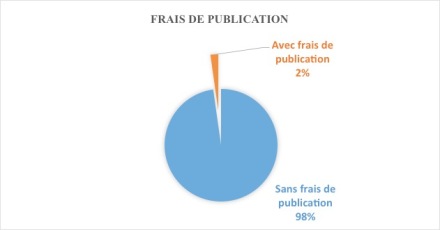
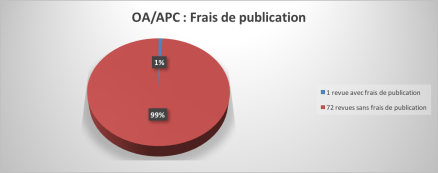
L’étude que nous présentons dans ce rapport a trait à 79 revues sensées être en accès libre uniquement en français dans Directory of Open Access Journals (DOAJ). Aucune autre langue n’est indiquée en complément pour ces 79 revues. Nous avons trouvé cependant que 73 revues sont vraiment en français. 4 sont dans d’autres langues. On y trouve également une confusion d’URL et une autre possède un lien qui ne fonctionne pas. De ces 73 revues en français, en nous avons recensé 1 (1%) qui a un frais de publication (article publishing charge (APC)). Les 72 restantes qui représentent 99% sont sans frais de publication.

Méthode et détails

Dans cette première étape, nous avons analysé les métadonnées du fichier DOAJ de février 2016 plus spécifiquement les données des revues ajoutées par Walt Crawford. 79 revues en français (issues de OA-APC-Main-2016.Version.1 français) ont été analysées. À l’issue de cette recherche, nous avons constaté qu’une revue qui se nomme Irish Medical Organization est en anglais. Trois autres revues en langue espagnole ont été recensées. Il s’agit de: Cauriensia : Revista Anual de Ciencias Ecleiásticas; de Rétor et de Çédille – Revista de Estudios Franceses. Cependant, Çédille – Revista de Estudios Franceses publie des articles en français. Par ailleurs, nous avons trouvé une autre revue en italien. Il s’agit de la revue Italienne d’Études Françaises. Seulement, lorsque nous avons vérifié le lien http://www.rief.it/, nous avons découvert que le site porte un autre nom d’une revue qui s’appelle DD ou DomaineDirect. Un autre cas similaire s’observe avec la revue : Recherches en Didactique des Langues et Cultures : les Cahiers de l’acedle. L’URL http://acedle.org/spip.php?rubrique40 que propose DOAJ ne permet d’accéder au site. Il est marqué : No found. Après vérification par le nom de la revue, nous avons trouvé le site. Toutefois, dans l’URL http://acedle.org/old/spip.php?rubrique40 du site le mot (/old/) est ajouté. Enfin, dans la revue Technologies de Laboratoire que nous avons consulté, nous n’avons pas réussi à accéder au site. Lorsque nous avons vérifié l’URL, la mention : Web Server’s Default Page, était affichée.

Dans cette même recherche, nous avons constaté que 17 revues (du numéro 64 à 80) n’ont pas de métadonnées de frais de publication. Par ailleurs, nous avons trouvé une seule revue qui a un frais de 100 € soit 50 € pour la soumission et un autre 50 € après l’acceptation, toutes les autres sont gratuites. Il s’agit de la revue Finance Contrôle Stratégie. La raison de cette exception n’est pas spécifiée.

Donc, le résultat de notre recherche par rapport à l’accès libre aux revues scientifiques en français ajouté par Walt Crawford dans DOAJ se résume à :

  • Revue avec frais de publication : 1 soit 1%
  • Revues sans frais de publication : 72 soit 99%

Note : nous précisons qu’il y a d’autres Revues en français en combinaison avec d’autres langages. Cette étude n’est qu’une première analyse des revues issue de DOAJ uniquement en français.

Ceci est la première poste en série «libre accès français».

 OA:APC FRAIS de PUBL.

Citation:

Kakou, T. L. (2016). Frais de publication/APC: Un regard sur les revues en français de Walt Crawford dans DOAJ. Sustaining the Knowledge Commons / Soutenir Les Savoirs Communs. Retrieved from https://sustainingknowledgecommons.org/2016/06/01/frais-de-publication-apc-2/


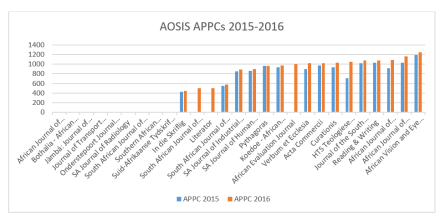
AOSIS 2015-2016 Comparison

AOSIS is a smaller South African based open access publisher, with 26 journals listed in the Directory of Open Access Journals (DOAJ).  As of May 2016, the AOSIS website lists 28 open access journals. We found 27 matching journal titles when comparing our 2015 and 2016 data gathered from the AOSIS website.

The AOSIS website lists a per-page cost or Article Page Processing Charge (APPC) while the DOAJ’s Article Processing Charge (APC) figure is per-article.  The APC amount listed on DOAJ is likely based on an estimate of the average number of pages for an article.

From the AOSIS website in 2015, 11 out of 27 journals were sponsored by various organizations, therefore they did not require APPCs to be paid by authors.  Two of these titles are no longer sponsored in 2016.  18 out of 27 titles require APPCs to be paid by authors.  Most of these APPCs have increased since 2015.  The APPCs are listed in South African Rand (ZAR). The current conversion rate between ZAR and the US dollar (USD) is 1 ZAR equals 0.064 USD.  The average APPC in 2016 is about 617 ZAR, which equates to about 40 USD. The average AOSIS APC in DOAJ is 6050 ZAR or 388 USD.

The journal with the lowest APPC in 2015 and 2016 is In die Skriflig.  This journal charged 429 ZAR in 2015 and has increased to 44o ZAR in 2016.  The journal with the highest APPC in 2015 and 2016 is African Vision and Eye Health, which was charging 1191 ZAR in 2015 and is now charging 1250 ZAR. In 2015, only 4 journals charged over 1000 ZAR for APPCs.  In 2016, 10 out of 27 charge over 1000 ZAR.

According to AOSIS’ Copyright policy page, “The author(s) retain copyright on work published by AOSIS unless specified otherwise.” All individual journals titles were checked to see if there are any other specifications regarding copyright.  After clicking through each title, we found that all journals provided a link to the main About Scholarly Journals page, which states “Rest assured: you always retain copyright of your work.”

AOSIS Chart
References

AOSIS. (n.d.). Retrieved May 30, 2016, from http://www.aosis.co.za/

Directory of Open Access Journals. (Mn.d.). Retrieved June 1, 2016, from https://doaj.org/

Cite as:

Wheatley, S. (2016). AOSIS 2015-2016 Comparison. Sustaining the Knowledge Commons / Soutenir Les Savoirs Communs. Retrieved from https://sustainingknowledgecommons.org/2016/06/01/aosis-2015-2016-comparison/


Nature Publishing Group 2016

Nature Publishing Group is 30th in number of Open Access (OA) journals in the Directory of Open Access Journals (DOAJ) with 22 journals.  We are interested in it because it is division of the international scientific publishing company Springer Nature.  Springer Nature is a scientific publishing company resulting from the 2015 merger of Springer Science+Business Media and Georg von Holtzbrinck Publishing Group’s Nature Publishing Group, Palgrave Macmillan, and Macmillan Education.

While only 22 journals are listed in DOAJ, Nature Publishing Group lists four types of OA journals, with 86 in total on its website (http://www.nature.com/openresearch/publishing-with-npg/nature-journals/). These four types are: 1. Multidisciplinary (3 journals), 2. Nature Partner Journals (21 journals), 3. Academic and society journals (22 journals), 4. Journals with hybrid open access options (40 journals).

There are APCs listed for all journals in three currencies: US dollar (USD), pound sterling (GBP), and Euro (EUR). We gathered data from Nature Publishing Group’s OA website and analyzed these APCs in USD.  We evaluated all OA journals except for the fourth group (Journals with hybrid open access options), therefore 46 journals in total were compared.

Of the 46 journals compared, the lowest APC is $1,350 for Scientific Data. The highest listed APC is $5,200 for Nature Communications. The mode is $4,000 and the average is $3,491.

The chart below shows a sample of the journals that were compared.

NaturePublishingGroupChart

Cite as:

Wheatley, S. (2016). Nature Publishing Group 2016. Sustaining the Knowledge Commons / Soutenir Les Savoirs Communs. Retrieved from https://sustainingknowledgecommons.org/2016/04/27/nature-publishing-group-2016/

De Gruyter Open (english)

by Myriam Dumais-DesRosiers et Widlyne Brutus; translated by Heather Morrison

Abstract (français)

The commercial publisher De Gruyter, not even listed in the Directory of Open Access Journals (DOAJ) in 2014, is now the 3rd largest publisher of open access scholarly journals in DOAJ. Two factors that can explain this large increase of the publisher: the first is the purchase of other open access publishers (for example, Versita and Berkeley Electronic Press), the second is partnerships that De Gruyter has undertaken with a number of societies and universities, primarily in Eastern Europe.

Details
The commercial publisher De Gruyter, that as of 2014 was not included in the Directory of Open Access Journals (DOAJ), was, in November 2015, the 3rd largest publisher of open access journals in DOAJ by number of journals(https://sustainingknowledgecommons.org/2015/10/22/top-10-publishers-in-doaj-by-number-of-titles-2014-to-2015/). One reason for this large increase is the purchase of other open access publishers (for example, Versita and Berkeley Electronic Press), another is partnerships that De Gruyter has undertaken with a number of societies and universities, primarily in Eastern Europe. This sudden growth is not the only interesting aspect of this publishing house. Among the journals published by De Gruyter, only 2% charge article processing fees, the others preferring to assume the production costs themselves.

Tableau 1

Frais de publication De Gruyter

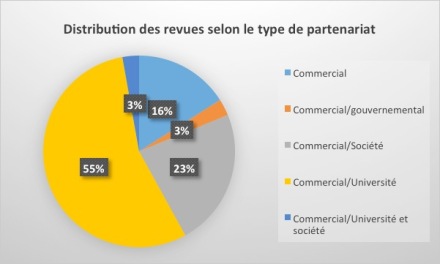
The journals that charge article processing fees are all commercial, without society / university partnerships. To put this another way, none of the journals produced in these partnerships charge APCs and all leave copyright in the hands of the authors. The division of types of partnerships is as follows:
• 16% commercial only
• 3% commercial / government
• 23% commercial / society
• 3% commercial / society / university
• 55% commercial / university

Tableau 2

Répartition selon le partenariat


In conclusion, one might say that De Gruyter, whose activities used to be very traditional, took a considerable turn towards open access to becomes the 3rd largest publisher in DOAJ, and this without charging article processing fees for the majority of authors or asking for copyright transfer. It remains to be seen whether this model will continue.

Cite as:

Dumais-DesRosiers, M., Brutus, W., & Morrison, H. (transl.). (2016). De Gruyter Open (english). Sustaining the Knowledge Commons / Soutenir Les Savoirs Communs. Retrieved from https://sustainingknowledgecommons.org/2016/04/27/de-gruyter-open-english/

SpringerOpen: 2015-2016 APCs Comparison

Update May 9: many of the journals with links to APC information not working in April are now working, so that we can confirm that about 40% of SpringerOpen journals are fully sponsored and do not charge article processing fees.

SpringerOpen is an Open Access (OA) publisher that requires Article Processing Charges (APCs) for most journals. This publisher displays APCs in three currencies: pound sterling (GBP), US dollar (USD) and Euro (EUR).
SpringerOpen is the fourth largest OA journal in the Directory of Open Access Journals (DOAJ) with 170 journals listed. As SpringerOpen is one of the largest OA publishers it must be examined in order to gain insight into future APC trends.

2015/2016

151 matching journals from 2015 and 2016 were compared in USD. When the journals not charging APCs were removed, the average APC for 2015 was $1,166 and is $1,239 in 2016.  The lowest APC for 2015 was $125 for Agricultural and Food Economics. In 2016, the lowest APC is $430 for two journals: Advanced Modeling and Simulation in Engineering Sciences and Botanical Studies. The mode APC was $1,085 for both 2015 and 2016.  The highest APC in 2015 was $1,935 for AMB Express and in 2016 is $2,500 for AAPS Open.

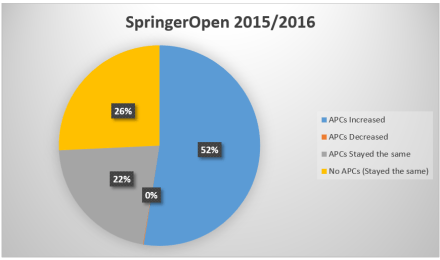
Only one journal’s APC decreased from 2015: Fire Science Reviews was charging $1,420 in 2015 and is now charging $1,155 (-19%) in 2016. 38 journals did not charge APCs in 2015, and still do not charge them in 2016. 32 journals are charging the same amount as they were in 2015. A little more than half of the journals (77/151) have increased their APCs. Most of those charging more (54/77), increased by 10% or less.

Screenshot (103)

Cite as:

Wheatley, S. (2016). SpringerOpen: 2015-2016 APCs Comparison. Sustaining the Knowledge Commons / Soutenir Les Savoirs Communs. Retrieved from https://sustainingknowledgecommons.org/2016/04/27/springeropen-2015-2016-apcs-comparison/

De Gruyter maintenant 3e éditeur en importance sur le Directory of Open Access Journals (DOAJ)

Co-écrit par Myriam Dumais-DesRosiers et Widlyne Brutus


Résumé (anglais)

La maison d’édition commerciale De Gruyter, bien qu’absente du Directory of Open Access Journals (DOAJ) en 2014, est maintenant le 3e plus important éditeur de revues savantes en libre accès sur cette même plateforme. Deux raisons pourraient expliquer cette importante croissante de l’éditeur : la première consiste en l’achat de quelques maisons d’édition produisant du contenu en libre accès (par exemple, Versitas et Berkeley Electronic Press), la seconde est le partenariat qu’entretient De Gruyter avec de nombreuses sociétés et universités, majoritairement de l’Europe de l’Est.

Détails

La maison d’édition commerciale De Gruyter, qui jusqu’en 2014 n’était pas incluse dans le Directory of Open Access Journals (DOAJ), était, en novembre 2015, le 3e plus important éditeur de revues savantes en libre accès sur DOAJ en nombre de revues (https://sustainingknowledgecommons.org/2015/10/22/top-10-publishers-in-doaj-by-number-of-titles-2014-to-2015/). Une des raisons expliquant cette progression est que De Gruyter a acquis quelques maisons d’édition publiant leur contenu en libre accès au cours des dernières années, par exemple Versitas et Berkeley Electronic Press. Cette ascension fulgurante n’est pas le seul aspect intéressant de cette maison d’édition. En effet, parmi les revues sous sa direction, seulement 2 % chargent des frais de publication, les autres préférant assumer eux-mêmes les coûts de production.

Tableau 1

Frais de publication De Gruyter

Les revues chargeant des frais de publication aux auteurs sont toutes de type commercial, sans partenariat.

Une autre raison expliquant la réussite de De Gruyter dans le domaine de la publication de revues savantes en libre accès est les multiples partenariats qu’elle entretient avec de nombreuses sociétés et universités, situées majoritairement en Europe de l’Est. Pour les revues en partenariat avec De Gruyter, aucun frais n’est exigé aux contributeurs et ceux-ci conservent leurs droits d’auteur. Ces partenariats sont répartis selon la division suivante :

  • 16 % sont uniquement de type commercial
  • 3 % sont de type commercial/gouvernemental
  • 23 % sont de type commercial/société
  • 3 % sont de type commercial/société/université
  • 55 % sont de type commercial/université


 Tableau 2

Répartition selon le partenariat


En conclusion, on constate que De Gruyter, dont les activités anciennement traditionnelles ont pris un virage considérable dans le domaine du libre accès pour devenir le 3e éditeur en importance sur le site de DOAJ, n’applique pas, pour la majorité de ses revues, un modèle d’imposition des frais aux auteurs. Ces revues ne facturent donc pas de frais de publication ni ne retiennent de droits d’auteur pour assumer les frais de production. Reste à voir si ce modèle va perdurer.

Citation:

Dumais-DesRosiers, M., & Brutus, W. (2016). De Gruyter maintenant 3e éditeur en importance sur le Directory of Open Access Journals (DOAJ). Sustaining the Knowledge Commons / Soutenir Les Savoirs Communs. Retrieved from https://sustainingknowledgecommons.org/2016/04/27/de-gruyter-maintenant-3e-editeur-en-importance-sur-le-directory-of-open-access-journals-doaj/

Hindawi publisher: 2016 findings and longitudinal comparison of APC rates

Hindawi is an Open Access (OA) publisher that follows the business model of Article Processing Charges (APC) in all its journals. This publisher charges APC only in USD, and it is known to often merge journals and provide free publishing on a rotating basis.

Hindawi is listed as the largest OA publisher in DOAJ with 540 journals.  Despite the fact that it lists only 406 journals on its website, mainly as a result of merging 130 ISRN journals into one journal, Hindawi is still considered the largest OA publisher and therefore needs to be observed to gain insight into the future APC trends.

2015-2016 comparison

A total of 389 matching journals are compared in years 2015 and 2016. The median and mode remain the same. The average, however, witnesses an increase of USD 65.

Untitled1

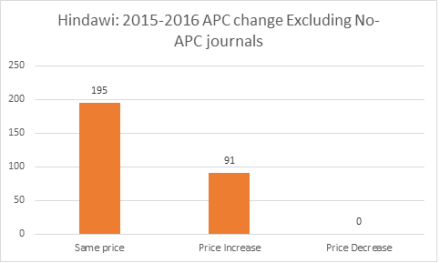
When removing all journals that charge no-APC in both years, 286 journals are compared and the following observations are noted:
More than two-thirds of journals charged the same price in both years, about one-third increased their prices, but not a single journal witnessed a price decrease.

Untitled2

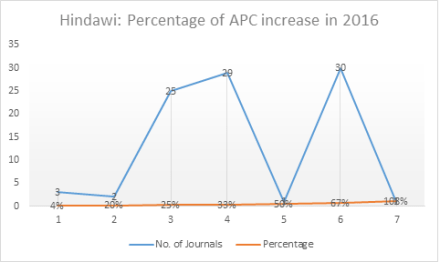
As to APC increase in 2016 (91 journals), the range noted is between 4% to 108%. The majority of journals charged 25% (30 journals), 33% (29 journals) and 67% (30 journals) respectively.

Untitled3

2015-2016: Rotating No-APC journals:

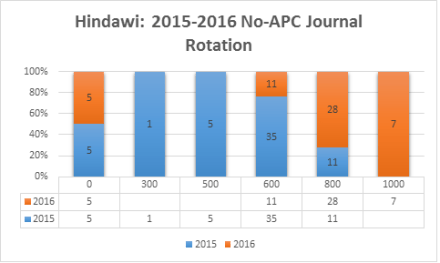
When examining the no-APC journals in both years, we found that 57 journals charged no-APC in 2015 whereas the number went down to 51 in 2016.  Only 5 journals charged no-APC in both years.

What is interesting, however, is not the number of journals per se, but rather the price increase for most of those journals in 2016. For example, in 2015, 28 out of 2016 no-APC journals charged USD 600 and only 11 charged USD 800. However when examining prices in 2016, we find that only 11 of 2015 no-APC journals charged USD 600, 35 charged USD 800 and that 7 journals went further to charge USD 1000.

Untitled4

Hindawi: Comparing years 2010 & 2016

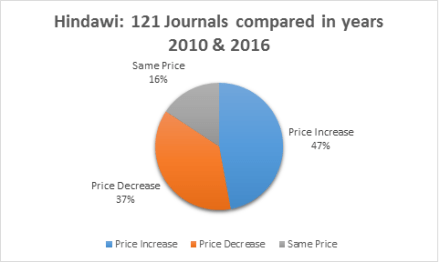
Unlike 2015-2016 comparison that showed that APC has either increased or stayed the same, comparing the year 2010 to 2016 proves that APCs are not always tending towards higher prices. A total of 121 journals were compared in both years where 57 journals increased APC, 45 decreased APC and only 19 kept the same price.

Untitled5

Hindawi: 2010-2016:

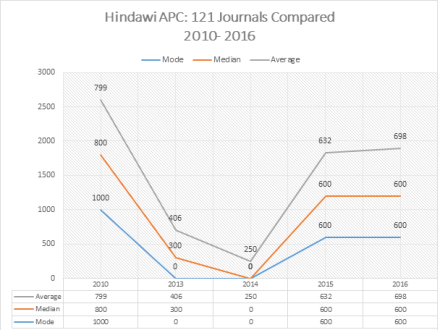
To examine APC prices in years 2010, 2013, 2014, 2015 & 2016, we compared also 121 matching journals.  The data shows that APC in 2010 was higher than all other years with an average of USD 799. However, unlike the sample from years 2013, 2014, 2015 and 2016 which include 41, 60, 17 and 13 no-APC journals respectively, the matching journals from 2010 does not include any no-APC journal. This explains the skewed distribution in years 2013 and 2014 with zero mode in both years. Nevertheless, the data shows that in this sample the APC used to be higher in 2010 than 2016 with an average of USD 799 compared to only USD 698 in 2016.

Untitled6

As we examine Hindawi APC pricing throughout the years, it is obvious that there is a lot of manipulation whether through price change or no-APC rotation policy.

Will Hindawi apply a gradual price increase while decreasing the number of no-APC journals as witnessed in years 2015-2016 or will it rather apply another round of huge shifts as in previous years? Here lies the importance of the longitudinal study in monitoring changes and hopefully predicting future practices.

Cite as:

Salhab, J. (2016). Hindawi publisher: 2016 findings and longitudinal comparison of APC rates. Sustaining the Knowledge Commons / Soutenir Les Savoirs Communs. Retrieved from https://sustainingknowledgecommons.org/2016/04/27/hindawi-publisher-2016-findings-and-longitudinal-comparison-of-apc-rates/


Comparison of BioMed Central APCs from 2010-2016

Method

We compared 2016 BioMed Central (BMC) Article Processing Charges (APCs) in US dollars (USD) with APC data from 2010, 2013, 2014 and 2015. A total of 165 matching journal titles were compared.

2010/2016

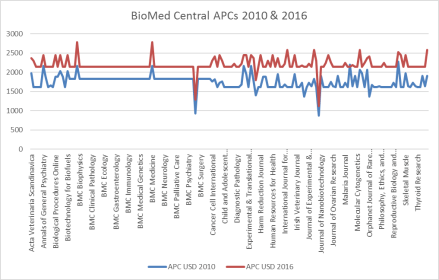
All but one title has increased its APCs since 2010. Molecular Autism was the only title that decreased. Its APCs were $2200 in 2010 and are now $2145, with a decrease of -3%. 18% was the mode of the percentage of increase since 2010, with 55/165 titles increasing their APCs by 18%, all of these APCs were $1825 and are now $2145. The highest percentage of change (77%) was for the journal, Orphanet Journal of Rare Diseases, which was charging $1365 in 2010 and is now charging $2410 in 2016. The average price in 2010 was about $1750 while the average price in 2016 is $2197. The chart below shows a comparison of a sample of BMC journal titles with APCs from 2010 and 2016.

Biomed Central APCs 2010 and 2016

2013/2016

Most APCs have increased since 2013 as well. 163/165 increased and two have decreased. The mode of percentage of change from 2013 to 2016 was 4%, 80/165 titles increased by 4%. Another prevalent percentage was 21%. 42 titles increased by 21%, 40/42 of these titles were priced at $1780 in 2013 and increased to $2145 in 2016. Finally, two titles, Molecular Autism and Neural Development, have decreased in price since 2013, both were priced at $2355, but have since reduced in price by $210. The highest percentage of change, 36%, was the Journal of Cardiovascular Magnetic Resonance, which was $1580 in 2013 and is now $2145. The average price in 2013 was $1984, compared to $2197 in 2016.

2014/2016

Interestingly, many APCs increased between 2013 and 2014, but decreased in 2015. APCs of 94 journal titles have decreased since 2014, and two have stayed the same. -3% was the mode of percentage of change for 76 titles, all but one of these was priced at $2215 in 2014, and they are now $2145 in 2016. The highest percentage of change, 17%, was the Health Research Policy and Systems, which was $1960 in 2010 and $2300 in 2016. The lowest percentage of decrease was a tie between Molecular Autism and Neural Development at -16%, both were $2545 in 2014 and are now $2145. The average charges were $2168 in 2014, which is slightly lower than the $2197 average in 2016.

2015/2016

Most, 111/165 (67%), titles’ APCs have stayed the same since 2015. Molecular Autism and Neural Development are the only two titles that have decreased their APCs, from $2450 to $2145. The average APC price has increased from $2149 to $2197. The highest percentage of increase was a tie between 21 journals at 11%, all of these titles were charging $1940 in 2015 and are now charging $2145.

US Inflation Rates Compared to BMC APCs

When comparing the percentage change of BMC APCs from 2010 to 2016, it is clear that most prices have increased at a higher rate than the US rate of inflation. The United States Bureau of Labor Statistics, lists the average Consumer Price Index (CPI) or US inflation rates for each year from 2010 to 2015 as: 2010: 1.6%, 2011: 3.2%, 2012: 2.1%, 2013: 1.5%, 2014: 1.6%, 2015: 0.1% (Bureau of Labor Statistics, 2016). When compounded, the US inflation rate from 2010 to 2016 comes to 8.7%. However, when comparing BMC’s APCs, most titles (148/165) have increased by 18% or more since 2010.

In 2010, $1825 was the most prevalent APC amount listed by BMC. According to the CPI Inflation Calculator provided by the Bureau of Labor Statistics, that price in 2016 would be $1,984.48. However, BMC lists all APCs that were formerly $1825, for example BMC Anesthesiology, in 2010 as $2145 in 2016. The chart below compares the price of BMC Anesthesiology using the US inflation rate against the BMC APC. As you can see, in 2014 the APC, like many APCs, increased (from $2060 in 2013 to $2215 in 2014), but decreased to $2145 in 2015 and has remained at this price as of April 13, 2016.

Our comparison of inflation rates to APCs harkens back to the Report on the Association of Research Libraries (ARL) Serials Project by Ann Okerson (1989). The objective of Okerson’s study was to test the hypothesis that subscription prices had risen at a faster rate than inflation in publishing costs, which was found to be true (1989). In our case, a majority of APCs have stayed the same since 2015, but most APCs have increased at a higher rate than the rate of inflation when comparing 2010 to 2016 charges. These mixed results suggest that BMC’s APCs could be increasing over time at a faster rate than the rate of inflation, however it is too soon to say what the future will hold. We will continue to monitor BMC’s APCs in order to gain insight into future pricing trends.

Screenshot (75)

References

BioMed Central. (2016). Fees and funding. Retrieved April 13, 2016, from http://bmcanesthesiol.biomedcentral.com/submission-guidelines/fees-and-funding

Bureau of Labor Statistics. (n.d.). Consumer Price Index – All Urban Consumers. Retrieved April 13, 2016, from http://data.bls.gov/pdq/SurveyOutputServlet

Bureau of Labor Statistics. (n.d.). CPI Inflation Calculator. Retrieved April 13, 2016, from http://www.bls.gov/data/inflation_calculator.htm

Okerson, A. (1989). Report on the ARL Serials Project. The Serials Librarian, 17(3-4), 111-119. doi:10.1300/j123v17n03_15

Cite as:   Wheatley, S. (2016). Comparison of BioMed Central APCs from 2010-2016. Sustaining the Knowledge Commons / Soutenir Les Savoirs Communs. Retrieved from https://sustainingknowledgecommons.org/2016/04/13/comparison-of-biomed-central-apcs-from-2010-2016/

Bentham open et les frais de publication d’un article

La grande majorité des revues de cet éditeur est inclue dans le Directory of open Access journal (DOAJ). Cependant, certains ne sont pas indiqués parce que l’éditeur ne les publie plus. Comparativement à 2015, une différence de prix est relevée en 2016 dans ce blogue. C’est également, le cas des prix de publication de 2010.

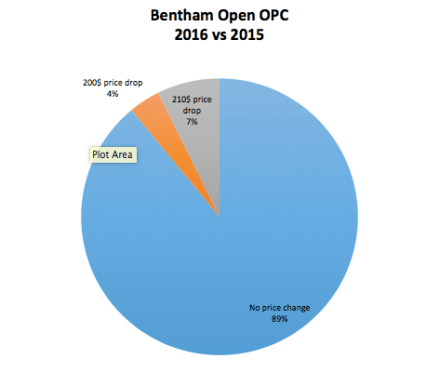
Dans un premier temps, l’analyse s’est effectuée en utilisant 82 titres de revues publiés par Bentham open. On remarque que les prix de 2016 sont restés stables dans la grande majorité des revues. On constate que dans:

  • 89% des cas les prix de 2016 sont demeurés inchangés par rapport a ceux de 2015
  • 4% des cas les prix ont subi une diminution de 200$
  • 7% des cas les prix une diminution de 210$.


Screen Shot 2016-03-30 at 3.52.24 PM

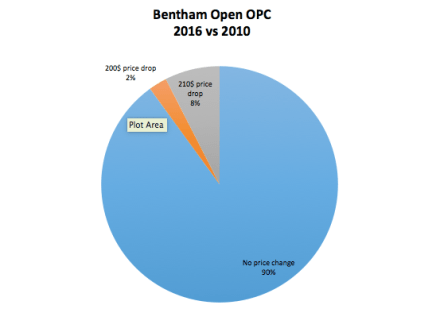
Pour ce qui est des prix de 2010 par rapport a ceux de 2016, la comparaison s’est effectuée sur 81 revues. On remarque également que les prix de 2010 sont restés semblable en 2016 pour la majorité des cas. On peut noter que les prix de 2010 sont :dans

  • 90% des cas restés inchangés en 2016
  • 2% des cas il y a eu une diminution de 200$ en 2016
  • 8% des cas il y a eu une diminution de 210$ en 2016.

Screen Shot 2016-03-30 at 3.55.27 PM

En somme, les frais liés à la publication d’articles sont restés stables au cours des six dernière années pour cet éditeur.

Cite as:

Brutus, W. (2016). Bentham open et les frais de publication d’un article. Sustaining the Knowledge Commons / Soutenir Les Savoirs Communs. Retrieved from https://sustainingknowledgecommons.org/2016/03/30/bentham-open-et-les-frais-de-publication-dun-article/