Taylor & Francis 2017 Data

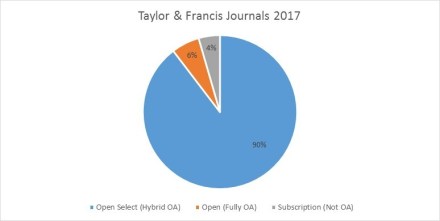
Abstract: Taylor & Francis is one of several major, traditionally commercial, scholarly publishers that is moving to the Open access space. Taylor & Francis publishes 2,550 journals and now has a major part of them available for Gold Open Access. 150 journal published by Taylor & Francis are in fully open access.

Around 77% of fully open access journals have an APC, but only 1% of those have an APC in DOAJ. Of the APCs available in DOAJ, 54% varies from the APCs found in Taylor & Francis. Less than 3% of fully open access journals have an APPC.

At least 7 journals published by Taylor & Francis do not have publications fees.

The APC average for fully open is 794.55 GBP (including only the 106 journals with APCs), for hybrid is 1574.38 GBP and for subscription was not calculated because only three journals had APCs.

These averages are higher than the APC average for 2016 of 702.74 GBP (converted with the Bank of Canada currency converter (on March 21st, 2017)). (Excluding journals with an APC of $0).

T&F Pie Chart 2017

See full text here

Cite as: Laprade, K. (2017). Taylor & Francis 2017 Data. Sustaining the Knowledge Commons / Soutenir Les Savoirs Communs. Retrieved from https://sustainingknowledgecommons.org/2017/03/28/taylor-francis-2017-data/

MPDI : suivi des APCs

Résumé :

En comparant les frais de publication des différentes revues mentionnées sur le site MDPI entre mars 2016 et mars 2017 nous remarquons quelques différences entre les 2 années.

Ceci dit que les APCs ont augmenté dans 92 % des revues. Cette augmentation oscille entre 6% et 350 %.

Par exemple, les APCs pour la revue Coalitions est passé de 350 CHF en 2016 a 850 CHF en 2017.

Selon le site MDPI, environ 60 revues en libre accès n’exigent pas de frais de publication en 2017.

En observant de près les APCs des différentes revues, nous remarquons qu’il n’y a aucune baisse des frais de publication et que seulement 8% des revues ont gardé les mêmes frais de publication 2016-2017.

mdpi_apc

Texte intégral de l’article

Citation:

Ouerghi, A. (2017). MPDI: Suivi des APCs. Sustaining the Knowledge Commons / Soutenir Les Savoirs Communs. Retrieved from https://sustainingknowledgecommons.org/2017/03/21/mpdi-suivi-des-apcs/

Hindawi APC: Le site web d’Hindawi versu le répertoire du DOAJ

Résumé :

Le répertoire du DOAJ (Directory of open access) recense les informations des diverses revues savantes disponibles en libre-accès. Hindawi est une maison d’édition dont ses revues sont répertoriées dans ce répertoire. L’information dans le DOAJ est contradictoire comparée à celle du Hindawi, on y retrouve 566 titres de revues tandis que le site web d’Hindawi en indique 339.

On remarque que 59 % des revues dans le DOAJ ne sont plus publiés par l’éditeur et 64 titres qui sont sur le site web de l’éditeur ne sont pas dans le catalogue du DOAJ. Les informations collectées par le DOAJ ne sont pas à jour pour la majorité des titres répertoriés.

Objectif :

Le but de cette collecte de données est d’examiner l’exactitude des titres et des frais de traitement des articles  qui sont indiqué dans le répertoire des revues en libre accès et sur le site web de l’éditeur Hindawi.

Méthodologie

Dans un premier temps, le 31 janvier 2017 nous avons effectué une copie d’écran de l’information contenue dans le site web de l’éditeur Hindawi. L’objectif est de comparer l’information contenue dans le DOAJ pour les titres des revues et les frais de publication afin de voir si elles sont bonnes. Ces informations une fois collectées, elles ont été consignées dans un fichier Excel afin d’effectuer une comparaison entre l’information fournie par l’éditeur et le répertoire.

Résultats

Nombre de revues

Premièrement, il y a 339 revues dans le site web d’Hindawi et le DOAJ indique 566 publications pour cet éditeur.

Il y a 227 titres de périodiques indiqués dans le DOAJ qui ne sont peut-être plus publiés de l’éditeur. Alors que 64 titres de revues publiées par Hindawi ne sont pas mentionnés le répertoire du DOAJ.

De plus, il n’y a aucune indication sur le site web qui indique que ces périodiques ne sont plus disponibles. Des 328 revues répertoriées dans le DOAJ, 59 % ne sont plus publiés.

La série ISRN est encore indiquée dans le répertoire du DOAJ, alors que Hindawi a décidé de publier cette série dans une revue qui s’intitule International Scholarly Research Notices

APC

Le tableau qui suit démontre le nombre compare le nombre de revues qui sont inscrites dans le répertoire et ceux indiqué sur le site web d’Hindawi

Hindawi DOAJ
Numéro de revues 339 566
# avec APC 335* 432**
  • *Ces quatre revues n’ont pas de frais pour l’année 2017 donc pour l’année 2017 les auteurs pourront publier sans payer de frais
  • * Pour les autres titres, le répertoire n’indique aucune information

Pour ce qui est de l’exactitude, des prix ont peu noté quelque différence dans l’information rapportée par l’éditeur et le répertoire.

Pour ce qui des prix, dans la majorité des cas les prix indiqués dans le DOAJ sont largement inférieur que les prix de l’éditeur la moyenne de la différence de prix est de 151 $ plus élevé dans le site web de l’éditeur que du répertoire

Il y a 33 revues où les prix indiqués sont les mêmes dans le site de l’éditeur que dans le répertoire. Donc seulement 9 % des périodiques affichent le même prix sur le site web de l’éditeur.

Pour 45 revues, le prix affiché dans le répertoire est plus élevé que pour l’éditeur. Pour la majorité des titres, la différence de prix dans le répertoire affiche un prix qui est supérieur de 50 $.

Pour 144 revues les prix affichés dans le DOAJ sont largement inférieurs au prix de l’éditeur. Ce nombre tient compte des titres pour lesquels il existe de l’information sur le site de l’éditeur et dans le DOAJ.

On peut remarquer des hausses de prix sur le site web d’Hindawi qui peut aller jusqu’à 66 %. Il s’agit d’une hausse importante. La plus haute augmentation des frais de publication est une hausse de 108 %. Donc pour certaines revues les frais de publication ont plus que doublé. Il s’agit en effet d’une hausse considérable

En bref, les informations collectées par le DOAJ ne sont pas à jour que ce soit pour les titres ou les prix. Une grande majorité des informations est contradictoire et même fausse.

Discussion

Le répertoire de DOAJ affiche de l’information sur son site web concernant différents éditeurs qui ont des ressources en libre accès. Ce que j’ai pu constater avec l’éditeur Hindawi, c’est qu’il y a beaucoup d’information contradictoire sur le site web de DOAJ.

Citation:

Brutus, W. (2017). Hindawi APC: Le site web d’Hindawi versu le répertoire du DOAJ. Sustaining the Knowledge Commons / Soutenir Les Savoirs Communs. Retrieved from https://sustainingknowledgecommons.org/2017/03/14/hindawi-apc-le-site-web-dhindawi-versu-le-repertoire-du-doaj/


Comparaison DOAJ et MDPI : Titres et APC

Résumé :

En comparant les frais de publication mentionnés par DOAJ et ceux de l’éditeur lui-même (MDPI) nous avons remarqué quelques différences : Selon le site MDPI, environ 175 revues en libre accès sont listées contre seulement 146 dans DOAJ.

Par ailleurs, parmi la liste MDPI, 107 revues exigent des frais de publication alors que DOAJ n’en mentionne que 21. Aussi, aucun des frais de publication DOAJ n’est inférieur à celui mentionné par MDPI. Seulement 3 revues ont les mêmes frais. Dans 31 des cas étudiés, les frais MDPI sont plus élevés de 50% et plus que ceux fournis par DOAJ.  Applied Science, l’exemple de différence le plus frappant, passe de 500 CHF en DOAJ à 1200 CHF sur le site MDPI.

Objectif :

Cette étude se propose de comparer la liste des revues répertoriées par DOAJ versus l’éditeur lui-même ; MDPI en l’occurrence; ainsi que la différence des frais de publication mentionnés.

Méthodologie :

L’échantillon est constitué de 107 revues de l’éditeur MDPI.

Nous avons commencé par repêcher les frais de publication sur le site de DOAJ en janvier 2017. Par la suite, nous avons cherché les frais de publication pour ces mêmes revues sur le site de l’éditeur lui-même, MDPI en l’occurrence et ce en février 2017.

Les données sont consignées sur un document Excel pour pouvoir par la suite calculer la différence des APC.

Résultats

  1. Selon le site MDPI, environ 175 revues en libre accès sont listées ; seulement 147 de ces revues sont recensées en DOAJ.

En comparant les APC (frais de publication par l’auteur) des revues répertoriées, nous constatons que DOAJ ne recense pas (ou la liste n’est pas a  jour)toutes les revues en accès libre de l’éditeur MDPI ; seulement 147 sur 175 titres y sont listées. Les 28 revues manquantes a l’appel sont :

  1. Big Data and Cognitive Computing
  2. Biomimetics
  3. ChemEngineering
  4. Condensed Matter
  5. Cryptography
  6. Data
  7. Designs
  8. Drones
  9. Epigenomes
  10. Fermentation
  11. Fishes
  12. Genealogy
  13. Horticulturae
  14. Infrastructures
  15. Instruments
  16. International Journal of Turbomachine Propulsion and Power
  17. Journal of Functional Morphology and Kinesiology
  18. Languages
  19. Logistics
  20. Magnetochemistry
  21. Mathematical and Computational Applications
  22. Multimodal Technologies and Interactions
  23. Philosophies
  24. Recycling
  25. Scientia Pharmaceutica
  26. Sinusitis
  27. Tropical Medicine and Infectious Disease
  28. Vision

Il est à noter que la majorité de ces titres sont de nouvelles revues 2017. Une seule revue « Chromatography » est listée dans DOAJ mais pas sur le site MDPI.

2. Parmi la liste MDPI, 107 revues exigent des frais de publication (APC) seulement 21 ont des frais de publication selon DOAJ (environ 20 %).

3. Pour ces 20 % des revues, aucun APC DOAJ n’est inférieur à celui mentionné par MDPI

En observant les APC fournis par les deux sites, nous remarquons qu’aucun des APC n’a diminué entre janvier 2017 et février 2017.  Seulement 3 desdites revues ont les mêmes frais de publication dans les deux répertoires (lignes vertes), ceci dit environ 86% des APC sont différents.

doaj_mdpi1

Cette augmentation des APC oscille entre 7% et 140 %. L’APC de la revue Applied Sciences est de 500 CHF selon DOAJ versus 1200 CHF selon MDPI.

slide1

4. Les APC fournis par MDPI sont plus élevés que ceux révélés par DOAJ. La différence atteint 50 % ou plus dans 31 % des cas. (revues en jaune et rouge )

mdpi_doaj2


Conclusion

En guise de conclusion, les observations ci-dessus nous amènent à se poser une question : Est-ce que l’information fournie par DOAJ est mise a jour?

Les chiffres obtenus démontrent une grande différence non seulement au niveau de la liste des revues en libre accès mais aussi au niveau de l’information fournie aux auteurs, les frais de publication en particulier.

Citation: Ouerghi, A. (2017). Comparaison DOAJ et MDPI: Titres et APC. Sustaining the Knowledge Commons / Soutenir Les Savoirs Communs. Retrieved from https://sustainingknowledgecommons.org/2017/03/02/comparaison-doaj-et-mdpi-titres-et-apc/

Various APC models: the case of conference proceedings

By Victoria Volkanova and Heather Morrison

In a small, serendipitous, non-random sample of 170 Eastern European journals that were part of gathering data for the OA APCs project, we came across an interesting income model where the APCs are included in the annual conference registration. The journals seem to be closely associated with the scientific conferences organized by either universities or academic societies. Six (6) out of 170 journals (3.5%) use this model:

  1. Academy of Sciences and Arts of Republic of Srpska publishes a journal that is part of the International Scientific Conference “Contemporary Materials”. It charges no APC for articles, but 100 KM (Bosnia and Herzegovina convertible mark) per paper is included in the conference registration
  2. Wychowanie w Rodzinie/Family Upbringing *: APC is 100 EUR; for participants of the International Scientific Conference “Education in the Family” publication fee is part of the conference fee *Please note that on February 21st the journal’s website is no longer responding. We will verify the link in the next days and update the blog accordingly.
  3. Aerul şi Apa: Componente ale Mediului/Air and Water Components of the Environment: 100 EUR Conference Fee, includes APC for the conference proceedings
  4. Challenges of the Knowledge Society: 100 EUR Conference Fee, includes APC for the conference proceedings (CKS Journal)
  5. Proceedings of the International Conference Nanomaterials : Applications and Properties: 200 EUR Conference Fee, includes APC for conference proceedings
  6. Risk in Contemporary Economy: 300 RON Conference Fee (Romanian New Leu), includes APC for conference proceedings

The countries of origin of the journals are:

  • Bosnia and Herzegovina (1)
  • Poland (1)
  • Romania (3)
  • Ukraine (1)

Their websites state that the fees for the publication in the conference proceedings or the journals are included in the conference registration. This is a model that looks like an APC but in fact isn’t. Other journals or conference organizers might consider this model as an alternative source of funding for scientific journals.

Cite as:

Volkanova, V., & Morrison, H. (2017). Various APC models: The case of conference proceedings. Sustaining the Knowledge Commons / Soutenir Les Savoirs Communs. Retrieved from https://sustainingknowledgecommons.org/2017/02/21/various-apc-models-the-case-of-conference-proceedings/


Oxford Open: Increased the Number of Open Access Journal

Oxford Open wants to distribute journals of high-quality research but to be able to publish the journal in the open access model. They do charge article processing fees for most of their journals. Oxford Open also has journals that the author can choose the open access option (hybrid journals), but for the purpose of our research, we only use the journal that is available fully in open access.

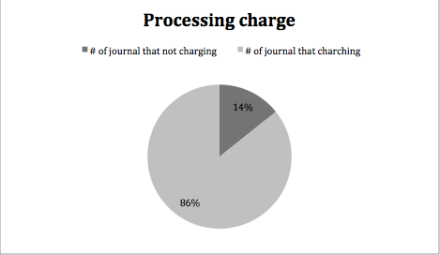
By collecting the information about the open-access journals I noticed that only 14 of their journals don’t have any processing charge and some of them don’t have them, but only for 2016.


Screen Shot 2016-11-17 at 11.40.15 AM.png

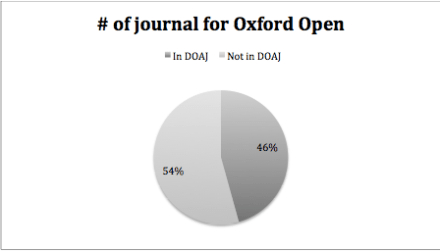
On their website I was able to collect 35 journal titles, the DOAJ only has 16. They seem to aim for more journals that will be available without fees for the user.


Screen Shot 2016-11-17 at 11.42.27 AM.png

In 2015 they had 11 journals and we sampled 5 of them. Only two have increased their price and the other three journals the price remained the same. The Journal DNA Research has increased the most of their processing fees in 2016. It has risen by 50%. However, the Nucleic Acids Research  has a rise they processing fees from 1400 GBP in 2015 to 1420 GBP in 2016.

Cite as:

Brutus, W. (2016). Oxford Open: Increased the Number of Open Access Journal. Sustaining the Knowledge Commons / Soutenir Les Savoirs Communs. Retrieved from https://sustainingknowledgecommons.org/2016/11/17/oxford-open-increased-the-number-of-open-access-journal/


Libertas Academica: follow-up

by Widlyne Brutus and Victoria Volkanova

Highlights

We recently reviewed the APCs of the publisher Libertas Academica for the year 2016 and found a mostly steady pricing compared with the year 2015. The fees are now listed in USD and GBP only, the latter replacing both Euro and Japanese Yen which were used in the previous years for authors from outside of North America. We also have noted the tendency to standardized pricing for the majority of the OA journals: US$1,848 / 1,399 GBP for the journals that are included in PubMed Central (PMC), and US$1,699 /1,299 GBP for the journals that are not included in PMC.

Details

According to its website, Libertas Academica (LA) publishes 83 international, peer-reviewed scientific, technical and medical journals.  Most of the LA journals are open access with the exception of the Clinical Medicine Reviews series that operates under the traditional subscription or pay-per-view model (http://www.la-press.com/about_us.php).

Last year we reviewed the APCs (or APFs, as they call it) of this publisher and found out the overall increases in all currencies (USD, Euros and Japanese Yen) that were much greater than the normal inflation rate warranted. In the comments to the original post, Tom Hill from Libertas Academica provided some explanation for the price increases, more specifically the addition of many journals to PubMed Central (i.e. XML creation, image quality requirements and additional quality control) and the depreciation of the Euro and the Yen, which were the two currencies used for authors from outside of North America. He also pointed out the ongoing possibility of fee waivers and discounts for authors.

Recently we revisited Libertas Academica’s website and compared their 2016 APCs with the previous years. First of all, we’ve noted one significant change in the currencies used: as of 2016, the authors from North America pay APCs in USD, whereas the authors from the rest of the world pay in GBP. We couldn’t find any explanation as to the reasons for which the publisher dropped both the Euro and the Japanese Yen in favour of the British Pound. Some of the possible reasons are the location of the company’s key external service providers in the United Kingdom (as well as in India and in New York, USA); generous UK APCs funding (RCUK, Wellcome Trust), or else the relative stability of this particular currency.

On a side note, the institutional membership fees are charged in USD only and go from US$3,300 to US$13,500, entitling the member institutions for an APC discount varying from 5% to 25%. So far, only one institution has subscribed to this option.

Another observation is the unified APCs for the journals that are being included in PubMed Central: US$1,848 and 1,399 GBP respectively. The fee in USD has remained stable for most journals. However, depending on the exchange rate between GBP and Euro (fluctuations ranging from 1.1054 to 1.4286 – GBP to Euro – in the past year, according to the Bank of England), the new price represents either a slight decrease (0.91% at the low point) or an increase of 1.17% at the high point.

For most journals that are not being included in PubMed Central, the APCs have been standardized at US$1,699 /1,299 GBP, which once again ranges from staying the same as in the year 2015 (for the APCs in USD and in some cases for the rest of the world) to an average increase of 1.47% (min being 1.28 % and max being 1.66%) for the other currencies.

However, there are a few exceptions to the standardized APCs (PMC- included or not): the journals Gene Expression to Genetical Genomics, Genomics Insights, and International Journal of Insect Science saw an increase of 1.59% in their 2016 APCs payable in GBP (1,399). Out of the three journals, Gene Expression to Genetical Genomics is not currently included in PMC.

As to the APCs stated previously in the Japanese Yen, the recent switch to the GBP had practically no impact: the charges fluctuated slightly between 0.916 % and 1.104 % compared to the previous year.

According to the LA’s website, the journals Breast Cancer: Basic and Clinical Research, Infectious Diseases: Research and Treatment, Palliative Care: Research and Treatment, and Virology: Research and Treatment are included in PMC, however, these titles do not appear on the PMC list as of November 1st, 2016 (https://www.ncbi.nlm.nih.gov/pmc/journals).

Cite as:

Brutus, W., & Volkanova, V. (2016). Libertas Academica: Follow-up. Sustaining the Knowledge Commons / Soutenir Les Savoirs Communs. Retrieved from https://sustainingknowledgecommons.org/2016/11/01/libertas-academica-follow-up/

Hikari- favor some disciplines?

Hikari is a publisher of journals in science, technology and medicine founded in 2005. They used to be in the DOAJ 2015, but in 2016 the publisher isn’t mentioned in the directory. The publisher didn’t change the amount of their OA APC. The majority of the journals still charge processing fees but they no longer charge publication fees in the fields of medicine and economics. This means that of their 20 journals, 4 of them no longer have publication fees. 25 percent of their journals have no publication fees. The journals that still have publication fees charge 200 EUR per page up to 8 pages and an extra 25 EUR per pages for the additional pages.

Cite as:

Brutus, W. (2016). Hikari- favor some disciplines? Sustaining the Knowledge Commons / Soutenir Les Savoirs Communs. Retrieved from https://sustainingknowledgecommons.org/2016/10/13/hikari-favor-some-disciplines/

Medknow 2016: it’s complicated!

by Widlyne Brutus and Heather Morrison

Highlights

Medknow is an emerging commercial scholarly journal publisher based in the developing world (India) that is owned by one of the oldest and most traditional western-based commercial publishers, Wolters Kluwer, that publishes in partnership with many long-standing traditional society and university journals. Even though the publisher is for-profit by nature, the majority of journals do not charge APCs. Of the journals that do charge APCs, most have not changed price between 2015 and 2016; some journals are adding or dropping APCs, and a few have lowered their APC. However, we identified 16 journals that did raise APCs from 2015 to 2016, in some cases by substantial amounts (over 50%, some even doubling or tripling in price).

medknow-partnershipsmedknow-apc-split

Details

Medknow is a commercial publisher of peer-review medical journals that originated in India. This publisher has partnerships with many associations, societies and universities and its publications include many long-standing not-for-profit journals. Of the 141 journals published by Medknow, more than half (83 journals) are published in partnership with universities and learned societies.

A traditional commercial scholarly publisher, with a history dating back to 1836, Wolters Kluwer, acquired Medknow in 2011. The reason for mentioning this is as one example of how the distinction between traditional and open access publishers may not be as relevant today as it used to be.

The partnership with the not-for-profit societies and universities likely explains why less than half of Medknow journals (70 journals) charge an APC as of 2016 (an increase from 61 journals with APCs in 2015).

In 2016, there are 26 journals that clearly state that there is no processing charge, down from 28 journals in 2015. It is not always clear whether there is an APC or not. In 2016 we note 38 journals with no cost found (meaning we did not find either an APC or clear language stating that there is no APC), down slightly from 41 in 2015.

There 28 publication in 2015 that have no publication fees and in 2016 26 publication have no processing charge.

Widlyne compared the averages of the article processing charge for the year of 2015 and 2016.

The average in 2015 was $285 and in 2016, $173 in US dollar. While the price seems to have decreased, this likely reflects currency fluctuations as the primary currency for a large portion of the journals is not USD, for example Indian rupees as the primary currency is very common. So this information should not be taking as a proof of the decrease of APC.

Comparing prices on a journal-by-journal basis, most of the prices did not change (31 journals had exactly the same price). Four journals lowered their APC and two no longer charge APC’s.

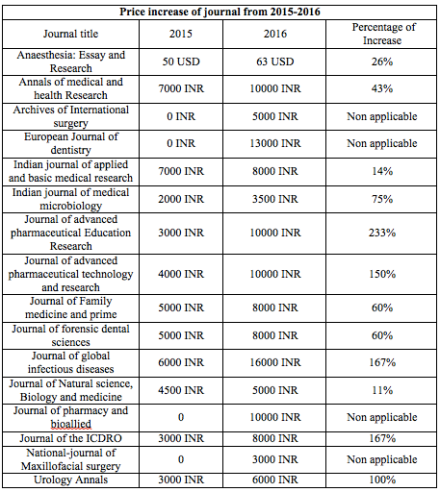
16 journals have increased their APCs, this table show which journal have increase their APC’s, the amount for 2015 and 2016 and the percentage of increase.

screen-shot-2016-10-06-at-4-57-36-pm

As you can see most of these journals have increase their APC considerably; at least 8 journals increased their price by more than half. Some journals even doubled or tripled their prices.

Cite as:

Brutus, W., & Morrison, H. (2016). Medknow 2016: It’s complicated! Sustaining the Knowledge Commons / Soutenir Les Savoirs Communs. Retrieved from https://sustainingknowledgecommons.org/2016/10/11/medknow-2016-its-complicated/


MDPI APC / FDP 2011 – 2016

Tanoh Laurent Kakou and Heather Morrison

Brief abstract (English)

This post presents highlights of preliminary results of our longitudinal study of the article processing charges (APCs) of MDPI, an open access publisher using the APC business model (exclusively), with new journals offering « free for now »  publication. Thanks to Solomon and Björk (2012) we have data for a sample of 25 of MDPI’s journals that did charge APCs in 2011 (non-charging journals were excluded from their study). The APCs for these 25 journals ranged from 300 CHF to 1,600 CHF, with an average of 624 CHF. Only 1 journal (Algorithms) did not change in price ; all others increased in price from 2011 – 2016. The average APC for this group of journals in 2016 was 1,148 CHF, an average increase of 524 CHF or an 84% increase in 5 years. This compares with a compound U.S. interest rate from 2010 – 2015 of 8.7% as calculated by Sara Wheatley https://sustainingknowledgecommons.org/2016/04/13/comparison-of-biomed-central-apcs-from-2010-2016/. The EU compound interest rate would have been lower during this time frame, with some years in negative growth. One might say that MDPI’s APCs for established journals have increased by an order of magnitude greater than the overall inflation rate in the past 5 years.

As of March 2016, MDPI listed 155 journals on its website. Of these, nearly half (72 journals) are <>, that is they use the APC model but are not yet charging. The average APC of 359 CHF (662 CHF when non-charging journals are excluded) contrasts with the 1,148 average APC of the 25 journals that were included in the 2011 sample (established journals). From 2014 to 2015 APCs either stayed the same or decreased ; from 2015 to 2016, we see only stable or increasing prices with an average price increase from 2015 to 2016 of 18% (60 CHF increase on a 2015 average APC of 334 CHF).

This case study illustrates one approach to the evolution of a new commercial publisher committed to the APC business model, with new journals offering free publishing until journals are established. APC payers need to take this into account for budgeting purposes; journals that today either are free or have very low APCs may have substantial APCs in a few year’s time.

Following are the original abstract (in French) by data analyst Tanoh Laurence Kakou and a table with the APCs of the 25 journals for which we have APC data for 2011 and 2016.

Résumé (Français)

Nous analysons des données de MDPI APC de 2011 à 2016. Notre recherche consiste à comprendre comment les frais de publication de MDPI ont évolué dans cette période. Nous avons analysé d’abord les données de chaque période. D’abord 2011, 2014, 2015, puis 2016. Puis nous avons comparé l’évolution des frais de 2011 à 2016, de 2014 à 2015 et de 2015 à 2016.

Les données de 2011 sont des prélèvements d’un échantillon effectué en 2011 par Solomon et Björk (2012) sur uniquement 25 revues avec des frais de publication. Ainsi, la moyenne des frais est 624 CHF, la médiane est de 500 CHF et le mode est de 300 CHF. Sensors a les frais de publication les plus élevés (1,600 CHF). Tandis que Molbank détient les moins élevés (200 CHF). En 2016, on a obtenu une moyenne de 345 CHF, une médiane de 300 CHF et un mode de 0 CHF. Sensors, Marine Drugs et Molecules ont les frais (1,800 CHF) les plus élevés. En ce qui a trait à l’évolution des frais entre 2011 et 2016, on obtient une moyenne de 115%, d’une médiane de 75% et d’un mode de 167%. S’agissant de l’évolution du nombre du montant des frais, nous obtenons une moyenne de 523 CHF, d’une médiane de 500 CHF et d’un mode de 200 CHF. Seule les frais de Algorithms n’ont pas changé. Ils sont restés à 300 CHF soit une évolution de 0%. Tandis que Polymers augmente de 367% qui représentent une valeur ajoutée de 1100 CHF.

Concernant les données de 2014 de Morrison et al, (2015) elles ont été effectuées sur toutes les 124 revues au site web de MDPI. On obtient dans cet échantillon, une moyenne de 372 CHF, d’une médiane de 300 CHF et d’un mode 0 CHF. 3 revues : Sensors, Marine Drugs et Molecules détiennent les frais les plus élevés. En 2015, Morrison et al. (2016) ont étudié 141 revues. 70 revues n’avaient pas de frais de publication. Sensors, Marine Drugs et Molecules gardent les mêmes frais (1800 CHF). Par rapport à l’évolution des frais de publication de 2014 à 2015, deux tendances s’observent.

Au niveau de l’évolution des frais des 124 revues de 2014 à 2015, les frais de 84 revues n’ont pas changé. 40 revues ont baissé leurs frais.

En mars 2016, nous avons trouvé 155 revues au site web de MDPI. Presque la moitié (72 revues) sont <>. La moyenne FDP est 359 CHF (662 CHF si on exclut les revues sans frais) la médiane 300 CHF (500 CHF si on exclut les revues sans frais et le mode 0 (300 CHF si on exclut les revues sans frais).

Au niveau de l’évolution 2015 et 2016, la moyenne augmentation est 18%, (60 CHF), une médiane de 0 et un mode de 0.

Conclusion

L’analyse des données de MDPI APC de 2011 à 2016 montre que les frais de publication de cette période ont augmenté en moyenne 84%, allant jusqu’ à 367% pour la revue Polymers. Cependant entre 2014 et 2015, on a constaté une stabilité des frais et même une baisse de 100% de 6 revues : Sports, Systems, Technologies, Toxics, Universe, Veterinary Sciences. Entre 2015 et 2016, on a remarqué en augmentation en moyenne de 18% (60 CHF).

JOURNAL NAME APC 2011 (CHF) APC 2016 (CHF) Change 2016 – 2011
Algorithms 300 300 0
Cancers 300 800 500
Diversity 300 800 500
Energies 800 1,400 600
Entropy 1,000 1,400 400
Future Internet 300 500 200
Games 300 500 200
Genes 300 800 500
International Journal of Environmental Research and Public Health 1,000 1,600 600
International Journal of Molecular Sciences 1,400 1,600 200
Marine Drugs 1,400 1,800 400
Materials 800 1,400 600
Molbank 200 300 100
Molecules 1,400 1,800 400
Nutrients 500 1,500 1,000
Pharmaceuticals 500 800 300
Pharmaceutics 300 500 200
Polymers 300 1,400 1,100
Remote Sensing 500 1,600 1,100
Sensors 1,600 1,800 200
Sustainability 500 1,200 700
Symmetry 300 800 500
Toxins 500 1,400 900
Viruses 500 1,500 1,000
Water 300 1,200 900
Average 624 1,148 524

Réference

Solomon, D.J. & Björk, B.-C. (2012) A study of open access journals using article processing charges. J. Am. Soc. Inf. Sci. Technol. 2012, 63, pp. 1485–1495. Retrieved from http://www.openaccesspublishing.org/apc2/preprint.pdf February 2, 2016.

Citation:

Kakou, T. L., & Morrison, H. (2016). MDPI APC / FDP 2011 – 2016. Sustaining the Knowledge Commons / Soutenir Les Savoirs Communs. Retrieved from https://sustainingknowledgecommons.org/2016/07/29/mdpi-apc-fdp-2011-2016/