Harvard Journal Flipping Project

Early results of a major study on journals that have converted from subscriptions to open access is available here: https://osc.hul.harvard.edu/programs/journal-flipping/public-consultation/ There is a lot of useful information here for journals considering such a flip, e.g. analysis of issues and models to consider.

Citation: cite the Harvard project, not this post. Recommended: look for final results.


De Gruyter Open (english)

by Myriam Dumais-DesRosiers et Widlyne Brutus; translated by Heather Morrison

Abstract (français)

The commercial publisher De Gruyter, not even listed in the Directory of Open Access Journals (DOAJ) in 2014, is now the 3rd largest publisher of open access scholarly journals in DOAJ. Two factors that can explain this large increase of the publisher: the first is the purchase of other open access publishers (for example, Versita and Berkeley Electronic Press), the second is partnerships that De Gruyter has undertaken with a number of societies and universities, primarily in Eastern Europe.

Details
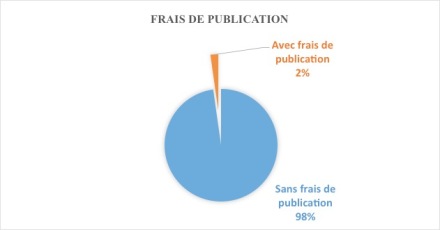
The commercial publisher De Gruyter, that as of 2014 was not included in the Directory of Open Access Journals (DOAJ), was, in November 2015, the 3rd largest publisher of open access journals in DOAJ by number of journals(https://sustainingknowledgecommons.org/2015/10/22/top-10-publishers-in-doaj-by-number-of-titles-2014-to-2015/). One reason for this large increase is the purchase of other open access publishers (for example, Versita and Berkeley Electronic Press), another is partnerships that De Gruyter has undertaken with a number of societies and universities, primarily in Eastern Europe. This sudden growth is not the only interesting aspect of this publishing house. Among the journals published by De Gruyter, only 2% charge article processing fees, the others preferring to assume the production costs themselves.

Tableau 1

Frais de publication De Gruyter

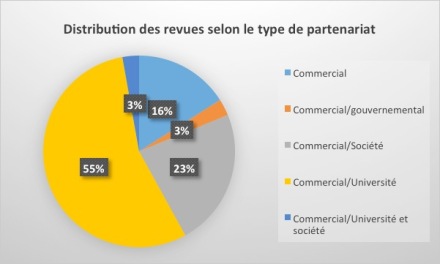
The journals that charge article processing fees are all commercial, without society / university partnerships. To put this another way, none of the journals produced in these partnerships charge APCs and all leave copyright in the hands of the authors. The division of types of partnerships is as follows:
• 16% commercial only
• 3% commercial / government
• 23% commercial / society
• 3% commercial / society / university
• 55% commercial / university

Tableau 2

Répartition selon le partenariat


In conclusion, one might say that De Gruyter, whose activities used to be very traditional, took a considerable turn towards open access to becomes the 3rd largest publisher in DOAJ, and this without charging article processing fees for the majority of authors or asking for copyright transfer. It remains to be seen whether this model will continue.

Cite as:

Dumais-DesRosiers, M., Brutus, W., & Morrison, H. (transl.). (2016). De Gruyter Open (english). Sustaining the Knowledge Commons / Soutenir Les Savoirs Communs. Retrieved from https://sustainingknowledgecommons.org/2016/04/27/de-gruyter-open-english/

Co-Action Publishing 2016

Summary: this post summarizes my analysis of Co-Action publication fees as of 2010, 2015, and 2016 and comments on the Co-Action pricing structure. In brief, there is a 5% average price increase for journals for which article-level publication fees are available for 2015 and 2016, and a 44% average price increase for the 7 journals for which article-level publication fee data is available for 2010 and 2016. These increases contrast with EU inflation rates during this time frame, generally modest (high of 3%) and sometimes negative. It is important to note that Co-Action is one of many publishers that offers a range of pricing rather than a single flat per-article fee. A number of Co-Action journals have a policy of free of charge to publish unless there is an author fund available. This model is a fairly clear illustration of the interests of APC-charging publishers in this type of funds. I raise the point that in this respect the interests of APC publishers is not necessarily aligned with the interests of researchers, institutions and funders, who may favour prioritizing funding for research and researchers. In this respect, the interests of APC publishers may more closely resemble the financial interests of toll access publishers than other stakeholders in the open access ecosystem. This may be understandable – but it is important to understand.

Details

Co-Action 2010-2016

Co-Action’s researcher pricing is interesting from a number of perspectives. It is important to note that there is no flat per-article publishing charge. Each journal has its own pricing structure. There is typically a range of prices based on such factors as type and length of article. Occasionally, there are deals for society members. A number of journals are free of charge – except for authors who have access to institutional or funder OA funds. I count these as APC journals. This explanation from the publication fee page of the Journal of European Continuing Medical Education is typical:

Publishing in Journal of European Continued Medical Education is now free of charge thanks to a generous grant from European CME Forum with additional support from the European Board for Accreditation in Cardiology (EBAC) and the European Union of Medical Specialists (UEMS).

However, if the author’s university or institute officially maintains a central fund to cover costs for Open Access Publishing, or the article describes results from research funded by an Open Access-friendly funding agency, a publication fee will be charged at a rate of 1250 EUR/1450 USD for a regular article.

Comment: this model is a clear illustration of the interests of publishers reliant on APCs in this funding model for open access. It is important to note that in this instance the interests of APC publishers are not necessarily aligned with the interests of researchers, institutions or funding agencies for whom funding for research per se, salaries and infrastructure support for researchers is a higher priority. In this respect, the interests of APC-charging publishers and publishers reliant on subscriptions / purchase (money to pay for publishing) are identical even if the preferred model is not.

As of 2016, Co-Action publishes 27 APC-charging journals, 4 journals with page rather than article charges, and 4 journals are completely free of publication charges. The 2016 average of 1,184 EUR compares favorably with the 2015 average of 1,173 EUR. However, when the per-journal price changes for 2015 and 2016 are compared, there is an average 5% price increase (22 journals with data both years) and when the 7 journals for which we have data for 2010 and 2016 are compared, there is an average increase of 342 EUR or a 44% price increase. These price increases are much higher than EU inflation rates in recent years; the 10-year average from 2005 – 2014 was just under 21% (EU Commission).


Co-Action 201516

Cite as:

Morrison, H. (2016). Co-Action Publishing 2016. Sustaining the Knowledge Commons / Soutenir Les Savoirs Communs. Retrieved from https://sustainingknowledgecommons.org/2016/04/26/co-action-publishing-2016/

Note: Co-Action was acquired by Taylor & Francis as documented by Laprade (2017).

Laprade, K. (2017). Taylor & Francis bought Co-Action Publishing. Sustaining the Knowledge Commons / Soutenir Les Savoirs Communs. Retrieved from https://sustainingknowledgecommons.org/2017/04/11/taylor-francis-bought-co-action-publishing/

March 31 Dramatic Growth of Open Access

Cross-posted from the Imaginary Journal of Poetic Economics

Highlights

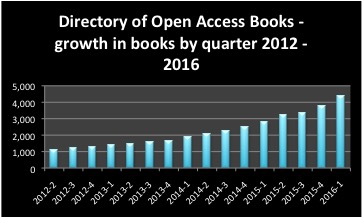
There are now 150 publishers of peer-reviewed open access books listed in the Directory of Open Access Books, publishing more than 4,400 open access books. 620 books were published in this quarter alone, a 16% increase in just this quarter.

The Directory of Open Access Journals has been adding titles at a net rate of 6 titles per day, 540 journals added this quarter for a total of over 11,000 journals. This is the highest DOAJ growth rate since this series started!

Bielefeld Academic Search Engine repositories collectively added more than 4.7 million documents this quarter for a total of just under 89 million documents.

SCOAP3 nearly doubled in size this past year (87% annual growth) for a total of 4,690 documents. arXiv grew by over 107,000 documents to over 1.1 million documents during the same time frame.

Internet Archive is likely to be featured in the next issue as it is currently edging towards a milestone of 10 million free texts.

The number of journals actively participating in PubMedCentral, making all content immediately freely accessible, and making all content open access, continues to grow. Meanwhile at PubMed a transition in indexing practice (from manual to automatic) means that a search for NIH-funded articles in the last 90 days significantly underreports results (1,402 NIH funded articles in the past 90 days compared with a range of 7,846 – 19,790 with a 90-day search limit for NIH funded article since 2008). Without the indexing, it is not possible to determine the percentage of full text. Here’s hoping the automated indexing process results in a catch-up soon; it doesn’t matter very much if the statistics for this series fall a bit behind, but people rely on this indexing to search for medical information.

The Electronic Journals Library added 3,612 journals that can be read free-of-charge in the past year, for a total of 52,000 journals, a 7% growth rate.

This post is part of the Dramatic Growth of Open Access series. Open data can be downloaded from the Dramatic Growth of Open Access dataverse.

Cite as:

Morrison, H. (2016). March 31 Dramatic Growth of Open Access. Sustaining the Knowledge Commons / Soutenir Les Savoirs Communs. Retrieved from https://sustainingknowledgecommons.org/2016/04/12/march-31-dramatic-growth-of-open-access/

Merci à CRSH / Thanks to SSHRC

Je veux remercier le Conseil de recherches en sciences humaines (CRSH) du Gouvernement du Canada de confirmer une Subvention Savoir pour continuer le travail de Soutenir les savoirs communs jusqu’a le 31 mars 2021.

I would like to thank Canada’s Social Sciences and Humanities Research Council (SSHRC) for confirming the award of an Insight Grant to continue the work of Sustaining the Knowledge Commons until March 31, 2021.

Total: $182,455

Cite as:

Morrison, H. (2016). Merci à CRSH / Thanks to SSHRC. Sustaining the Knowledge Commons / Soutenir Les Savoirs Communs. Retrieved from https://sustainingknowledgecommons.org/2016/04/04/merci-a-crsh-thanks-to-sshrc/

Small scholar-led scholarly journals: can they survive and thrive in an open access future? (published as early view February 2016)

If you are citing my commentary or have not viewed the original article, cite this post as:


Editorial: Open access, copyright and licensing: basics for open access publishers

by Heather Morrison & Lisa Desautels

Just published (February 2016) in the open access Journal of Orthopaedic Case Reports at the invitation of Editor-In-Chief Dr. Ashok Shyam: Editorial: open access, copyright and licensing: basics for open access publishers. Journal of Orthopaedic Case Reports 6:1 p. 1-2. DOI: 10.13107/jocr.2250-0685.360

Cite the original article (not this blogpost) as:

Morrison, H., & Desautels, L. (2016). Editorial – Open access, copyright and licensing: Basics for open access publishers. Journal of Orthopaedic Case Reports. Retrieved from http://www.jocr.co.in/wp/2016/01/02/2250-0685-360-fulltext/

OA APC preliminary data 2015: range, central tendencies and preliminary longitudinal analysis

by Heather Morrison & Jihane Salhab

Noting the important caveat of the mythical nature of “the OA APC” as a single per-article price, following are the range, central tendencies and some highlights from our 2015 OA APC data.

Note that a2015APCll prices are in USD.


Highlights

The overall average of journals sampled in 2015 was $998, compared to $964 in 2014 and $906 reported by Solomon & Björk in 2010. These are modest average increases (4% 2014 – 2015, 2% per year from 2010 – 2015). However, the average may mask contradictory tendencies, such as low or no fees for new journals to attract content obscuring increases for journals that either are, or are be2014-15 price changescoming, established.
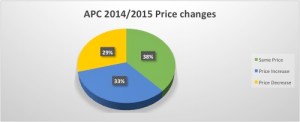
From 2014 – 2015 on a per-title basis there was a fairly even 3-way split between journals that retained the same price, increased or decreased their price.

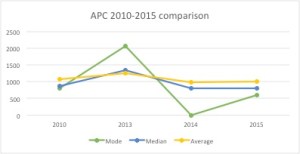
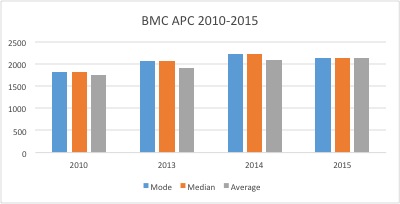
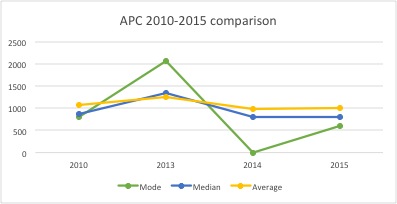
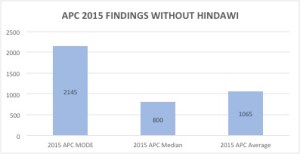
Different publishers show different tendencies. Hindawi, the largest OA publisher by number of journals, has such an 2015apcnohindawiimpact we are beginning to call this the “Hindawi factor”. In 2015, the overall mode (most common price) is $800, while the mode without Hindawi is $2,145. The following two charts illustrate the variation in pricing tendencies from 2010 – 2015 for the two largest OA APC publishers, Hindawi and BMC, reflecting the differences in approach to pricing for these publishers over the same time frame.
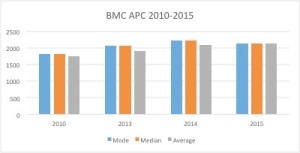
hindawi 20102015 BMC20102015 APC 2010 to 2015

The above chart shows a relatively steady average and median in contrast with a varying mode (most common price) from 2010 – 2015.

It is important to note that the samples are not entirely comparable. Notably, to facilitate the longitudinal study we have not included new publishers listed in DOAJ as of 2015. This is an important limitation. For example,  DeGruyter, not present in 2014, is the 3rd largest DOAJ publisher in 2015. The following details illustrate that the average cost-to-publish in a fully OA journal with publication fees in 2015 varies from about $250 USD to $2,145 USD, depending on the measure and particular sample of journals selected.

Details

Range: $0 – $4,500

$0 APC = journals has APCs but currently price is $0. Most commonly this is used by journals that are “free for now” until more content is added.

Average (mean) Median Mode Standard deviation
Preliminary sample (all) 1,051


800 800 795
Preliminary sample (weighted) 858
Preliminary sample (excluding $0 APC) 1114
Preliminary sample (excluding $0 APC) weighted 1370

Preliminary sample: includes the 1,363 journals sampled in 2010, 2013 and/or 2014 confirmed as using APCs (excluding journals using APPC but not APC). APC of $0 (journals for which APC method is confirmed but no current charges, e.g. “free for now” approach) are included unless otherwise specified. The weighted figures adjust by a sampling factor designed to give added weight to journals from categories with lower rates of sampling, journals by publishers with less than 10 journals using APCs.

Full sample: 1,999 journals including preliminary sample plus additional journals sampled from publisher’s website.

Average (mean) Median Mode
All 998


800 600
Weighted 866
Excluding $0 APC 1,077


Excluding $0 APC) weighted 1,034


See above for description of “weighted”.

More details will be posted as our data analysis continues.

Cite as:

Morrison, H., & Salhab, J. (2015). OA APC preliminary data 2015: Range, central tendencies and preliminary longitudinal analysis. Sustaining the Knowledge Commons / Soutenir Les Savoirs Communs. Retrieved from https://sustainingknowledgecommons.org/2015/12/03/oa-apc-preliminary-data-2015-range-central-tendencies-and-preliminary-longitudinal-analysis/
The mythical OA article processing charge

The purpose of this post is to provide some important context for understanding OA publication charges. A key point that I would like to highlight is that the OA APC, in the sense of a single number charged for each article published, is a myth. It is important to understand this because  OA journals are obviously conducting some real-world experiments that have the potential for beneficial results for high-quality, sustainable open access publishing, and providing discounts that may be needed by some authors and OA APC payers.

Pricing is often tailored to reflect the work involved in publishing an article. A well-written article that is submitted in good shape with little need for language editing or copyediting with camera-ready graphics is less work to publish – this should, and sometimes does, cost less. There are a variety of discounts reflecting contributions to the journal community; discounts for editors, reviewers, society or association members, loyalty discounts for repeat authors. Details about variations on APC pricing can be found in these posts by Guinsly Mondésir (Version en français / English version).

The “average” cost to pay-to-publish an article in a fully open access journal that we found in 2015 (ignoring $0 APC) ranges from an estimated $250 USD for a journal using OA page charges based on an estimate of 9 pages, to a fairly consistent median of $800, modes of $600 to $800, to averages or median numbers from $858 (weighting results to include smaller publishers) to the overall average of $998 to $1,370 for the same set of journals excluding $0 to a mode of $2,154 after removing the “Hindawi factor” (The practices of this largest OA publisher by number of journals skews the sample).

Even this wide range of “averages” conceals the full complexity involved with deciphering publisher pricing and with translating currencies into USD. A set of prices, gathered on the same date in 2015, would yield different averages if the currency calculation were conducted on a different date. In gathering the data we had to make many tough decisions about the “original” currency, because a number of publishers provide pricing in several different currencies. It is harder than one might think to decide on which is the “real” price, for example when differential pricing is provided based on the author’s location. Having a single APC would be simpler, but not necessarily better if it means a loss of a discount for authors or payers who could really use them or if it eliminates an incentive to streamline the process of publishing itself in the process of transition to OA.

With this important caveat we will now present our preliminary quantitative analysis of this mythical variable here.

Morrison, H. (2015). The mythical OA article processing charge. Sustaining the Knowledge Commons / Soutenir Les Savoirs Communs. Retrieved from https://sustainingknowledgecommons.org/2015/12/03/the-mythical-oa-article-processing-charge/


Current status of OA APC journals sampled 2010 – 2014

Update and correction December 2019: this early analysis did not take into account publishers and journals that had been removed prior to the beginning of our SKC APC longitudinal study. In 2019, we completed the sample by adding these journals to obtain a more complete picture of the status and APC changes. In brief, from 2010 – 2019 there was an apparent substantial attribution rate of 26%, however this appears to be an anomaly reflecting several new commercial APC based publishers (Bentham Open, Hindawi, Frontiers, BioMedCentral, and Dove Medical Press) that followed a start-up strategy of starting with a large number of journals to cover a broad range of disciplines, then retiring titles that were not successful. For the latest analysis of the 2010 dataset, see:

Morrison, H. (2019). 2010 – 2019 APC update. Sustaining the Knowledge Commons. Retrieved from https://sustainingknowledgecommons.org/2019/11/26/2010-2019-apc-update/


Analysis of the current status of journals sampled in 2010 (by Solomon & Björk) and/or by the SKC team in 2013 or 2014. In brief: the attrition rate for journals previously sampled is quite low, with 2% of the 1,559 titles previously sampled either apparently or actually no longer publishing. Most of the journals no longer active (34 of the 37), not surprisingly, are from the 2010 sampling. The vast majority of journals found to have APCs or APPCs (article page processing charges), over 90%, clearly had APCs in 2015. A noticeable number of journals previously identified as having publication charges either do not have publication charges, or cannot be confirmed as having publication charges today. The following chart and table provide additional detail. For more detail and documentation on how this data is calculated, see the open access article processing charges dataverse – under the Open access article processing charges longitudinal study 2015 preliminary dataset the data file is called DataSet – Main v.12 current status of previously sampled journals.csv and the accompanying documentation PDF file is called OA APC study 2015 current status journals samples 2010 – 2014 documentation .pdf

current status of journals sampled 2010 - 2014


Current status of preliminary sample journals (sampled in 2010, 2013, or 2014)
Category Total (numeric) Total (percentage) * 2010 numeric 2010 percentage
Confirmed publication charges 1,425 91% 828 95%
Confirmed no publication fees 51 3% 1 0%
Title no longer published 37 2% 34 4%
No cost found 35 2% 7 1%
Other 11 1% 4 0%
Total 1,559 100% 874 100%
* Note total adds up to 99%, not 100% due to rounding error


Citation: if referring to updated information on the 2010 dataset, please see and cite the 2019 post, not this one which will be retained for historical purposes:

Morrison, H. (2019). 2010 – 2019 APC update. Sustaining the Knowledge Commons. Retrieved from https://sustainingknowledgecommons.org/2019/11/26/2010-2019-apc-update/

To cite this post (e.g. to note correction or for purposes of teaching research methods): Morrison, H. (2015). Current status of OA APC journals sampled 2010 – 2014. Sustaining the Knowledge Commons / Soutenir Les Savoirs Communs. Retrieved from https://sustainingknowledgecommons.org/2015/11/26/current-status-of-oa-apc-journals-sampled-2010-2014/