March 31 Dramatic Growth of Open Access

Cross-posted from the Imaginary Journal of Poetic Economics

Highlights

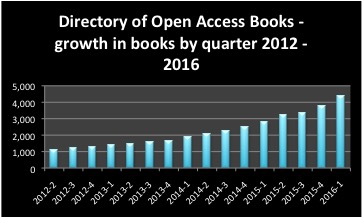
There are now 150 publishers of peer-reviewed open access books listed in the Directory of Open Access Books, publishing more than 4,400 open access books. 620 books were published in this quarter alone, a 16% increase in just this quarter.
The Directory of Open Access Journals has been adding titles at a net rate of 6 titles per day, 540 journals added this quarter for a total of over 11,000 journals. This is the highest DOAJ growth rate since this series started!

Bielefeld Academic Search Engine repositories collectively added more than 4.7 million documents this quarter for a total of just under 89 million documents.

SCOAP3 nearly doubled in size this past year (87% annual growth) for a total of 4,690 documents. arXiv grew by over 107,000 documents to over 1.1 million documents during the same time frame.

Internet Archive is likely to be featured in the next issue as it is currently edging towards a milestone of 10 million free texts.

The number of journals actively participating in PubMedCentral, making all content immediately freely accessible, and making all content open access, continues to grow. Meanwhile at PubMed a transition in indexing practice (from manual to automatic) means that a search for NIH-funded articles in the last 90 days significantly underreports results (1,402 NIH funded articles in the past 90 days compared with a range of 7,846 – 19,790 with a 90-day search limit for NIH funded article since 2008). Without the indexing, it is not possible to determine the percentage of full text. Here’s hoping the automated indexing process results in a catch-up soon; it doesn’t matter very much if the statistics for this series fall a bit behind, but people rely on this indexing to search for medical information.

The Electronic Journals Library added 3,612 journals that can be read free-of-charge in the past year, for a total of 52,000 journals, a 7% growth rate.

This post is part of the Dramatic Growth of Open Access series. Open data can be downloaded from the Dramatic Growth of Open Access dataverse.

Cite as:

Morrison, H. (2016). March 31 Dramatic Growth of Open Access. Sustaining the Knowledge Commons / Soutenir Les Savoirs Communs. Retrieved from https://sustainingknowledgecommons.org/2016/04/12/march-31-dramatic-growth-of-open-access/
Merci à CRSH / Thanks to SSHRC

Je veux remercier le Conseil de recherches en sciences humaines (CRSH) du Gouvernement du Canada de confirmer une Subvention Savoir pour continuer le travail de Soutenir les savoirs communs jusqu’a le 31 mars 2021.

I would like to thank Canada’s Social Sciences and Humanities Research Council (SSHRC) for confirming the award of an Insight Grant to continue the work of Sustaining the Knowledge Commons until March 31, 2021.

Total: $182,455

Cite as:

Morrison, H. (2016). Merci à CRSH / Thanks to SSHRC. Sustaining the Knowledge Commons / Soutenir Les Savoirs Communs. Retrieved from https://sustainingknowledgecommons.org/2016/04/04/merci-a-crsh-thanks-to-sshrc/

Bentham open et les frais de publication d’un article

La grande majorité des revues de cet éditeur est inclue dans le Directory of open Access journal (DOAJ). Cependant, certains ne sont pas indiqués parce que l’éditeur ne les publie plus. Comparativement à 2015, une différence de prix est relevée en 2016 dans ce blogue. C’est également, le cas des prix de publication de 2010.

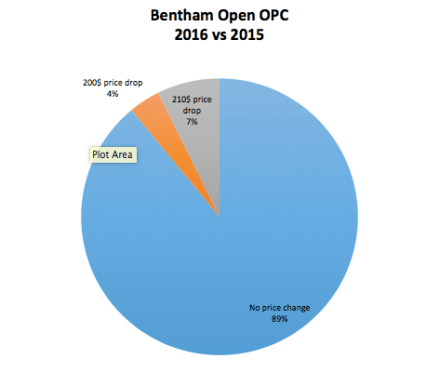
Dans un premier temps, l’analyse s’est effectuée en utilisant 82 titres de revues publiés par Bentham open. On remarque que les prix de 2016 sont restés stables dans la grande majorité des revues. On constate que dans:

  • 89% des cas les prix de 2016 sont demeurés inchangés par rapport a ceux de 2015
  • 4% des cas les prix ont subi une diminution de 200$
  • 7% des cas les prix une diminution de 210$.


Screen Shot 2016-03-30 at 3.52.24 PM

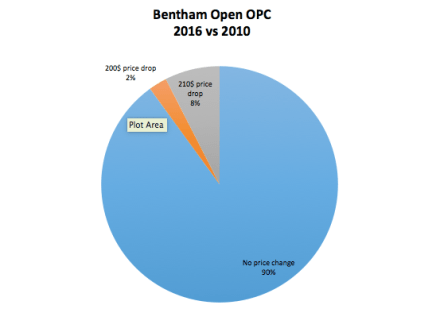
Pour ce qui est des prix de 2010 par rapport a ceux de 2016, la comparaison s’est effectuée sur 81 revues. On remarque également que les prix de 2010 sont restés semblable en 2016 pour la majorité des cas. On peut noter que les prix de 2010 sont :dans

  • 90% des cas restés inchangés en 2016
  • 2% des cas il y a eu une diminution de 200$ en 2016
  • 8% des cas il y a eu une diminution de 210$ en 2016.

Screen Shot 2016-03-30 at 3.55.27 PM

En somme, les frais liés à la publication d’articles sont restés stables au cours des six dernière années pour cet éditeur.

Cite as:

Brutus, W. (2016). Bentham open et les frais de publication d’un article. Sustaining the Knowledge Commons / Soutenir Les Savoirs Communs. Retrieved from https://sustainingknowledgecommons.org/2016/03/30/bentham-open-et-les-frais-de-publication-dun-article/

Diminution de l’APC des revues publiées par le Scientific Research Publishing

Entre 2015 et 2016, il semblerait qu’il y ait eu un arrêt, temporaire ou permanent, de l’indexation des revues de l’éditeur Scientific Research Publishing par le Directory of Open Access Journals (DOAJ), pour une raison inconnue. En effet, l’éditeur publie toujours les revues sous sa responsabilité en libre accès. La consultation du site de l’éditeur nous apprend toutefois que les frais associés à la publication d’articles ont diminué en 2016 par rapport à ceux de 2015. Parmi les 66 revues publié par Scientific Research Publishing et indexées en 2015 par DOAJ[1]

  • 20 revues n’ont pas augmenté leurs frais de publication
  • 17 revues ont diminué leurs frais de publication d’au moins 100$
  • 21 revues ont diminué leurs frais de publication d’au moins 200$
  • 5 revues ont diminué leurs frais de publication d’au moins 300$
  • 2 revues ont diminué leurs frais de publication d’au moins 400$

Capture d’écran 2016-03-30 à 09.38.12

Nous constatons donc une diminution des frais de publication pour 69% des revues publiées par le Scientific Research Publishing et anciennement recensées pas le DOAJ.


[1] Les données compilées ne tiennent compte que des revues indexées par DOAJ en 2015, bien que le site de l’éditeur Scientific Research Publishing compte un nombre plus important de titres.

Citation: Dumais-DesRosiers, M. (2016). Diminution de l’APC des revues publiées par le Scientific Research Publishing. Sustaining the Knowledge Commons / Soutenir Les Savoirs Communs. Retrieved from https://sustainingknowledgecommons.org/2016/03/30/diminution-de-lapc-des-revues-publiees-par-le-scientific-research-publishing/

BioMed Central Article Processing Charges

BioMed Central and Directory of Open Access Journals (2016)

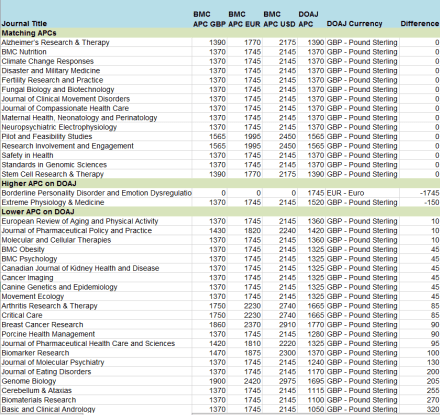
If you look at the Directory of Open Access Journals (DOAJ) you will see that some journals have Article Processing Charges (APCs) listed. So why are we still gathering APC data? Two reasons: one is to check the accuracy and completeness of the DOAJ APC data, and the other is that we gather more detail on the model than what is captured in DOAJ.  BioMed Central (BMC) offers one good illustration – while DOAJ includes a single figure1 for APC amount, BMC provides pricing in 3 currencies on its website.

306 titles are listed on BMC’s website (2016, February 22)2, and 289 BMC titles are listed in DOAJ.  When comparing the two lists of journal titles we found that 274 matched.

  • Of the 274 matching titles, only 38 (14%) provided an APC in DOAJ
  • Of the 38, the number of titles with an accurate APC was 15 out of 38 (40%)
  • 23 of the 38 APCs (60%) did not match
  • Two of the 38 (5%) had a higher APC in DOAJ
  • 21 of 38 (55%) had a lower APC in DOAJ

In summary, only 15 of the 289 (5%) BMC journals have accurate APCs listed in DOAJ.

Table 1. Comparison of the 38 APCs from BMC’s website and DOAJ

BMC DOAJ 2016 Comparison

BioMed Central Article Processing Charges Between 2015 and 2016

The chart below compares APCs listed on BMC’s website from May 15, 2015 with February 22, 2016.  Most (65%) APCs have stayed the same, however 34% have increased.

Screenshot (27)

Note: This is our first post on BMC this year.  We are doing more longitudinal work and will report back soon.

I would like to thank Jihane Salhab for allowing me to build on her work.

Footnotes

1. BMC’s APC currency in DOAJ is usually GBP (Pound Sterling).
2. As of March 30, 2016, BMC no longer has the table of APCs available on its website that was used for this price comparison.

Cite as:

Wheatley, S. (2016, March 23). BioMed Central Article Processing Charges. Retrieved December 13, 2019, from Sustaining the Knowledge Commons / Soutenir les savoirs communs website: https://sustainingknowledgecommons.org/2016/03/23/biomed-central-article-processing-charges/

Small scholar-led scholarly journals: can they survive and thrive in an open access future? (published as early view February 2016)

If you are citing my commentary or have not viewed the original article, cite this post as:


Editorial: Open access, copyright and licensing: basics for open access publishers

by Heather Morrison & Lisa Desautels

Just published (February 2016) in the open access Journal of Orthopaedic Case Reports at the invitation of Editor-In-Chief Dr. Ashok Shyam: Editorial: open access, copyright and licensing: basics for open access publishers. Journal of Orthopaedic Case Reports 6:1 p. 1-2. DOI: 10.13107/jocr.2250-0685.360

Cite the original article (not this blogpost) as:

Morrison, H., & Desautels, L. (2016). Editorial – Open access, copyright and licensing: Basics for open access publishers. Journal of Orthopaedic Case Reports. Retrieved from http://www.jocr.co.in/wp/2016/01/02/2250-0685-360-fulltext/

OA APC preliminary data 2015: range, central tendencies and preliminary longitudinal analysis

by Heather Morrison & Jihane Salhab

Noting the important caveat of the mythical nature of “the OA APC” as a single per-article price, following are the range, central tendencies and some highlights from our 2015 OA APC data.

Note that a2015APCll prices are in USD.


Highlights

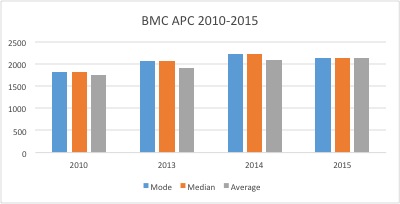
The overall average of journals sampled in 2015 was $998, compared to $964 in 2014 and $906 reported by Solomon & Björk in 2010. These are modest average increases (4% 2014 – 2015, 2% per year from 2010 – 2015). However, the average may mask contradictory tendencies, such as low or no fees for new journals to attract content obscuring increases for journals that either are, or are be2014-15 price changescoming, established.

From 2014 – 2015 on a per-title basis there was a fairly even 3-way split between journals that retained the same price, increased or decreased their price.

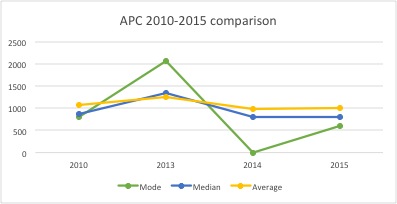
Different publishers show different tendencies. Hindawi, the largest OA publisher by number of journals, has such an 2015apcnohindawiimpact we are beginning to call this the “Hindawi factor”. In 2015, the overall mode (most common price) is $800, while the mode without Hindawi is $2,145. The following two charts illustrate the variation in pricing tendencies from 2010 – 2015 for the two largest OA APC publishers, Hindawi and BMC, reflecting the differences in approach to pricing for these publishers over the same time frame.

hindawi 20102015 BMC20102015 APC 2010 to 2015

The above chart shows a relatively steady average and median in contrast with a varying mode (most common price) from 2010 – 2015.

It is important to note that the samples are not entirely comparable. Notably, to facilitate the longitudinal study we have not included new publishers listed in DOAJ as of 2015. This is an important limitation. For example,  DeGruyter, not present in 2014, is the 3rd largest DOAJ publisher in 2015. The following details illustrate that the average cost-to-publish in a fully OA journal with publication fees in 2015 varies from about $250 USD to $2,145 USD, depending on the measure and particular sample of journals selected.

Details

Range: $0 – $4,500

$0 APC = journals has APCs but currently price is $0. Most commonly this is used by journals that are “free for now” until more content is added.

Average (mean) Median Mode Standard deviation
Preliminary sample (all) 1,051


800 800 795
Preliminary sample (weighted) 858
Preliminary sample (excluding $0 APC) 1114
Preliminary sample (excluding $0 APC) weighted 1370

Preliminary sample: includes the 1,363 journals sampled in 2010, 2013 and/or 2014 confirmed as using APCs (excluding journals using APPC but not APC). APC of $0 (journals for which APC method is confirmed but no current charges, e.g. “free for now” approach) are included unless otherwise specified. The weighted figures adjust by a sampling factor designed to give added weight to journals from categories with lower rates of sampling, journals by publishers with less than 10 journals using APCs.

Full sample: 1,999 journals including preliminary sample plus additional journals sampled from publisher’s website.

Average (mean) Median Mode
All 998


800 600
Weighted 866
Excluding $0 APC 1,077


Excluding $0 APC) weighted 1,034


See above for description of “weighted”.

More details will be posted as our data analysis continues.

Cite as:

Morrison, H., & Salhab, J. (2015). OA APC preliminary data 2015: Range, central tendencies and preliminary longitudinal analysis. Sustaining the Knowledge Commons / Soutenir Les Savoirs Communs. Retrieved from https://sustainingknowledgecommons.org/2015/12/03/oa-apc-preliminary-data-2015-range-central-tendencies-and-preliminary-longitudinal-analysis/

The mythical OA article processing charge

The purpose of this post is to provide some important context for understanding OA publication charges. A key point that I would like to highlight is that the OA APC, in the sense of a single number charged for each article published, is a myth. It is important to understand this because  OA journals are obviously conducting some real-world experiments that have the potential for beneficial results for high-quality, sustainable open access publishing, and providing discounts that may be needed by some authors and OA APC payers.

Pricing is often tailored to reflect the work involved in publishing an article. A well-written article that is submitted in good shape with little need for language editing or copyediting with camera-ready graphics is less work to publish – this should, and sometimes does, cost less. There are a variety of discounts reflecting contributions to the journal community; discounts for editors, reviewers, society or association members, loyalty discounts for repeat authors. Details about variations on APC pricing can be found in these posts by Guinsly Mondésir (Version en français / English version).

The “average” cost to pay-to-publish an article in a fully open access journal that we found in 2015 (ignoring $0 APC) ranges from an estimated $250 USD for a journal using OA page charges based on an estimate of 9 pages, to a fairly consistent median of $800, modes of $600 to $800, to averages or median numbers from $858 (weighting results to include smaller publishers) to the overall average of $998 to $1,370 for the same set of journals excluding $0 to a mode of $2,154 after removing the “Hindawi factor” (The practices of this largest OA publisher by number of journals skews the sample).

Even this wide range of “averages” conceals the full complexity involved with deciphering publisher pricing and with translating currencies into USD. A set of prices, gathered on the same date in 2015, would yield different averages if the currency calculation were conducted on a different date. In gathering the data we had to make many tough decisions about the “original” currency, because a number of publishers provide pricing in several different currencies. It is harder than one might think to decide on which is the “real” price, for example when differential pricing is provided based on the author’s location. Having a single APC would be simpler, but not necessarily better if it means a loss of a discount for authors or payers who could really use them or if it eliminates an incentive to streamline the process of publishing itself in the process of transition to OA.

With this important caveat we will now present our preliminary quantitative analysis of this mythical variable here.

Morrison, H. (2015). The mythical OA article processing charge. Sustaining the Knowledge Commons / Soutenir Les Savoirs Communs. Retrieved from https://sustainingknowledgecommons.org/2015/12/03/the-mythical-oa-article-processing-charge/


Variations in pricing of the article processing charges

Version en français (French version)

From the datasets downloaded from the Directory of Open Access Journal, we did some analysis. We found that among the journals that do offer article processing charges (APC), 87 % of them offer variations. So that the APC that the author expects to pay could be higher or lower. Those fluctuations depend on many factors. For example an article that requires language editing would have higher APC and if the author comes from a low/medium income countries then the APC will decrease. The table one shows the percentage of journals offering variations in pricing. The table 2 shows the list of the most frequent factors that contribute to APC variations.

Table 1. Percentage of journals offering variations in pricing (2015).

variations

Table 2. Frequency of sub-types of variations.

table2

Please note that we did not count every variation found. For example, variations likely based on simultaneous print versions of journals such as colour charges were not capture.

Cite as: Mondésir, G. (2015). Variations in pricing of the article processing charges. Sustaining the Knowledge Commons / Soutenir Les Savoirs Communs. Retrieved from https://sustainingknowledgecommons.org/2015/12/03/variations-in-pricing-of-the-article-processing-charges/