Bentham open et les frais de publication d’un article

La grande majorité des revues de cet éditeur est inclue dans le Directory of open Access journal (DOAJ). Cependant, certains ne sont pas indiqués parce que l’éditeur ne les publie plus. Comparativement à 2015, une différence de prix est relevée en 2016 dans ce blogue. C’est également, le cas des prix de publication de 2010.

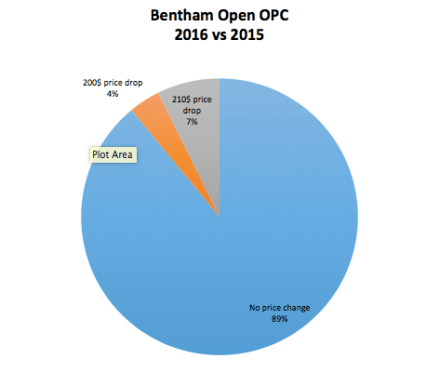
Dans un premier temps, l’analyse s’est effectuée en utilisant 82 titres de revues publiés par Bentham open. On remarque que les prix de 2016 sont restés stables dans la grande majorité des revues. On constate que dans:

  • 89% des cas les prix de 2016 sont demeurés inchangés par rapport a ceux de 2015
  • 4% des cas les prix ont subi une diminution de 200$
  • 7% des cas les prix une diminution de 210$.


Screen Shot 2016-03-30 at 3.52.24 PM

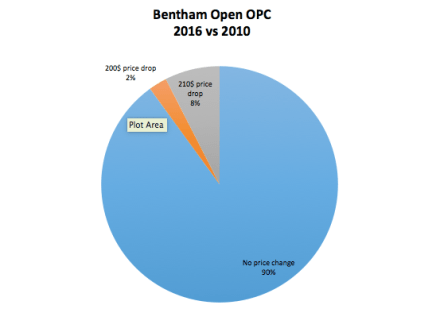
Pour ce qui est des prix de 2010 par rapport a ceux de 2016, la comparaison s’est effectuée sur 81 revues. On remarque également que les prix de 2010 sont restés semblable en 2016 pour la majorité des cas. On peut noter que les prix de 2010 sont :dans

  • 90% des cas restés inchangés en 2016
  • 2% des cas il y a eu une diminution de 200$ en 2016
  • 8% des cas il y a eu une diminution de 210$ en 2016.

Screen Shot 2016-03-30 at 3.55.27 PM

En somme, les frais liés à la publication d’articles sont restés stables au cours des six dernière années pour cet éditeur.

Cite as:

Brutus, W. (2016). Bentham open et les frais de publication d’un article. Sustaining the Knowledge Commons / Soutenir Les Savoirs Communs. Retrieved from https://sustainingknowledgecommons.org/2016/03/30/bentham-open-et-les-frais-de-publication-dun-article/

Diminution de l’APC des revues publiées par le Scientific Research Publishing

Entre 2015 et 2016, il semblerait qu’il y ait eu un arrêt, temporaire ou permanent, de l’indexation des revues de l’éditeur Scientific Research Publishing par le Directory of Open Access Journals (DOAJ), pour une raison inconnue. En effet, l’éditeur publie toujours les revues sous sa responsabilité en libre accès. La consultation du site de l’éditeur nous apprend toutefois que les frais associés à la publication d’articles ont diminué en 2016 par rapport à ceux de 2015. Parmi les 66 revues publié par Scientific Research Publishing et indexées en 2015 par DOAJ[1]

  • 20 revues n’ont pas augmenté leurs frais de publication
  • 17 revues ont diminué leurs frais de publication d’au moins 100$
  • 21 revues ont diminué leurs frais de publication d’au moins 200$
  • 5 revues ont diminué leurs frais de publication d’au moins 300$
  • 2 revues ont diminué leurs frais de publication d’au moins 400$

Capture d’écran 2016-03-30 à 09.38.12

Nous constatons donc une diminution des frais de publication pour 69% des revues publiées par le Scientific Research Publishing et anciennement recensées pas le DOAJ.


[1] Les données compilées ne tiennent compte que des revues indexées par DOAJ en 2015, bien que le site de l’éditeur Scientific Research Publishing compte un nombre plus important de titres.

Citation: Dumais-DesRosiers, M. (2016). Diminution de l’APC des revues publiées par le Scientific Research Publishing. Sustaining the Knowledge Commons / Soutenir Les Savoirs Communs. Retrieved from https://sustainingknowledgecommons.org/2016/03/30/diminution-de-lapc-des-revues-publiees-par-le-scientific-research-publishing/

BioMed Central Article Processing Charges

BioMed Central and Directory of Open Access Journals (2016)

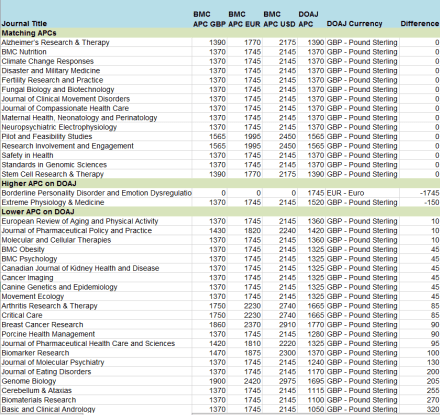
If you look at the Directory of Open Access Journals (DOAJ) you will see that some journals have Article Processing Charges (APCs) listed. So why are we still gathering APC data? Two reasons: one is to check the accuracy and completeness of the DOAJ APC data, and the other is that we gather more detail on the model than what is captured in DOAJ.  BioMed Central (BMC) offers one good illustration – while DOAJ includes a single figure1 for APC amount, BMC provides pricing in 3 currencies on its website.

306 titles are listed on BMC’s website (2016, February 22)2, and 289 BMC titles are listed in DOAJ.  When comparing the two lists of journal titles we found that 274 matched.

  • Of the 274 matching titles, only 38 (14%) provided an APC in DOAJ
  • Of the 38, the number of titles with an accurate APC was 15 out of 38 (40%)
  • 23 of the 38 APCs (60%) did not match
  • Two of the 38 (5%) had a higher APC in DOAJ
  • 21 of 38 (55%) had a lower APC in DOAJ

In summary, only 15 of the 289 (5%) BMC journals have accurate APCs listed in DOAJ.

Table 1. Comparison of the 38 APCs from BMC’s website and DOAJ

BMC DOAJ 2016 Comparison

BioMed Central Article Processing Charges Between 2015 and 2016

The chart below compares APCs listed on BMC’s website from May 15, 2015 with February 22, 2016.  Most (65%) APCs have stayed the same, however 34% have increased.

Screenshot (27)

Note: This is our first post on BMC this year.  We are doing more longitudinal work and will report back soon.

I would like to thank Jihane Salhab for allowing me to build on her work.

Footnotes

1. BMC’s APC currency in DOAJ is usually GBP (Pound Sterling).
2. As of March 30, 2016, BMC no longer has the table of APCs available on its website that was used for this price comparison.

Cite as:

Wheatley, S. (2016, March 23). BioMed Central Article Processing Charges. Retrieved December 13, 2019, from Sustaining the Knowledge Commons / Soutenir les savoirs communs website: https://sustainingknowledgecommons.org/2016/03/23/biomed-central-article-processing-charges/

OA APC preliminary data 2015: range, central tendencies and preliminary longitudinal analysis

by Heather Morrison & Jihane Salhab

Noting the important caveat of the mythical nature of “the OA APC” as a single per-article price, following are the range, central tendencies and some highlights from our 2015 OA APC data.

Note that a2015APCll prices are in USD.


Highlights

The overall average of journals sampled in 2015 was $998, compared to $964 in 2014 and $906 reported by Solomon & Björk in 2010. These are modest average increases (4% 2014 – 2015, 2% per year from 2010 – 2015). However, the average may mask contradictory tendencies, such as low or no fees for new journals to attract content obscuring increases for journals that either are, or are be2014-15 price changescoming, established.
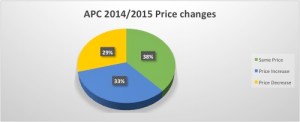
From 2014 – 2015 on a per-title basis there was a fairly even 3-way split between journals that retained the same price, increased or decreased their price.

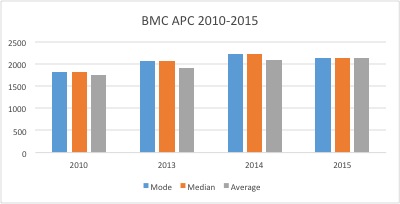
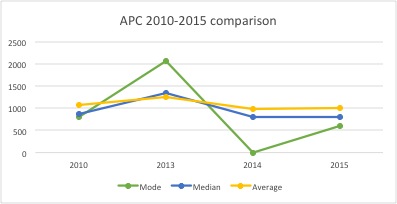
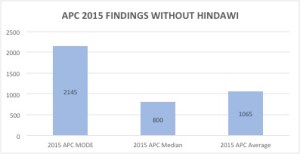
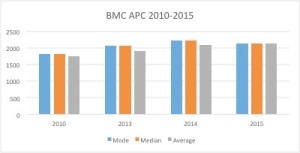
Different publishers show different tendencies. Hindawi, the largest OA publisher by number of journals, has such an 2015apcnohindawiimpact we are beginning to call this the “Hindawi factor”. In 2015, the overall mode (most common price) is $800, while the mode without Hindawi is $2,145. The following two charts illustrate the variation in pricing tendencies from 2010 – 2015 for the two largest OA APC publishers, Hindawi and BMC, reflecting the differences in approach to pricing for these publishers over the same time frame.
hindawi 20102015 BMC20102015 APC 2010 to 2015

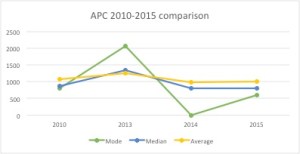
The above chart shows a relatively steady average and median in contrast with a varying mode (most common price) from 2010 – 2015.

It is important to note that the samples are not entirely comparable. Notably, to facilitate the longitudinal study we have not included new publishers listed in DOAJ as of 2015. This is an important limitation. For example,  DeGruyter, not present in 2014, is the 3rd largest DOAJ publisher in 2015. The following details illustrate that the average cost-to-publish in a fully OA journal with publication fees in 2015 varies from about $250 USD to $2,145 USD, depending on the measure and particular sample of journals selected.

Details

Range: $0 – $4,500

$0 APC = journals has APCs but currently price is $0. Most commonly this is used by journals that are “free for now” until more content is added.

Average (mean) Median Mode Standard deviation
Preliminary sample (all) 1,051


800 800 795
Preliminary sample (weighted) 858
Preliminary sample (excluding $0 APC) 1114
Preliminary sample (excluding $0 APC) weighted 1370

Preliminary sample: includes the 1,363 journals sampled in 2010, 2013 and/or 2014 confirmed as using APCs (excluding journals using APPC but not APC). APC of $0 (journals for which APC method is confirmed but no current charges, e.g. “free for now” approach) are included unless otherwise specified. The weighted figures adjust by a sampling factor designed to give added weight to journals from categories with lower rates of sampling, journals by publishers with less than 10 journals using APCs.

Full sample: 1,999 journals including preliminary sample plus additional journals sampled from publisher’s website.

Average (mean) Median Mode
All 998


800 600
Weighted 866
Excluding $0 APC 1,077


Excluding $0 APC) weighted 1,034


See above for description of “weighted”.

More details will be posted as our data analysis continues.

Cite as:

Morrison, H., & Salhab, J. (2015). OA APC preliminary data 2015: Range, central tendencies and preliminary longitudinal analysis. Sustaining the Knowledge Commons / Soutenir Les Savoirs Communs. Retrieved from https://sustainingknowledgecommons.org/2015/12/03/oa-apc-preliminary-data-2015-range-central-tendencies-and-preliminary-longitudinal-analysis/
The mythical OA article processing charge

The purpose of this post is to provide some important context for understanding OA publication charges. A key point that I would like to highlight is that the OA APC, in the sense of a single number charged for each article published, is a myth. It is important to understand this because  OA journals are obviously conducting some real-world experiments that have the potential for beneficial results for high-quality, sustainable open access publishing, and providing discounts that may be needed by some authors and OA APC payers.

Pricing is often tailored to reflect the work involved in publishing an article. A well-written article that is submitted in good shape with little need for language editing or copyediting with camera-ready graphics is less work to publish – this should, and sometimes does, cost less. There are a variety of discounts reflecting contributions to the journal community; discounts for editors, reviewers, society or association members, loyalty discounts for repeat authors. Details about variations on APC pricing can be found in these posts by Guinsly Mondésir (Version en français / English version).

The “average” cost to pay-to-publish an article in a fully open access journal that we found in 2015 (ignoring $0 APC) ranges from an estimated $250 USD for a journal using OA page charges based on an estimate of 9 pages, to a fairly consistent median of $800, modes of $600 to $800, to averages or median numbers from $858 (weighting results to include smaller publishers) to the overall average of $998 to $1,370 for the same set of journals excluding $0 to a mode of $2,154 after removing the “Hindawi factor” (The practices of this largest OA publisher by number of journals skews the sample).

Even this wide range of “averages” conceals the full complexity involved with deciphering publisher pricing and with translating currencies into USD. A set of prices, gathered on the same date in 2015, would yield different averages if the currency calculation were conducted on a different date. In gathering the data we had to make many tough decisions about the “original” currency, because a number of publishers provide pricing in several different currencies. It is harder than one might think to decide on which is the “real” price, for example when differential pricing is provided based on the author’s location. Having a single APC would be simpler, but not necessarily better if it means a loss of a discount for authors or payers who could really use them or if it eliminates an incentive to streamline the process of publishing itself in the process of transition to OA.

With this important caveat we will now present our preliminary quantitative analysis of this mythical variable here.

Morrison, H. (2015). The mythical OA article processing charge. Sustaining the Knowledge Commons / Soutenir Les Savoirs Communs. Retrieved from https://sustainingknowledgecommons.org/2015/12/03/the-mythical-oa-article-processing-charge/


Variations in pricing of the article processing charges

Version en français (French version)

From the datasets downloaded from the Directory of Open Access Journal, we did some analysis. We found that among the journals that do offer article processing charges (APC), 87 % of them offer variations. So that the APC that the author expects to pay could be higher or lower. Those fluctuations depend on many factors. For example an article that requires language editing would have higher APC and if the author comes from a low/medium income countries then the APC will decrease. The table one shows the percentage of journals offering variations in pricing. The table 2 shows the list of the most frequent factors that contribute to APC variations.

Table 1. Percentage of journals offering variations in pricing (2015).

variations

Table 2. Frequency of sub-types of variations.

table2

Please note that we did not count every variation found. For example, variations likely based on simultaneous print versions of journals such as colour charges were not capture.

Cite as: Mondésir, G. (2015). Variations in pricing of the article processing charges. Sustaining the Knowledge Commons / Soutenir Les Savoirs Communs. Retrieved from https://sustainingknowledgecommons.org/2015/12/03/variations-in-pricing-of-the-article-processing-charges/

Variation dans les frais de publications de l’article

Version en anglais (English version)

Nous avons analysé la liste de journaux en libre accès téléchargé du site internet du répertoire des revues en libre accès (DOAJ). Nos résultats nous démontrent que parmi les journaux qui adoptent comme modèle d’affaire la méthode de frais de publication de l’article, 87 % de ces journaux offrent une variation des frais de publication. Cela signifie que les frais que l’auteur s’attende à payer peuvent augmenter ou diminuer. Les frais supplémentaires peuvent être dû pour plusieurs raisons. Par exemple, il peut y avoit une charge additionnelle si le nombre de page excéde la limite fixée par l’éditeur. De la même manière plusieurs raisons peuvent expliquer une réduction des frais de publication de l’auteur. Par exemple, l’auteur a utilisé le gabarit de l’éditeur pour rédiger son article. Le tableau 1 montre le pourcentage de journaux dont les frais de publication de l’article peuvent varier. L’année dernière des résultats semblables ont été publiés dans cet article.

Table 1. Pourcentage de journaux ayant de frais de publication avec des variations.

variations

Table 2. Les différentes sortes de variations dans les frais de publication.

table2


Nous n’avons pas compté tous les types de variations. Par exemple, les frais de publication qui semble d’être plus pertinente aux versions imprimé (frais de couleurs) sont omis ici.


Citation:

Mondésir, G. (2015). Variation dans les frais de publications de l’article. Sustaining the Knowledge Commons / Soutenir Les Savoirs Communs. Retrieved from https://sustainingknowledgecommons.org/2015/12/03/variation-dans-les-frais-de-publications-de-larticle/


Current status of OA APC journals sampled 2010 – 2014

Update and correction December 2019: this early analysis did not take into account publishers and journals that had been removed prior to the beginning of our SKC APC longitudinal study. In 2019, we completed the sample by adding these journals to obtain a more complete picture of the status and APC changes. In brief, from 2010 – 2019 there was an apparent substantial attribution rate of 26%, however this appears to be an anomaly reflecting several new commercial APC based publishers (Bentham Open, Hindawi, Frontiers, BioMedCentral, and Dove Medical Press) that followed a start-up strategy of starting with a large number of journals to cover a broad range of disciplines, then retiring titles that were not successful. For the latest analysis of the 2010 dataset, see:

Morrison, H. (2019). 2010 – 2019 APC update. Sustaining the Knowledge Commons. Retrieved from https://sustainingknowledgecommons.org/2019/11/26/2010-2019-apc-update/


Analysis of the current status of journals sampled in 2010 (by Solomon & Björk) and/or by the SKC team in 2013 or 2014. In brief: the attrition rate for journals previously sampled is quite low, with 2% of the 1,559 titles previously sampled either apparently or actually no longer publishing. Most of the journals no longer active (34 of the 37), not surprisingly, are from the 2010 sampling. The vast majority of journals found to have APCs or APPCs (article page processing charges), over 90%, clearly had APCs in 2015. A noticeable number of journals previously identified as having publication charges either do not have publication charges, or cannot be confirmed as having publication charges today. The following chart and table provide additional detail. For more detail and documentation on how this data is calculated, see the open access article processing charges dataverse – under the Open access article processing charges longitudinal study 2015 preliminary dataset the data file is called DataSet – Main v.12 current status of previously sampled journals.csv and the accompanying documentation PDF file is called OA APC study 2015 current status journals samples 2010 – 2014 documentation .pdf

current status of journals sampled 2010 - 2014


Current status of preliminary sample journals (sampled in 2010, 2013, or 2014)
Category Total (numeric) Total (percentage) * 2010 numeric 2010 percentage
Confirmed publication charges 1,425 91% 828 95%
Confirmed no publication fees 51 3% 1 0%
Title no longer published 37 2% 34 4%
No cost found 35 2% 7 1%
Other 11 1% 4 0%
Total 1,559 100% 874 100%
* Note total adds up to 99%, not 100% due to rounding error


Citation: if referring to updated information on the 2010 dataset, please see and cite the 2019 post, not this one which will be retained for historical purposes:

Morrison, H. (2019). 2010 – 2019 APC update. Sustaining the Knowledge Commons. Retrieved from https://sustainingknowledgecommons.org/2019/11/26/2010-2019-apc-update/

To cite this post (e.g. to note correction or for purposes of teaching research methods): Morrison, H. (2015). Current status of OA APC journals sampled 2010 – 2014. Sustaining the Knowledge Commons / Soutenir Les Savoirs Communs. Retrieved from https://sustainingknowledgecommons.org/2015/11/26/current-status-of-oa-apc-journals-sampled-2010-2014/

Open access article processing charges longitudinal study: 2015 preliminary dataset

We’ve been busy gathering data from publisher websites and other sources since mid-May this year. Our recent check of the top publishers in DOAJ by number of journals illustrates that there is so much change in this area that it’s going to take a while longer to complete this data. In future we’re not even going to attempt a short-term annual census period, rather pursue the gathering of data on an ongoing basis which will permit richer publisher case studies along the way. In the meantime, if anyone can make use of the 2,286 journals that we gathered APC data for or the 103 journals that we gathered article page processing charges for, this plus all the other data we have gathered from various sources, as well as detailed documentation is now available in the OA APC dataverse: http://dataverse.scholarsportal.info/dvn/dv/oaapc/faces/study/StudyPage.xhtml?globalId=hdl:10864/11269&studyListingIndex=2_dc438dc55e8a1e8d291f4fad61a9

We hope this is useful. Informal peer review (please check the documentation for the many limitations to this dataset already noted) in the form of comments to this post are most welcome. We will continue with data gathering and analysis so watch for further posts.

Cite as: Morrison, H. (2015). Open access article processing charges longitudinal study: 2015 preliminary dataset. Sustaining the Knowledge Commons / Soutenir Les Savoirs Communs. Retrieved from https://sustainingknowledgecommons.org/2015/11/12/open-access-article-processing-charges-longitudinal-study-2015-preliminary-dataset/

Top 10 publishers in DOAJ (by number of titles) 2014 to 2015

by Heather Morrison & Guinsly Mondésir

There have been a few changes in the collection of fully open access journals listed in the Directory of Open Access Journals in the past year, as demonstrated by the following chart. While Hindawi and BioMedCentral remain the largest publishers (by number of journals, not number of articles), traditional publisher De Gruyter has gone from no titles in DOAJ in 2014 to 3rd largest DOAJ publisher and Elsevier is now the 7th largest DOAJ publisher by number of journals. Figures are based on an analysis of publisher by size drawn by DOAJ metadata downloaded in May 2014 and May 2015. Full data is available in the OA APC dataverse

Note that publisher size by title offerings is different from publisher size by number of articles published, which is outside the scope of our study. The percentage of journals in DOAJ published by the top 10 publishers has increased slightly, from 14% to 16%. This is likely not a significant difference, but perhaps an indication of a trend to watch. Note that we have made no attempt to correct for variations in publisher name listings; we recommend instead that publishers update their information in DOAJ and ensure correct entry for future research and researchers.

Publisher Frequency_2014 Publisher Frequency_2015
Hindawi Publishing Corporation 438 Hindawi Publishing Corporation 539
BioMed Central 238 BioMed Central 271
Scientific Research Publishing 119 De Gruyter Open 212
Bentham open 99 MDPI AG 121
MDPI AG 95 Springer 108
Springer 95 Dove Medical Press 105
Dove Medical Press 91 Bentham open 81
Medknow Publications 80 Medknow Publications 78
Libertas Academica 49 Elsevier 72
PAGEPress Publications 47 Libertas Academica 56
Total top 10 publishers 1,351 1,643
DOAJ total 9,709 10,532
% published by top 10 14% 16%


Update: This article influenced two articles Reblog: Top 10 publishers in DOAJ (by number of titles) 2014 to 2015 and DE GRUYTER – Traditional Scholarly Publisher’s Shift Towards Open Access. The Facts Behind the Numbers

Cite as:

Morrison, H., & Mondésir, G. (2015). Top 10 publishers in DOAJ (by number of titles) 2014 to 2015. Sustaining the Knowledge Commons / Soutenir Les Savoirs Communs. Retrieved from https://sustainingknowledgecommons.org/2015/10/22/top-10-publishers-in-doaj-by-number-of-titles-2014-to-2015/