How a flat APC with no price increase for 3 years can be a 6% – 77% price increase

by Jihane Salhab and Heather Morrison

The purpose of this post is to explain the impact of currency differences on article processing charges. Over the past few years megajournal PLOS ONE has been a good model in at least one way, maintaining the APC of $1,350 USD with no price increase over several years. However, if you happen to be paying in Euros, the PLOS ONE APC rose 14% from March to December of 2014, or 23% from March 20, 2014 to March 20, 2015. In South Africa, the price increased 58% in the same 3-year period; in Brazil, the price increase was 77%. Click on the following link to view the PLOS ONE price rises from March to December 2014 and from March 2012 to March 2015 in 8 currencies.

The PLOS ONE APC 8 curr

Any scholarly publishing system that involves cross-border payments, whether demand side (subscriptions / payments) or supply side (APC, journal hosting or other production services) has this disadvantage of pricing variability almost everywhere. In this case, US payers benefit from the flat fee, but anytime an APC is paid for a US scholar publishing in an international venue the same pricing variations based on currency will apply. In contrast, any scholarly publishing system that involves local payments (e.g. hosting of local journals, paying local copyeditors and proofreaders) has the advantage of relative pricing stability that comes with paying in the local currency.

This post is part of the open access article processing charges project.

Cite as:

Salhab, J., & Morrison, H. (2015). How a flat APC with no price increase for 3 years can be a 6% – 77% price increase. Sustaining the Knowledge Commons / Soutenir Les Savoirs Communs. Retrieved from https://sustainingknowledgecommons.org/2015/05/13/how-a-flat-apc-with-no-price-increase-for-3-years-can-be-a-6-77-price-increase/

Market Economy and Social reality – A pragmatic view from a well known author

The pragmatics of having a market economy deal with social realities are highlighted in an interview with award winning author David Simon. Link to article including the interview: http://www.theguardian.com/world/2013/may/25/the-wire-creator-us-drug-laws

Why we need more than market economy theory to understand social stability.

Without commenting on David Simon’s conclusions on the American war on drugs, this interview highlights the importance of understanding social realities from a holist perspective. This has the effect of trying to identify little known influences on social reality. Knowledge commonly available through media outlets or public discourse does not necessarily shed light on the full consequences of using a market economy to regulate social interactions.

The critical view of Simon, seeing the war on drugs thrive along the poverty line, can be appreciated as a description of a reality where a segment of the American population has distanced itself from another. This distancing could be read as a consequence of criminal activity if Simon did not reverse this perception and present it with brutal pragmatism. Simon talks about how American society is splitting itself with the criminalization of the only working opportunity available to pockets of people left behind after the golden days of the American middle class.

We can see why, for Simon and political economists such as Karl Polanyi long before him, a market economy cannot be relied upon for social stability and in fact erodes the social fabric. Morality, as Simon describes it in the American context, is the expression of rejection from one group to another and I would argue, sign of the absence of moral obligation between those groups, that is, between two groups where one could be said to be privileged in relation to the other. In addition, a “pure form” of capitalism, says Simon, does not exist nor solve those issues.

Needless to say the marginalization and repression of a group by another is an all too common occurrence. What Simon does is to awaken the listener to the need to question market economy solutions to social problems. The lessons of this awakening are yet to come in his opinion, as the current system has not yet reached a point where the people has had enough. This was two years ago. Current events in Baltimore and elsewhere lead me to think we North Americans are living a sudden awakening to underlying social tensions in part resulting from market logics applied to social reality.

Questioning the free market notion is nothing new. On this blog, and in a recent publication (http://www.mdpi.com/2304-6775/3/1/1), the Sustaining Knowledge Commons team explores various Open access alternatives to the current publication system. By researching a transition of published scholarly works to a knowledge commons, the project may help avoid some of the pitfalls of a market economy for scholarly works such as the enclosure of knowledge or a segmented participation to the public good due to prohibitive publication costs.

Cite as:

Calvé-Genest, A. (2015). Market Economy and Social reality – A pragmatic view from a well known author. Sustaining the Knowledge Commons / Soutenir Les Savoirs Communs. Retrieved from https://sustainingknowledgecommons.org/2015/05/13/market-economy-and-social-reality-a-pragmatic-view-from-a-well-known-author/

Subject classification of DOAJ journals – data and documentation

Data for the subject classification of DOAJ journals is now available in the OA APC dataverse:

Morrison, Heather; Villamizar, César; Mondésir, Guinsly; Calvé-Genest, Alexis, 2019, “OA APC – Subject Analysis – Statistic Frequency & Coding”, https://doi.org/10.5683/SP2/4WKTZF, Scholars Portal Dataverse, V1

Documentation of the dataset:

Documentation – Subject Classification – OA APC – V1.3

Presentation of results:

Morrison, H., Villamizar, C., Salhab, J., & Calvé-Genest, A. (2015). Open access APC subject, content and impact factor correlational study. Presented at the Canadian Association of Information Studies annual conference, Ottawa, ON, Canada. Retrieved from https://ruor.uottawa.ca/handle/10393/32440

Cite as:

Villamizar, C., Mondésir, G., Calvé-Genest, A., & Morrison, Heather. (2015). Edit Post ‹ Sustaining the Knowledge Commons / Soutenir les savoirs communs. Sustaining the Knowledge Commons / Soutenir Les Savoirs Communs. Retrieved from https://wordpress.com/post/sustainingknowledgecommons.org/334


L’économie du don

par Alexis Calvé-Genest & Heather Morrison (English)

Y a-t-il d’autres modes d’échange que l’échange marchand? Surestimons-nous la place de ces échanges lorsque nous tentons de jeter un regard sur la nature des transactions humaines? Si tel est le cas, quelques leçons peuvent-elles en être tirées aux fins de soutenir un projet de savoirs communs?

Il y a près de cent ans déjà, ce questionnement faisait l’objet d’un texte qui a depuis été pour ainsi dire redécouvert par les anthropologues et autres intéressés de la question humaine. Bien entendu, ce texte est au fondement d’une question beaucoup plus large sur la nature humaine que nous éviterons ici. Retenons cependant la possibilité que les échanges humains soient empreints d’une qualité qui perdure après que l’échange soit conclu, que cet échange soit entre groupes ou individus. En sommes, retenons l’idée de réciprocité dans les échanges par contraste à un échange fini où les parties impliquées se doivent d’en rester sur leurs gains.

Un échange basé sur le don, tel que conçu par Marcel Mauss il y a déjà très longtemps, implique une obligation morale, sociale, qui établit un enchevêtrement de relations entre groupes et individus intéressés sans pour autant paraître obligatoire. Cette relation en est une de prestige et de rivalité et elle sous-tend les échanges en société de manière universelle, tel que tente de le concevoir Mauss en 1924. Sans pour autant nier l’échange marchand, Mauss le pose comme superficiel à un type de transaction qui lui, est plus répandu dans toutes les sociétés de son temps, y compris celles du passé. Évidemment, nous faisons ici un bon en avant en posant que cela n’a que peu changé depuis son analyse quasi centenaire.

L’obligation de donner, de recevoir et de redonner est à la base de son économie du don, pour ainsi dire. En rivalisant par le don, les groupes et individus créent des liens et les renforcent sous peine de mort, si ce n’est que symbolique. Rappelons que la perception des anthropologues étudiant les sociétés dites primitives (qui ne le sont pas du tout d’ailleurs) est que l’accumulation y est bien malvenue. Le principe de la redistribution y règne et les cérémonies et événements du type potlatch, sur lesquels Mauss se base pour conceptualiser un système d’échange basé sur le don socialement obligé, sont des phénomènes cruciaux pour comprendre la cohésion sociale des groupes et leurs relations à autrui.

Si l’on considère que Mauss a mis le doigt sur un rouage important des échanges humains nous nous devons alors de considérer les notions de rivalité de prestige et d’obligations sociales comme parties prenantes de toute compréhension des transactions humaines qui dépassent le simple troc ou l’échange marchand. Il en va de même si l’on veut changer la nature d’une transaction humaine ou en créer de plus soutenables, réciproques, juste.

Est-ce que la théorie de l’économie du don peut s’appliquer à l’érudition? Prenons en considération le réseau international des établissements et des dépôts institutionnels, il y en a plus de 2600 répertoriés sur OpenDOAR http://opendoar.org/, et les plus de 72 millions de documents érudits qui furent légués de par le monde par les dépôts répertoriés par le Bielefeld Academic Search Engine http://www.base-search.net/about/en/index.php.

Chaque érudit fait don de son propre travail – un article, un livre, un ensemble de données – sans s’attendre à un retour sur investissement immédiat, mais plutôt avec l’espoir d’avoir un impact sur leur discipline ou une autre, de voir des contributions d’autres chercheurs à leurs travaux et de les voir reconnus comme apport à un savoir humanitaire collectif. Cela satisfait l’obligation de donner. D’autre lisent et utiliser ces dons, qui peuvent être applaudis et appréciés, ou tournée en dérision et critiqués. Peu importe ; ces actions satisfont l’obligation de recevoir. La réception du don contient avec elle l’obligation morale et sociale d’ajouter au don et de partager son travail, pas avec le donateur original, mais plutôt avec le monde entier ; c’est l’obligation subséquente de donner (ou redonner). Comme le potlatch, le prestige s’accroit au donateur des meilleurs dons. Ce n’est pas un troc direct, mais plutôt un réseau mondial de donateurs et de donataires qui ressemble beaucoup aux bases d’une économie du don émergente dans le monde de l’érudition.

Référence

Mauss, M. (1924, 2002 version numérique). Essai sur le don. Forme et raison de l’échange dans les sociétés primitives. Disponible via Les Classiques des sciences sociales http://dx.doi.org/doi:10.1522/cla.mam.ess3

Calvé-Genest, A., & Morrison, H. (2015). L’économie du don. Sustaining the Knowledge Commons / Soutenir Les Savoirs Communs. Retrieved from https://sustainingknowledgecommons.org/2015/04/28/leconomie-du-don/

The gift economy

by Alexis Calvé-Genest & Heather Morrison (Français)

Are there other modes of exchange besides the market? Are we overestimating the place of market exchange when we look at the nature of human transactions? If so, are there lessons to be learned concerning possible approaches to sustaining the knowledge commons?

It has been almost a hundred years since this question has been considered and reconsidered by anthropologists and others since the publication of Mauss’ seminal work The Gift (free version at Internet Archive here: https://archive.org/details/giftformsfunctio00maus). The focus of this work is a much bigger question about human nature than we can address in this post. However, let’s consider the possibility that human exchange includes the possibility of a quality that lasts long after the exchange is concluded, whether the exchange is between groups or individuals. Let’s consider the principle of reciprocity and in contrast with the one-time market exchange.

The gift economy as conceived by Mauss nearly a century ago, based on empirical anthropological studies of actual human societies, contemporary and ancient, involves moral and social obligations that creates a bond between groups and individuals without necessarily being obligatory obligations.

Without denying the importance of market exchange, Mauss presents this as superficial in comparison with the gift economy that has pervaded human societies since ancient times. We argue that the gift economy is every bit as relevant today. At the heart of the gift economy are the obligations to give, receive, and give again. Rivalries in giving both create and reinforce social bonds. Remember that in most societies, hoarding is not well received; redistribution, often through ceremonies such as the potlatch, is the norm. Perhaps by studying the gift economy we can work towards both scholarship and societies that are more sustainable, reciprocal, and just.

Can the theory of the gift economy be applied to scholarship? Consider the worldwide network of institutional and disciplinary repositories, the over 2,600 repositories listed in OpenDOAR http://opendoar.org/, the more than 72 million documents scholars have gifted to the world through the repositories indexed by the Bielefeld Academic Search Engine http://www.base-search.net/about/en/index.php

Each scholar gifts their own work – an article, a book, a dataset – with no expectation of immediate rewards in return, rather the hope of having an impact, having their work built upon by others and recognized as a contribution to the collective knowledge of humankind. This fulfills the obligation to give. Others read and use these gifts, which may be met with applause and appreciation, or derision and critique. No matter; either one fulfills the obligation to receive. The receipt of a gift carries with it a social and moral obligation to build on the gift and share one’s own work, not with the original gift-giver but rather with the whole world; this is the downstream obligation to give (or re-give). Like the potlatch, prestige accrues to the giver of the best gifts. This is not one-time barter, rather a worldwide network of givers and receivers that looks a lot like the basis of an emerging global gift economy in scholarship.

Reference

Mauss, M. (1924, 1966 english ed.). The gift. London: Cohen & West. Available via Internet Archive at https://archive.org/details/giftformsfunctio00maus

Cite as:

Calvé-Genest, A., & Morrison, H. (2015). The gift economy. Sustaining the Knowledge Commons / Soutenir Les Savoirs Communs. Retrieved from https://sustainingknowledgecommons.org/2015/04/28/the-gift-economy/

Who is served by for-profit gold open access publishing? A case study of Hindawi and Egypt

by: Jihane Salhab and Heather Morrison

Abstract

The highly successful Egypt-based open access publisher Hindawi is presented as a model of quality publishing and commercial success. However, this success is not accompanied by obvious benefits to Egypt’s own research and researchers. Even in the best-case scenario for academics in Egypt’s public university system, it would take three month’s salary for a full professor to pay the $1,500 USD OA APC of Hindawi’s high-end Disease Markers. Egypt’s largest public university, Cairo University, has no institutional repository. Fortunately for Egyptian researchers, there are open access journals that do not charge APCs, and not all open access repositories are institutional repositories. Open access may not be the most salient issue for Egyptian researchers at any rate. It is not clear that the pre-revolutionary state interference with research detailed in a 2005 Human Rights Watch report has been resolved, and the need to take on other work due to low salaries leaves many academics with little to no time to do research. In this instance, commercial success is not correlated with social benefit.

Details

Hindawi is an open access commercial publishing success story and an Egyptian business success story. Hindawi Publishing Corporation was founded by Ahmed Hindawi who, in an interview with Richard Poynder conducted in September 2012, confirmed a revenue of millions of dollars from APCs alone – a $3.3 net profit on $12 million in revenue, a 28% profit rate (Poynder, 2012). Hindawi is highly respected in open access publishing circles, and was an early leader in establishing the Open Access Scholarly Publishers’ Association (OASPA), an organization that takes quality in publishing seriously.

However, it seems highly unlikely that Egyptian researchers could afford to publish in the larger Hindawi journals. It would take three months’ salary for a full professor in today’s public university system to pay the $1,500 USD APC of Hindawi’s Disease Markers; this would take six months’ salary for a lecturer. This is the best-case scenario, assuming a university that has been able to implement the raise for academics decreed by Morsi in July 2012 to 3500 EGY monthly for a full professor ($579 USD) (1).

In addition to the financial factor, years of the pre-revolution regime’s interference with research subjects and methods formed a stagnant nature of contemporary scholarship where “the state restricts who can research what and severely punishes those who overstep their bounds” (Human Rights Watch, 46). Though there is a slight improvement after the revolution, still “economic, political, and physical insecurity in the country make it very difficult for serious changes to be made” (El-Awady, 2013).

There are other options for Egyptian researchers: the vast majority of open access journals do not charge article processing fees (Morrison et. al., 2015), there are subject as well as institutional open access repositories, and Egyptian researchers can read open access works of others. Still it might be reasonable to ask whether the most appropriate route to “open” in the short-term for researchers in Egypt involves opening up time to do the research through adequate salaries and opening up freedom to conduct and share research by building support for intellectual and academic freedom.

Note

1. In July 2012, more than a year after the revolution that ousted the Mubarak regime, elected president Morsi issued decree 84, amending the wages for academics that had not been changed since 1972. Published on July 14th in the Egyptian Official Journal (issue 28), Decree 84 (translated from Arabic by Jihane Salhab). lists the amendments of academics’ monthly wages as follows: 3500 EGY ($579 US) for professors, 3000 EGY ($497 US) for associate professors, 2500 EGY ($414 US) for lecturers, 1500 EGY ($248 US) for assistant lecturers and 1000EGY ($165 US) for teaching assistants respectively (using XE currency converter for that same date at a rate of $1=6.045 EGY). That raise was supposed to be only the first phase, but in February 2013 Egyptian minister of higher education Mas’ad confirmed in a statement that no other phases would follow (Bedewi, 2013).

References

Bedewi, M. (24 February 2013). Higher education: the country cannot endure the second phase of ‘academic wages.’ Al-Youm Al-Sabe’ [In Arabic]. Retrieved on 10 April 2015.

El-Awady, Nadia. (8 June 2013). Higher education still suffering after the revolution. University World News. Retrieved March 28, 2015 from http://www.universityworldnews.com/article.php?story=20130606161959301

Human Rights Watch (2005). Reading between the “Red Lines”: the repression of academic freedom in Egyptian universities. Human Rights Watch, 17(6): 1-109. Retrieved February 17, 2015 from http://www.hrw.org/reports/2005/egypt0605/egypt0605.pdf

Morrison H, Salhab J, Calvé-Genest A, Horava T (2015). Open Access Article Processing Charges: DOAJ Survey May 2014. Publications 3(1):1-16. Retrieved April 10, 2015 from http://www.mdpi.com/2304-6775/3/1/1

Poynder, R. (2012).The OA interviews: Ahmed Hindawi, founder of Hindawi Publishing Corporation. Retrieved March 10, 2015 from http://www.richardpoynder.co.uk/Hindawi_Interview.pdf

This post is the first in a series analyzing the actual or potential impact of APCs.

Cite as:

Salhab, J., & Morrison, H. (2015). Who is served by for-profit gold open access publishing? A case study of Hindawi and Egypt. Sustaining the Knowledge Commons / Soutenir Les Savoirs Communs. Retrieved from https://sustainingknowledgecommons.org/2015/04/10/who-is-served-by-for-profit-gold-open-access-publishing-a-case-study-of-hindawi-and-egypt/


How to download and work with DOAJ journal metadata without messing up the characters in the journal titles and publisher names.

Background: the file containing the sample for May 2014 has incorrect characters which are very difficult to fix because we did not contemplate how to download and open the csv files in the right way.

These are the most important steps to download and work with DOAJ journal metadata without messing up the characters in the journal titles and publisher names:

  • Go to DOAJ and download metadata
  • Save the CSV file on your computer WITHOUT opening it
  • If you’re using a spreadsheet package, first open the application (e.g. Excel or LibreOffice Calc) and then IMPORT the CSV file into the application.

The following is one example of how you can import and work with the file without messing up the characters using Excel 2013.

  • Open Excel and click on the “Data” menu option.
  • Click on the “From Text” icon.
  • Browse the location of the CSV file, and then click on the “Import” button.
  • The Text Import Wizard will prompt, showing Step 1 of 3.
  • Choose “Delimited” on data type.
  • Select the character set as “65001: Unicode (UTF-8)”
  • Click on the “Next” button to display Step 2 of 3.
  • Select the “Comma” character.
  • Click on the Next button to display Step 3 of 3.
  • Choose the appropriate data format for each column
  • Click on the “Finish” button to complete importing your data into MS Excel.
  • Save the file in MS Excel format WITH ANOTHER NAME, ensuring that you preserve a copy of the original CSV file for further verifications.

If you use open software like LibreOffice Calc, you can import and work with the file and save it again without messing up the characters using Excel 2013.

Import file into LibreOffice Calc.

  • Open the application (LibreOffice Calc).
  • Click on “File – Open”.
  • Browse the location of the CSV file and click on the “Open” button.
  • An import file dialog box will prompt
  • Select the character set “Unicode (UTF-8)”
  • On the Separator Options, select “Comma”
  • Choose the appropriate data format for each column
  • Click on the “Finish” button to complete importing your data into LibreOffice Calc.
  • Save the file in LibreOffice Calc format, WITH ANOTHER NAME, ensuring that you preserve a copy of the original CSV file

Now you can work and modify the file, adding more information if needed using any spreadsheet software. However, if you work with Excel and need to save the file again in CSV format, you need to follow another process or you end up messing up the characters in the journal titles and publisher names, or special characters added in another columns.

The easiest way to do this is to follow these steps:

  • Open the Excel file using LibreOffice Calc
  • Choose File – Save as – Text CSV
  • An export file dialog box will prompt
  • Select the character set “Unicode (UTF-8)” and click Ok

If you know other methods or alternatives, please share them with us.

Cite as: Villamizar, C. (2015). How to download and work with DOAJ journal metadata without messing up the characters in the journal titles and publisher names. Sustaining the Knowledge Commons / Soutenir Les Savoirs Communs. Retrieved from https://sustainingknowledgecommons.org/2015/03/12/how-to-download-and-work-with-doaj-journal-metadata-without-messing-up-the-characters-in-the-journal-titles-and-publisher-names/

Sustaining the Knowledge Commons team at CASRAI Reconnect 2014

IMG_0876

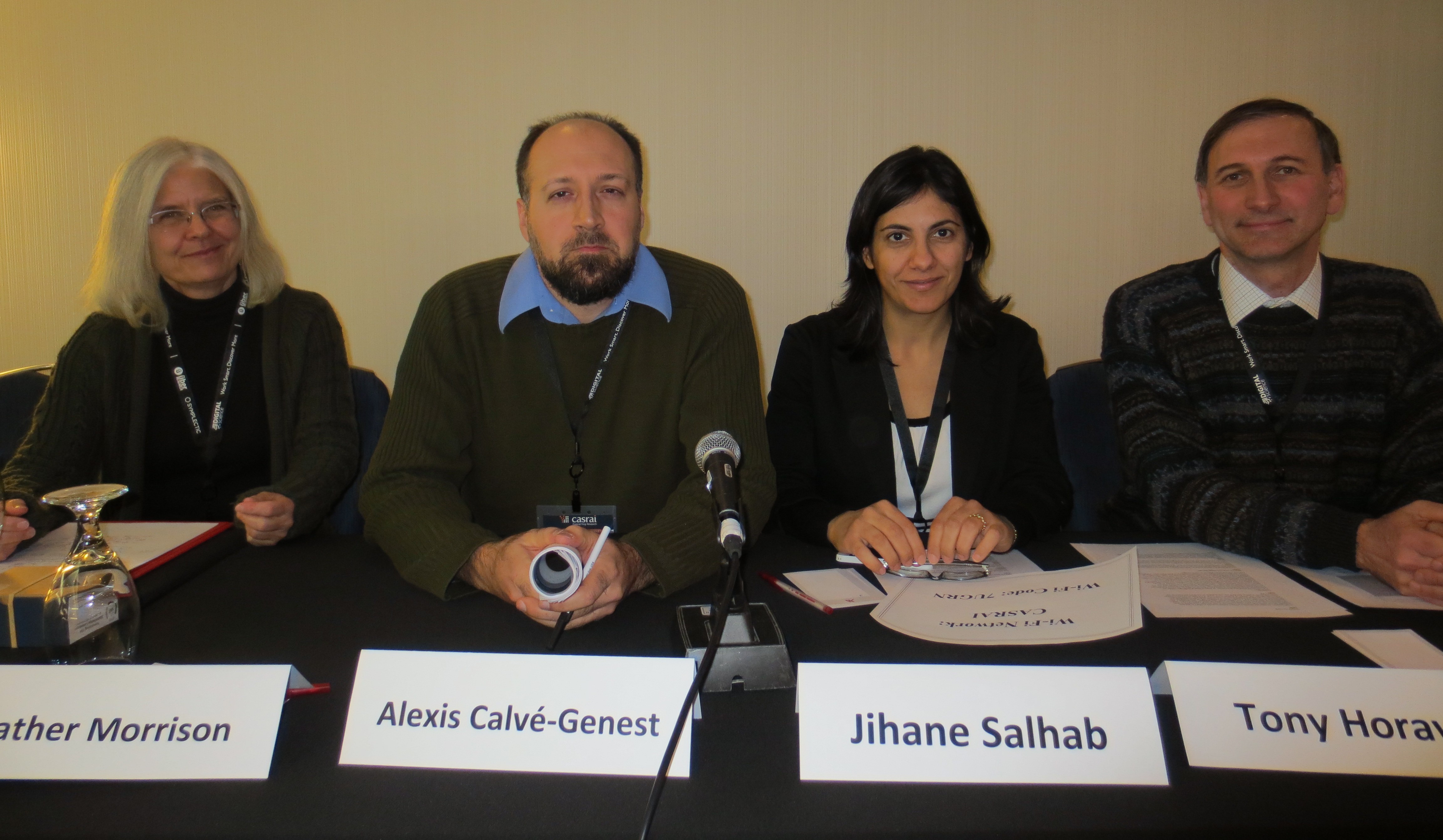
The Sustaining the Knowledge Commons Team (left to right Heather Morrison, Alexis Calvé-Genest, Jihane Salhab and Tony Horava) presenting at the CASRAI Reconnect conference in Ottawa, Nov. 20, 2014. Click the link below to view the team’s presentation in PDF. The uO Recherche (IR) link can be found in the citation.

CASRAISKC20141118

Cite as:

Morrison, H., Calvé-Genest, A., & Salhab, J. (2014, November). Sustaining the knowledge commons: Open access scholarship. Presented at the CASRAI reconnect, Ottawa, ON, Canada. Retrieved from http://ruor.uottawa.ca/handle/10393/32314

Copernicus Publications: when length of articles and choice of templates matter

Copernicus Open Access publishing requires the author or a supporting institution to pay the Article Page Processing Charges (APPC). These cover the cost of the review process, typesetting, web publication and long term archiving, upon publication. Copernicus also gives the author the choice of customization, using a complex system for calculating its APPCs based on the number of pages published and the format of the material submitted. As Copernicus puts it, “authors can directly influence the price of the publication.”
Accordingly, what makes the financing models at Copernicus variant and flexible are charges that are based on article length and sources files (Word/LaTeX). For example, publishing a 10 page article (without calculating the additional tax) in Atmospheric Chemistry and Physics could vary from €792 when using the publisher’s LaTeX template, to €1122 when using a different LaTeX template. Another option might be to use the publisher’s Word template and pay €957, or else pay €1287 when using another Word template. Surely, there is always the author’s choice between the publisher’s LaTeX and Word templates; i.e. between paying €792 or €957 respectively. Of course, fewer pages would cost the author even less.
In addition, Copernicus Publications provides several agreements where settlement of payments can be done directly between the publisher and the respective institution, given that members of those institutions opt to use Copernicus’s templates. For example, members of ETH Zurich, do not pay any publication fees for any of Copernicus’s journals if they use their LaTex or Word template. However, if an author does not use one of these templates, Copernicus will charge the difference to the author.
As to authors who lack financial support, Copernicus waivers policy provides another way to lower the price as they can benefit from the budget of free pages which is assigned by the chief editor of each journal.

Cite as:

Salhab, J. (2014). Copernicus Publications: When length of articles and choice of templates matter. Sustaining the Knowledge Commons / Soutenir Les Savoirs Communs. Retrieved from https://sustainingknowledgecommons.org/2014/10/23/copernicus-publications-when-length-of-articles-and-choice-of-templates-matter/

Characteristics of a enduring Common Pool Resource (CPR)

If a common pool resource framework is applicable to a knowledge commons, how simple is it to set up? We need to know the basic ground rules of a CPR first. And here they are.

Seven characteristics and an eight one, in more complex cases, are generally considered to constitute a CPR. As constructed through inductive research by Nobel laureate Elinor Ostrom and colleagues, these characteristics are the subject of this entry. We will also discuss pragmatic examples for some of these characteristics listed below.

1. Clearly defined boundaries

2. Congruence between appropriation and provision rules and local conditions

3. Collective-choice arrangements

4. Monitoring

5. Graduated sanctions

6. Conflict-resolution mechanism

7. Minimal recognition of right to organize

8. Nested enterprises (for larger systems)

The most problematic behaviour enduring CPRs face is often depicted as free riding. Essentially this is the act of profiting from a resource shared in common without participating to maintaining it. In the case of institutional repositories, for example, this notion must be adapted because digital goods have, in certain instances, zero cost for being shared (copied).

What is a free rider? It’s the roommate that takes dishwashing soap for his dishes and never pitches in to buy any. It’s the neighbour that wants to share a parking space and never shovels the snow from it. It’s the team that stays past their scheduled time on the court. Those examples are not always a pure CPR, but the idea is representative of free riding.

A more abstract definition of free riding is someone, a group, or entity, that profits from a CPR and fails to uphold their responsibility in maintaining it, including taking more than their agreed-upon share. How are CPRs enduring in the face of this recurring and all too common human behaviour? Here is what transpired from decades of observation and analysis:

1. Clearly defined boundaries

What are the commons boundaries. Who is part of it? You need to know this if you are going to keep some people or groups out, and to determine who will need to participate in maintaining the commons.

We will try to take a shared wireless network with limited bandwidth as an example to illustrate those rules. Who has access to your wireless network at your shared apartment, and how much they pay for it every month is the idea here.

2. Congruence between appropriation and provision rules and local conditions

Rules respecting specific attributes of a resource contribute to an enduring CPR. Adapt to your environment, resource, people. One solution fits all is a precarious choice here.

Position of the wireless hub, thus varying quality signal around the apartment, may be part of how payment levels and bandwidth usage are negotiated amongst users here. Preferred usage, streaming movies using large bandwidth and needing a low latency for gaming, maybe be parts of arrangements between users as well. Peek usage times may need to be drawn out and agreed upon by the users, along with corresponding payment levels, or usage throttle.

3. Collective-choice arrangements

Involvement of most stakeholders in rule crafting. Helps reinforce previous point as well since participation and information exchange is important in maintaining CPRs.

Everyone, or most people, involved in the shared network should participate in the discussion about rules, usage, and maintenance (mostly payment in this case).

4. Monitoring

Monitors keep tabs on both the resource and its users (appropriators). These monitors can be appropriators, or accountable to them.

Ideally a board would display individual usage (bandwidth) of the network daily for all to see and be aware of. This may be grounds for sanctions or praise for respectful usage of the network, accumulating a form of social status based on that. It may even be transferred to good standings in the apartment in general.

5. Graduated sanctions

This is the point most discussed by Ostrom when describing the successful characteristics of an enduring CPR. Empirical research demonstrates that not only are participants in a CPR monitoring each other, but initial sanctions can appear low to the outsider. Why?

The problem here is that punishment tends to be costly to the punisher, while the benefits of the punishment goes to all involved (community). It seems therefore there is little incentive to apply punishment. Nobody wants to be a sucker. Why would I be the guy who has to invest his time coercing others in participating or respecting common rules while everybody will benefit for free?

The success of CPRs relies in lowering monitoring costs, and including notions of prestige and status in our comprehension of the mechanism for CPRs endurance. A prestige or status gain when a participating individual finds a rule infractor, or loss of prestige and status when one is found cheating, can participate in explaining why low-cost monitoring systems can be efficient.

Not only does self-monitoring of a CPR participate in increased information gathering about rule compliance, it also does it about the condition of the resource and contributes in lowering the cost of the act itself, but introducing notions of social capital, if we wanted to use that term. This is a form of social pressure to the benefit of the CPR.

We can see that a sense of community and trust is very central to a successful CPR.

Coming back to our idea of a shared wireless network: a display board with usage information, per participant, would here be used to determine if someone’s access needs to be throttled, or reduced, for using too much bandwidth, or missing payments. Here the idea is to avoid completely shutting out someone from the network without possibility of returning, tolerating they may need to bend or break the rules from time to time. The cost for breaking the rules may be increasing as bandwidth usage goes over limit (throttling), or as payments get overdue for longer periods (pressure to contribute). A generally recognized good user may get away with occasional breach of the rules in those cases, based on social capital. We already function this way, we simply hardly ever realize it.

6. Conflict-resolution mechanism

Although this may not guarantee success, long-term CPR must include some mechanism to allow participants to make amends or resolve conflicts in a manner that is enduring. This may be very informal. Informal methods of resolving conflicts are perhaps one of the most powerful tools human being have for maintaining social cohesion.

Users of the shared wireless would have the means to resolve conflicts in a way that is acceptable to all, and long lasting. Making amends with extra house-work may be a solution, following a group meeting about a breach of participation agreement, or letting someone off the hook because the group agrees it is in everyone’s best interest, and the costs are absorbable by everyone else.

7. Minimal recognition of right to organize

This speaks to non-intrusion from external bodies, including governments. Minimal recognition of legitimacy over their own capacity to devise their own institutions must be achieved by CPRs to be enduring.

The shared wireless network agreement would have to hold on its own, interdependently of landlord or internet provider interference for example. A landlord demanding a certain provider be used and to control the location of the hubs for aesthetics reasons would infringe on the CPR. Likewise for an internet service provider (ISP) that would throttle the bandwidth of the network, trumping the capacity of the participants to do it themselves. The ISP would then be at risk of punishing all users for the exaggeration of only one of them.

8. Nested enterprises (for larger systems)

Producing a complete and enduring system of CPRs must include be blended in multiple levels of government when they exist. There’s no use making up all these rules if they are trumped easily by another governing body.


Reading those points should elicit a sense that those characteristics reinforce community building, a sense of belonging, participating and benefiting from associating to a CPR. If we look around ourselves, we can begin to see how the ensemble of these general characteristic, working together, contribute to the enduring use of a resource by a community.

Cite as:

Calvé-Genest, A. (2014). Characteristics of a enduring Common Pool Resource (CPR). Sustaining the Knowledge Commons / Soutenir Les Savoirs Communs. Retrieved from https://sustainingknowledgecommons.org/2014/10/08/characteristics-of-a-enduring-common-pool-resource-cpr/