Who is served by for-profit gold open access publishing? A case study of Hindawi and Egypt

by: Jihane Salhab and Heather Morrison

Abstract

The highly successful Egypt-based open access publisher Hindawi is presented as a model of quality publishing and commercial success. However, this success is not accompanied by obvious benefits to Egypt’s own research and researchers. Even in the best-case scenario for academics in Egypt’s public university system, it would take three month’s salary for a full professor to pay the $1,500 USD OA APC of Hindawi’s high-end Disease Markers. Egypt’s largest public university, Cairo University, has no institutional repository. Fortunately for Egyptian researchers, there are open access journals that do not charge APCs, and not all open access repositories are institutional repositories. Open access may not be the most salient issue for Egyptian researchers at any rate. It is not clear that the pre-revolutionary state interference with research detailed in a 2005 Human Rights Watch report has been resolved, and the need to take on other work due to low salaries leaves many academics with little to no time to do research. In this instance, commercial success is not correlated with social benefit.

Details

Hindawi is an open access commercial publishing success story and an Egyptian business success story. Hindawi Publishing Corporation was founded by Ahmed Hindawi who, in an interview with Richard Poynder conducted in September 2012, confirmed a revenue of millions of dollars from APCs alone – a $3.3 net profit on $12 million in revenue, a 28% profit rate (Poynder, 2012). Hindawi is highly respected in open access publishing circles, and was an early leader in establishing the Open Access Scholarly Publishers’ Association (OASPA), an organization that takes quality in publishing seriously.

However, it seems highly unlikely that Egyptian researchers could afford to publish in the larger Hindawi journals. It would take three months’ salary for a full professor in today’s public university system to pay the $1,500 USD APC of Hindawi’s Disease Markers; this would take six months’ salary for a lecturer. This is the best-case scenario, assuming a university that has been able to implement the raise for academics decreed by Morsi in July 2012 to 3500 EGY monthly for a full professor ($579 USD) (1).

In addition to the financial factor, years of the pre-revolution regime’s interference with research subjects and methods formed a stagnant nature of contemporary scholarship where “the state restricts who can research what and severely punishes those who overstep their bounds” (Human Rights Watch, 46). Though there is a slight improvement after the revolution, still “economic, political, and physical insecurity in the country make it very difficult for serious changes to be made” (El-Awady, 2013).

There are other options for Egyptian researchers: the vast majority of open access journals do not charge article processing fees (Morrison et. al., 2015), there are subject as well as institutional open access repositories, and Egyptian researchers can read open access works of others. Still it might be reasonable to ask whether the most appropriate route to “open” in the short-term for researchers in Egypt involves opening up time to do the research through adequate salaries and opening up freedom to conduct and share research by building support for intellectual and academic freedom.

Note

1. In July 2012, more than a year after the revolution that ousted the Mubarak regime, elected president Morsi issued decree 84, amending the wages for academics that had not been changed since 1972. Published on July 14th in the Egyptian Official Journal (issue 28), Decree 84 (translated from Arabic by Jihane Salhab). lists the amendments of academics’ monthly wages as follows: 3500 EGY ($579 US) for professors, 3000 EGY ($497 US) for associate professors, 2500 EGY ($414 US) for lecturers, 1500 EGY ($248 US) for assistant lecturers and 1000EGY ($165 US) for teaching assistants respectively (using XE currency converter for that same date at a rate of $1=6.045 EGY). That raise was supposed to be only the first phase, but in February 2013 Egyptian minister of higher education Mas’ad confirmed in a statement that no other phases would follow (Bedewi, 2013).

References

Bedewi, M. (24 February 2013). Higher education: the country cannot endure the second phase of ‘academic wages.’ Al-Youm Al-Sabe’ [In Arabic]. Retrieved on 10 April 2015.

El-Awady, Nadia. (8 June 2013). Higher education still suffering after the revolution. University World News. Retrieved March 28, 2015 from http://www.universityworldnews.com/article.php?story=20130606161959301

Human Rights Watch (2005). Reading between the “Red Lines”: the repression of academic freedom in Egyptian universities. Human Rights Watch, 17(6): 1-109. Retrieved February 17, 2015 from http://www.hrw.org/reports/2005/egypt0605/egypt0605.pdf

Morrison H, Salhab J, Calvé-Genest A, Horava T (2015). Open Access Article Processing Charges: DOAJ Survey May 2014. Publications 3(1):1-16. Retrieved April 10, 2015 from http://www.mdpi.com/2304-6775/3/1/1

Poynder, R. (2012).The OA interviews: Ahmed Hindawi, founder of Hindawi Publishing Corporation. Retrieved March 10, 2015 from http://www.richardpoynder.co.uk/Hindawi_Interview.pdf

This post is the first in a series analyzing the actual or potential impact of APCs.

Cite as:

Salhab, J., & Morrison, H. (2015). Who is served by for-profit gold open access publishing? A case study of Hindawi and Egypt. Sustaining the Knowledge Commons / Soutenir Les Savoirs Communs. Retrieved from https://sustainingknowledgecommons.org/2015/04/10/who-is-served-by-for-profit-gold-open-access-publishing-a-case-study-of-hindawi-and-egypt/
 

Soutenir les savoirs communs à Érudit

Merci beaucoup d’Érudit de l’invitation de faire une présentation à leur réunion annuelle, le 2 avril 2015, a l’Université de Montréal. Voici ma présentation:

https://sustainingknowledgecommons.org/wp-content/uploads/2015/04/erudit20150401hgm.pdf

Citation:

Morrison, H. (2015, April). Soutenir les savoirs communs. Panel presented at the Réunion annuelle d’érudit, Montréal. Retrieved from http://ruor.uottawa.ca/handle/10393/32200


How to download and work with DOAJ journal metadata without messing up the characters in the journal titles and publisher names.

Background: the file containing the sample for May 2014 has incorrect characters which are very difficult to fix because we did not contemplate how to download and open the csv files in the right way.

These are the most important steps to download and work with DOAJ journal metadata without messing up the characters in the journal titles and publisher names:

  • Go to DOAJ and download metadata
  • Save the CSV file on your computer WITHOUT opening it
  • If you’re using a spreadsheet package, first open the application (e.g. Excel or LibreOffice Calc) and then IMPORT the CSV file into the application.

The following is one example of how you can import and work with the file without messing up the characters using Excel 2013.

  • Open Excel and click on the “Data” menu option.
  • Click on the “From Text” icon.
  • Browse the location of the CSV file, and then click on the “Import” button.
  • The Text Import Wizard will prompt, showing Step 1 of 3.
  • Choose “Delimited” on data type.
  • Select the character set as “65001: Unicode (UTF-8)”
  • Click on the “Next” button to display Step 2 of 3.
  • Select the “Comma” character.
  • Click on the Next button to display Step 3 of 3.
  • Choose the appropriate data format for each column
  • Click on the “Finish” button to complete importing your data into MS Excel.
  • Save the file in MS Excel format WITH ANOTHER NAME, ensuring that you preserve a copy of the original CSV file for further verifications.

If you use open software like LibreOffice Calc, you can import and work with the file and save it again without messing up the characters using Excel 2013.

Import file into LibreOffice Calc.

  • Open the application (LibreOffice Calc).
  • Click on “File – Open”.
  • Browse the location of the CSV file and click on the “Open” button.
  • An import file dialog box will prompt
  • Select the character set “Unicode (UTF-8)”
  • On the Separator Options, select “Comma”
  • Choose the appropriate data format for each column
  • Click on the “Finish” button to complete importing your data into LibreOffice Calc.
  • Save the file in LibreOffice Calc format, WITH ANOTHER NAME, ensuring that you preserve a copy of the original CSV file

Now you can work and modify the file, adding more information if needed using any spreadsheet software. However, if you work with Excel and need to save the file again in CSV format, you need to follow another process or you end up messing up the characters in the journal titles and publisher names, or special characters added in another columns.

The easiest way to do this is to follow these steps:

  • Open the Excel file using LibreOffice Calc
  • Choose File – Save as – Text CSV
  • An export file dialog box will prompt
  • Select the character set “Unicode (UTF-8)” and click Ok

If you know other methods or alternatives, please share them with us.

Cite as: Villamizar, C. (2015). How to download and work with DOAJ journal metadata without messing up the characters in the journal titles and publisher names. Sustaining the Knowledge Commons / Soutenir Les Savoirs Communs. Retrieved from https://sustainingknowledgecommons.org/2015/03/12/how-to-download-and-work-with-doaj-journal-metadata-without-messing-up-the-characters-in-the-journal-titles-and-publisher-names/

Many small open access journals / publishers do not charge APCs

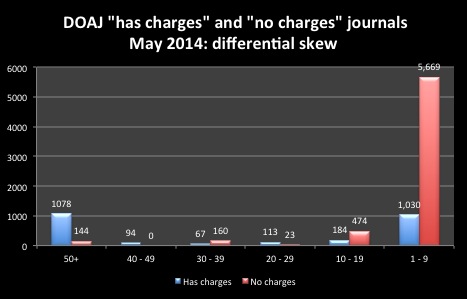
This chart illustrates the difference in skew between DOAJ charges that had charges or no charges in May 2014, as explained in the blogpost text.As we recently reported in MDPI’s Publications, our sample of DOAJ journals charging APCs showed a skew in size of publisher with journals in this category. Most journals were published either by publishers with 50+ journals using APCs, or 1- 9 journals using APCs, with not much in the middle. To prepare for our next study we are drawing a small sample of the much larger set of DOAJ journals with “no charges”. In preparing for this stratified / random sample we stumbled upon a different skew for this set of journals, that is, a very large skew towards the very small journals but no skew towards larger publishers. The chart above illustrates this difference in skew. To express this in plain language, what we are seeing here is a very large number of open access journals with no article processing charges (5,669 journals or 88% of no-charges journals) published by publishers with less than 10 journals in this category. The relatively small percentage of journals that do not fit in this category are spread somewhat evenly between the other size ranges.

Cite as:

Morrison, H. (2015). Many small open access journals / publishers do not charge APCs. Sustaining the Knowledge Commons / Soutenir Les Savoirs Communs. Retrieved from https://sustainingknowledgecommons.org/2015/02/20/many-small-open-access-journals-publishers-do-not-charge-apcs/

Open Access Article Processing Charges: DOAJ Survey May 2014

The article reporting the results of our May 2014 survey of DOAJ journals using open access article processing charges is now available in MPDI’s Publications. The abstract and citation details are below. To download the data behind the study, go to the dataverse.

Abstract: As of May 2014, the Directory of Open Access Journals (DOAJ) listed close to ten thousand fully open access, peer reviewed, scholarly journals. Most of these journals do not charge article processing charges (APCs). This article reports the results of a survey of the 2567 journals, or 26% of journals listed in DOAJ, that do have APCs based on a sample of 1432 of these journals. Results indicate a volatile sector that would make future APCs difficult to predict for budgeting purposes. DOAJ and publisher title lists often did not closely match. A number of journals were found on examination not to have APCs. A wide range of publication costs was found for every publisher type. The average (mean) APC of $964 contrasts with a mode of $0. At least 61% of publishers using APCs are commercial in nature, while many publishers are of unknown types. The vast majority of journals charging APCs (80%) were found to offer one or more variations on pricing, such as discounts for authors from mid to low income countries, differential pricing based on article type, institutional or society membership, and/or optional charges for extras such as English language editing services or fast track of articles. The complexity and volatility of this publishing landscape is discussed.

Citation: Morrison, H.; Salhab, J.; Calvé-Genest, A.; Horava, T. Open Access Article Processing Charges: DOAJ Survey May 2014. Publications 2015, 3, 1-16 https://doi.org/10.3390/publications3010001

Sustaining the Knowledge Commons team at CASRAI Reconnect 2014

IMG_0876

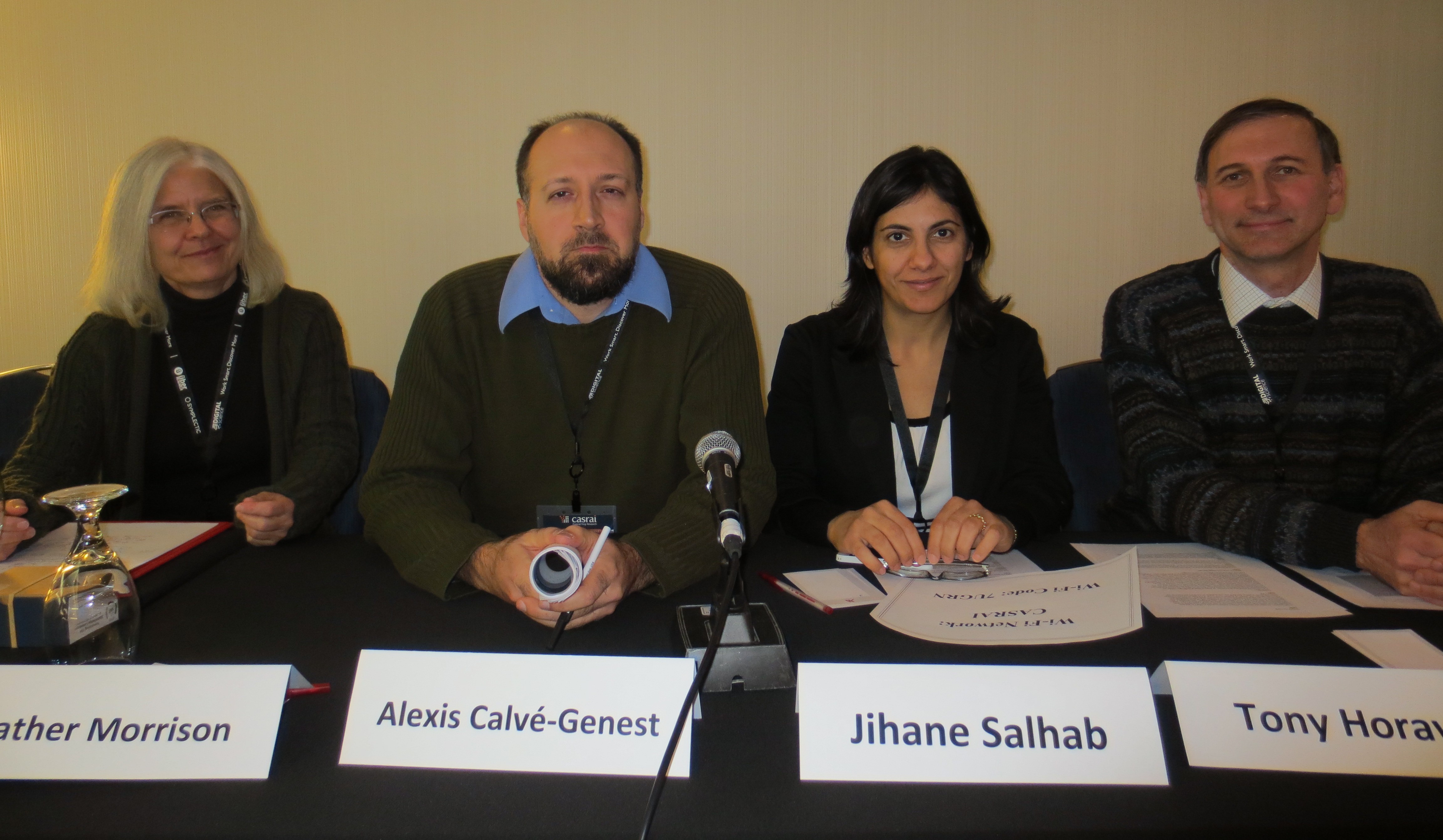
The Sustaining the Knowledge Commons Team (left to right Heather Morrison, Alexis Calvé-Genest, Jihane Salhab and Tony Horava) presenting at the CASRAI Reconnect conference in Ottawa, Nov. 20, 2014. Click the link below to view the team’s presentation in PDF. The uO Recherche (IR) link can be found in the citation.

CASRAISKC20141118

Cite as:

Morrison, H., Calvé-Genest, A., & Salhab, J. (2014, November). Sustaining the knowledge commons: Open access scholarship. Presented at the CASRAI reconnect, Ottawa, ON, Canada. Retrieved from http://ruor.uottawa.ca/handle/10393/32314

Closing Open Medicine: why we need to work at Sustaining the Knowledge Commons

A sad moment for open access: the closing of Open Medicine. Kendall, Maskalyk & Papelu’s final editorial provides a good explanation of the resources that we need to support scholar-led open access publishing: active participation in the form of academic editing, and financial support for the work involved in running a journal. This illustrates why we need to work towards sustaining the knowledge commons.

Morrison, H. (2014). Closing Open Medicine: Why we need to work at Sustaining the Knowledge Commons. Sustaining the Knowledge Commons / Soutenir Les Savoirs Communs. Retrieved from https://sustainingknowledgecommons.org/2014/11/18/closing-open-medicine-why-we-need-to-work-at-sustaining-the-knowledge-commons/

Copernicus Publications: when length of articles and choice of templates matter

Copernicus Open Access publishing requires the author or a supporting institution to pay the Article Page Processing Charges (APPC). These cover the cost of the review process, typesetting, web publication and long term archiving, upon publication. Copernicus also gives the author the choice of customization, using a complex system for calculating its APPCs based on the number of pages published and the format of the material submitted. As Copernicus puts it, “authors can directly influence the price of the publication.”
Accordingly, what makes the financing models at Copernicus variant and flexible are charges that are based on article length and sources files (Word/LaTeX). For example, publishing a 10 page article (without calculating the additional tax) in Atmospheric Chemistry and Physics could vary from €792 when using the publisher’s LaTeX template, to €1122 when using a different LaTeX template. Another option might be to use the publisher’s Word template and pay €957, or else pay €1287 when using another Word template. Surely, there is always the author’s choice between the publisher’s LaTeX and Word templates; i.e. between paying €792 or €957 respectively. Of course, fewer pages would cost the author even less.
In addition, Copernicus Publications provides several agreements where settlement of payments can be done directly between the publisher and the respective institution, given that members of those institutions opt to use Copernicus’s templates. For example, members of ETH Zurich, do not pay any publication fees for any of Copernicus’s journals if they use their LaTex or Word template. However, if an author does not use one of these templates, Copernicus will charge the difference to the author.
As to authors who lack financial support, Copernicus waivers policy provides another way to lower the price as they can benefit from the budget of free pages which is assigned by the chief editor of each journal.

Cite as:

Salhab, J. (2014). Copernicus Publications: When length of articles and choice of templates matter. Sustaining the Knowledge Commons / Soutenir Les Savoirs Communs. Retrieved from https://sustainingknowledgecommons.org/2014/10/23/copernicus-publications-when-length-of-articles-and-choice-of-templates-matter/

Open access article processing charges: DOAJ survey May 2014

To celebrate open access week 2014, the Sustaining the Knowledge Commons team is posting an early preprint of the Open access article processing charges: DOAJ survey May 2014 )  for open commenting:  http://wp.me/a4L0Lh-49

Please post your comments (or reviews?) on the article as comments to this post. The commenting period is open until November 3rd. If anyone would like to comment but prefers more time please let us know.

Data is posted as open data in the OA APC dataverse: http://dataverse.scholarsportal.info/dvn/dv/oaapc

Happy Open Access Week! Heather, Jihane, Alexis & Tony.

https://i0.wp.com/api.ning.com/files/bQfOv76fsJeymkfhtUcyDdpHJXpG1Q2JHrVTt0xOBGxR7M8q26SEwCG2GMXDAlkN9lchchQc0bWtlSj1KRSPea785bNX1-2t/120x240.jpg

Citation: please read and cite the final article:

Morrison, H., Salhab, J., Calvé-Genest, A., & Horava, T. (2015). Open Access Article Processing Charges: DOAJ Survey May 2014. Publications, 3(1), 1–16. https://doi.org/10.3390/publications3010001

Most DOAJ journals using article processing fees charge under $1,000 US

This data from the May 2014 census of DOAJ journals identified as using the open access article processing fee method may be of interest. In brief: the majority (68%) of fully gold OA journals in this sample charge less than $1,000 USD. Only about 1% charge more than $3,000.

Of the minority of journals included in DOAJ at that time identified as using the OA APC approach (approximately 26% of journals in DOAJ) which were confirmed through sampling to be using APCs, a majority of journals charge less than $1,000 USD.

As these charts illustrate, 68% of journals sampled (adjusted for sampling factor, e.g. if one out of five titles by a publisher or in a particular publisher size range was sampled, the results were multiplied by 5) had APCs in the 0 – $999 USD range. Only 1 journal (10 adjusted for sampling factor) was over $4,000. Only 5 journals (18 adjusted for sampling) were over $3,000. That’s a combined total of less than 1% of the total in this price range.

Details forthcoming.

freq by price range 2freq by price range 1 corrected

Updated October 20, 2014: date correction – original post and charts showed May 2015, corrected to May 2014. hm

Update October 14, 2014: the pie chart was updated as the colour scheme in the original was misleading – the colours for low price range were identified as high price range and vice versa. hm

Cite as: Morrison, H. (2014). Most DOAJ journals using article processing fees charge under $1,000 US. Sustaining the Knowledge Commons / Soutenir Les Savoirs Communs. Retrieved from https://sustainingknowledgecommons.org/2014/10/09/most-doaj-journals-using-article-processing-fees-charge-under-1000-us/