Elsevier as an open access publisher

Just published:

Morrison, H. (2017). From the field: Elsevier as an open access publisher. The Charleston Advisor 18:3, pp. 53-59 doi https://doi.org/10.5260/chara.18.3.53

Abstract:

Highlights of this broad-brush case study of Elsevier’s Open Access (OA) journals as of 2016: Elsevier offers 511 fully OA journals and 2,149 hybrids. Most fully OA journals do not charge article processing charges (APCs). APCs of fully OA journals average $660 US ($1,731 excluding no-fee journals); hybrid OA averages $2,500. A practice termed author nominal copyright is observed, where copyright is in the name of the author although the author contract is essentially a copyright transfer. The prospects for a full Elsevier flip to OA via APC payments for articles going forward are considered and found to be problematic.

Citation: cite the original article rather than this blogpost.

Oxford Open: Increased the Number of Open Access Journal

Oxford Open wants to distribute journals of high-quality research but to be able to publish the journal in the open access model. They do charge article processing fees for most of their journals. Oxford Open also has journals that the author can choose the open access option (hybrid journals), but for the purpose of our research, we only use the journal that is available fully in open access.

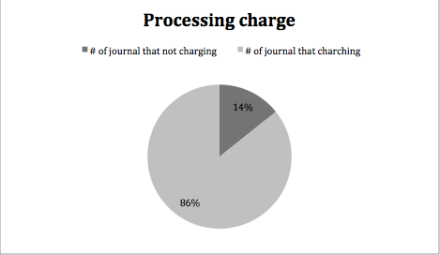
By collecting the information about the open-access journals I noticed that only 14 of their journals don’t have any processing charge and some of them don’t have them, but only for 2016.


Screen Shot 2016-11-17 at 11.40.15 AM.png

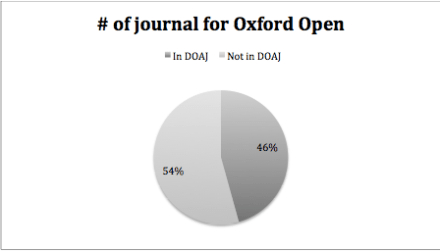
On their website I was able to collect 35 journal titles, the DOAJ only has 16. They seem to aim for more journals that will be available without fees for the user.


Screen Shot 2016-11-17 at 11.42.27 AM.png

In 2015 they had 11 journals and we sampled 5 of them. Only two have increased their price and the other three journals the price remained the same. The Journal DNA Research has increased the most of their processing fees in 2016. It has risen by 50%. However, the Nucleic Acids Research  has a rise they processing fees from 1400 GBP in 2015 to 1420 GBP in 2016.

Cite as:

Brutus, W. (2016). Oxford Open: Increased the Number of Open Access Journal. Sustaining the Knowledge Commons / Soutenir Les Savoirs Communs. Retrieved from https://sustainingknowledgecommons.org/2016/11/17/oxford-open-increased-the-number-of-open-access-journal/


Libertas Academica: follow-up

by Widlyne Brutus and Victoria Volkanova

Highlights

We recently reviewed the APCs of the publisher Libertas Academica for the year 2016 and found a mostly steady pricing compared with the year 2015. The fees are now listed in USD and GBP only, the latter replacing both Euro and Japanese Yen which were used in the previous years for authors from outside of North America. We also have noted the tendency to standardized pricing for the majority of the OA journals: US$1,848 / 1,399 GBP for the journals that are included in PubMed Central (PMC), and US$1,699 /1,299 GBP for the journals that are not included in PMC.

Details

According to its website, Libertas Academica (LA) publishes 83 international, peer-reviewed scientific, technical and medical journals.  Most of the LA journals are open access with the exception of the Clinical Medicine Reviews series that operates under the traditional subscription or pay-per-view model (http://www.la-press.com/about_us.php).

Last year we reviewed the APCs (or APFs, as they call it) of this publisher and found out the overall increases in all currencies (USD, Euros and Japanese Yen) that were much greater than the normal inflation rate warranted. In the comments to the original post, Tom Hill from Libertas Academica provided some explanation for the price increases, more specifically the addition of many journals to PubMed Central (i.e. XML creation, image quality requirements and additional quality control) and the depreciation of the Euro and the Yen, which were the two currencies used for authors from outside of North America. He also pointed out the ongoing possibility of fee waivers and discounts for authors.

Recently we revisited Libertas Academica’s website and compared their 2016 APCs with the previous years. First of all, we’ve noted one significant change in the currencies used: as of 2016, the authors from North America pay APCs in USD, whereas the authors from the rest of the world pay in GBP. We couldn’t find any explanation as to the reasons for which the publisher dropped both the Euro and the Japanese Yen in favour of the British Pound. Some of the possible reasons are the location of the company’s key external service providers in the United Kingdom (as well as in India and in New York, USA); generous UK APCs funding (RCUK, Wellcome Trust), or else the relative stability of this particular currency.

On a side note, the institutional membership fees are charged in USD only and go from US$3,300 to US$13,500, entitling the member institutions for an APC discount varying from 5% to 25%. So far, only one institution has subscribed to this option.

Another observation is the unified APCs for the journals that are being included in PubMed Central: US$1,848 and 1,399 GBP respectively. The fee in USD has remained stable for most journals. However, depending on the exchange rate between GBP and Euro (fluctuations ranging from 1.1054 to 1.4286 – GBP to Euro – in the past year, according to the Bank of England), the new price represents either a slight decrease (0.91% at the low point) or an increase of 1.17% at the high point.

For most journals that are not being included in PubMed Central, the APCs have been standardized at US$1,699 /1,299 GBP, which once again ranges from staying the same as in the year 2015 (for the APCs in USD and in some cases for the rest of the world) to an average increase of 1.47% (min being 1.28 % and max being 1.66%) for the other currencies.

However, there are a few exceptions to the standardized APCs (PMC- included or not): the journals Gene Expression to Genetical Genomics, Genomics Insights, and International Journal of Insect Science saw an increase of 1.59% in their 2016 APCs payable in GBP (1,399). Out of the three journals, Gene Expression to Genetical Genomics is not currently included in PMC.

As to the APCs stated previously in the Japanese Yen, the recent switch to the GBP had practically no impact: the charges fluctuated slightly between 0.916 % and 1.104 % compared to the previous year.

According to the LA’s website, the journals Breast Cancer: Basic and Clinical Research, Infectious Diseases: Research and Treatment, Palliative Care: Research and Treatment, and Virology: Research and Treatment are included in PMC, however, these titles do not appear on the PMC list as of November 1st, 2016 (https://www.ncbi.nlm.nih.gov/pmc/journals).

Cite as:

Brutus, W., & Volkanova, V. (2016). Libertas Academica: Follow-up. Sustaining the Knowledge Commons / Soutenir Les Savoirs Communs. Retrieved from https://sustainingknowledgecommons.org/2016/11/01/libertas-academica-follow-up/

Hikari- favor some disciplines?

Hikari is a publisher of journals in science, technology and medicine founded in 2005. They used to be in the DOAJ 2015, but in 2016 the publisher isn’t mentioned in the directory. The publisher didn’t change the amount of their OA APC. The majority of the journals still charge processing fees but they no longer charge publication fees in the fields of medicine and economics. This means that of their 20 journals, 4 of them no longer have publication fees. 25 percent of their journals have no publication fees. The journals that still have publication fees charge 200 EUR per page up to 8 pages and an extra 25 EUR per pages for the additional pages.

Cite as:

Brutus, W. (2016). Hikari- favor some disciplines? Sustaining the Knowledge Commons / Soutenir Les Savoirs Communs. Retrieved from https://sustainingknowledgecommons.org/2016/10/13/hikari-favor-some-disciplines/

Medknow 2016: it’s complicated!

by Widlyne Brutus and Heather Morrison

Highlights

Medknow is an emerging commercial scholarly journal publisher based in the developing world (India) that is owned by one of the oldest and most traditional western-based commercial publishers, Wolters Kluwer, that publishes in partnership with many long-standing traditional society and university journals. Even though the publisher is for-profit by nature, the majority of journals do not charge APCs. Of the journals that do charge APCs, most have not changed price between 2015 and 2016; some journals are adding or dropping APCs, and a few have lowered their APC. However, we identified 16 journals that did raise APCs from 2015 to 2016, in some cases by substantial amounts (over 50%, some even doubling or tripling in price).

medknow-partnershipsmedknow-apc-split

Details

Medknow is a commercial publisher of peer-review medical journals that originated in India. This publisher has partnerships with many associations, societies and universities and its publications include many long-standing not-for-profit journals. Of the 141 journals published by Medknow, more than half (83 journals) are published in partnership with universities and learned societies.

A traditional commercial scholarly publisher, with a history dating back to 1836, Wolters Kluwer, acquired Medknow in 2011. The reason for mentioning this is as one example of how the distinction between traditional and open access publishers may not be as relevant today as it used to be.

The partnership with the not-for-profit societies and universities likely explains why less than half of Medknow journals (70 journals) charge an APC as of 2016 (an increase from 61 journals with APCs in 2015).

In 2016, there are 26 journals that clearly state that there is no processing charge, down from 28 journals in 2015. It is not always clear whether there is an APC or not. In 2016 we note 38 journals with no cost found (meaning we did not find either an APC or clear language stating that there is no APC), down slightly from 41 in 2015.

There 28 publication in 2015 that have no publication fees and in 2016 26 publication have no processing charge.

Widlyne compared the averages of the article processing charge for the year of 2015 and 2016.

The average in 2015 was $285 and in 2016, $173 in US dollar. While the price seems to have decreased, this likely reflects currency fluctuations as the primary currency for a large portion of the journals is not USD, for example Indian rupees as the primary currency is very common. So this information should not be taking as a proof of the decrease of APC.

Comparing prices on a journal-by-journal basis, most of the prices did not change (31 journals had exactly the same price). Four journals lowered their APC and two no longer charge APC’s.

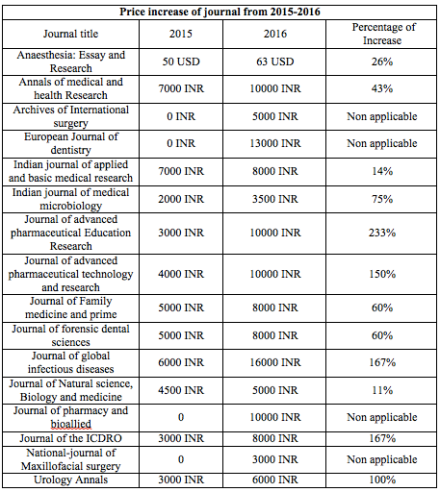
16 journals have increased their APCs, this table show which journal have increase their APC’s, the amount for 2015 and 2016 and the percentage of increase.

screen-shot-2016-10-06-at-4-57-36-pm

As you can see most of these journals have increase their APC considerably; at least 8 journals increased their price by more than half. Some journals even doubled or tripled their prices.

Cite as:

Brutus, W., & Morrison, H. (2016). Medknow 2016: It’s complicated! Sustaining the Knowledge Commons / Soutenir Les Savoirs Communs. Retrieved from https://sustainingknowledgecommons.org/2016/10/11/medknow-2016-its-complicated/


Inside e-life: what it costs to publish

Update September 6: Kent Anderson has published a critique of e-life’s annual report on the Scholarly Kitchen blog (published by the Society for Scholarly Publishing). Thanks to Danny Kingsley on the Global Open Access List.

Thanks to Emily Packer, e-life Press Office, via the SSP list for the following, and to e-life for their transparency. As a bit of context, e-life is a new journal aiming to compete with the most prestigious scholarly journals. Their costs are quite a bit higher than the average APC, reflecting a number of factors, including paying editors and significant staff costs, and the costs of developing their own technology platform (now available to all as open source).

Emily Packer’s message:

Of interest, eLife has published its 2015 annual report, detailing our costs of publishing versus those of our technology innovation and development.

Every year since 2012, eLife has published an annual report on activities along with our US Form 990 (required for our type of non-profit organisation) and our audited financial accounts. This year, we present a deeper view of our 2015 financials, covering publishing and non-publishing expenses.

As part of our ambition to change how science publishing works, especially among highly selective journals, we hope that being transparent about our costs will help set a future course for research communication that is efficient and sustainable.

eLife’s Executive Director, Mark Patterson, and Head of External Relations, Jennifer McLennan, have written a blog post that provides further information about our costs (https://elifesciences.org/elife-news/inside-elife-what-it-costs-publish) and the Times Higher Education featured a news piece: https://www.timeshighereducation.com/news/elife-reveals-publication-costs-spark-debate-journal-prices.

Our 2015 annual report is also available to view here: https://2015.elifesciences.org.

Citation: ideally cite the originals; if you have only used this blogpost, cite as:

Inside e-life: What it costs to publish. (2016). Sustaining the Knowledge Commons / Soutenir Les Savoirs Communs. Retrieved from https://sustainingknowledgecommons.org/2016/09/06/inside-e-life-what-it-costs-to-publish/

MDPI APC / FDP 2011 – 2016

Tanoh Laurent Kakou and Heather Morrison

Brief abstract (English)

This post presents highlights of preliminary results of our longitudinal study of the article processing charges (APCs) of MDPI, an open access publisher using the APC business model (exclusively), with new journals offering « free for now »  publication. Thanks to Solomon and Björk (2012) we have data for a sample of 25 of MDPI’s journals that did charge APCs in 2011 (non-charging journals were excluded from their study). The APCs for these 25 journals ranged from 300 CHF to 1,600 CHF, with an average of 624 CHF. Only 1 journal (Algorithms) did not change in price ; all others increased in price from 2011 – 2016. The average APC for this group of journals in 2016 was 1,148 CHF, an average increase of 524 CHF or an 84% increase in 5 years. This compares with a compound U.S. interest rate from 2010 – 2015 of 8.7% as calculated by Sara Wheatley https://sustainingknowledgecommons.org/2016/04/13/comparison-of-biomed-central-apcs-from-2010-2016/. The EU compound interest rate would have been lower during this time frame, with some years in negative growth. One might say that MDPI’s APCs for established journals have increased by an order of magnitude greater than the overall inflation rate in the past 5 years.

As of March 2016, MDPI listed 155 journals on its website. Of these, nearly half (72 journals) are <>, that is they use the APC model but are not yet charging. The average APC of 359 CHF (662 CHF when non-charging journals are excluded) contrasts with the 1,148 average APC of the 25 journals that were included in the 2011 sample (established journals). From 2014 to 2015 APCs either stayed the same or decreased ; from 2015 to 2016, we see only stable or increasing prices with an average price increase from 2015 to 2016 of 18% (60 CHF increase on a 2015 average APC of 334 CHF).

This case study illustrates one approach to the evolution of a new commercial publisher committed to the APC business model, with new journals offering free publishing until journals are established. APC payers need to take this into account for budgeting purposes; journals that today either are free or have very low APCs may have substantial APCs in a few year’s time.

Following are the original abstract (in French) by data analyst Tanoh Laurence Kakou and a table with the APCs of the 25 journals for which we have APC data for 2011 and 2016.

Résumé (Français)

Nous analysons des données de MDPI APC de 2011 à 2016. Notre recherche consiste à comprendre comment les frais de publication de MDPI ont évolué dans cette période. Nous avons analysé d’abord les données de chaque période. D’abord 2011, 2014, 2015, puis 2016. Puis nous avons comparé l’évolution des frais de 2011 à 2016, de 2014 à 2015 et de 2015 à 2016.

Les données de 2011 sont des prélèvements d’un échantillon effectué en 2011 par Solomon et Björk (2012) sur uniquement 25 revues avec des frais de publication. Ainsi, la moyenne des frais est 624 CHF, la médiane est de 500 CHF et le mode est de 300 CHF. Sensors a les frais de publication les plus élevés (1,600 CHF). Tandis que Molbank détient les moins élevés (200 CHF). En 2016, on a obtenu une moyenne de 345 CHF, une médiane de 300 CHF et un mode de 0 CHF. Sensors, Marine Drugs et Molecules ont les frais (1,800 CHF) les plus élevés. En ce qui a trait à l’évolution des frais entre 2011 et 2016, on obtient une moyenne de 115%, d’une médiane de 75% et d’un mode de 167%. S’agissant de l’évolution du nombre du montant des frais, nous obtenons une moyenne de 523 CHF, d’une médiane de 500 CHF et d’un mode de 200 CHF. Seule les frais de Algorithms n’ont pas changé. Ils sont restés à 300 CHF soit une évolution de 0%. Tandis que Polymers augmente de 367% qui représentent une valeur ajoutée de 1100 CHF.

Concernant les données de 2014 de Morrison et al, (2015) elles ont été effectuées sur toutes les 124 revues au site web de MDPI. On obtient dans cet échantillon, une moyenne de 372 CHF, d’une médiane de 300 CHF et d’un mode 0 CHF. 3 revues : Sensors, Marine Drugs et Molecules détiennent les frais les plus élevés. En 2015, Morrison et al. (2016) ont étudié 141 revues. 70 revues n’avaient pas de frais de publication. Sensors, Marine Drugs et Molecules gardent les mêmes frais (1800 CHF). Par rapport à l’évolution des frais de publication de 2014 à 2015, deux tendances s’observent.

Au niveau de l’évolution des frais des 124 revues de 2014 à 2015, les frais de 84 revues n’ont pas changé. 40 revues ont baissé leurs frais.

En mars 2016, nous avons trouvé 155 revues au site web de MDPI. Presque la moitié (72 revues) sont <>. La moyenne FDP est 359 CHF (662 CHF si on exclut les revues sans frais) la médiane 300 CHF (500 CHF si on exclut les revues sans frais et le mode 0 (300 CHF si on exclut les revues sans frais).

Au niveau de l’évolution 2015 et 2016, la moyenne augmentation est 18%, (60 CHF), une médiane de 0 et un mode de 0.

Conclusion

L’analyse des données de MDPI APC de 2011 à 2016 montre que les frais de publication de cette période ont augmenté en moyenne 84%, allant jusqu’ à 367% pour la revue Polymers. Cependant entre 2014 et 2015, on a constaté une stabilité des frais et même une baisse de 100% de 6 revues : Sports, Systems, Technologies, Toxics, Universe, Veterinary Sciences. Entre 2015 et 2016, on a remarqué en augmentation en moyenne de 18% (60 CHF).

JOURNAL NAME APC 2011 (CHF) APC 2016 (CHF) Change 2016 – 2011
Algorithms 300 300 0
Cancers 300 800 500
Diversity 300 800 500
Energies 800 1,400 600
Entropy 1,000 1,400 400
Future Internet 300 500 200
Games 300 500 200
Genes 300 800 500
International Journal of Environmental Research and Public Health 1,000 1,600 600
International Journal of Molecular Sciences 1,400 1,600 200
Marine Drugs 1,400 1,800 400
Materials 800 1,400 600
Molbank 200 300 100
Molecules 1,400 1,800 400
Nutrients 500 1,500 1,000
Pharmaceuticals 500 800 300
Pharmaceutics 300 500 200
Polymers 300 1,400 1,100
Remote Sensing 500 1,600 1,100
Sensors 1,600 1,800 200
Sustainability 500 1,200 700
Symmetry 300 800 500
Toxins 500 1,400 900
Viruses 500 1,500 1,000
Water 300 1,200 900
Average 624 1,148 524

Réference

Solomon, D.J. & Björk, B.-C. (2012) A study of open access journals using article processing charges. J. Am. Soc. Inf. Sci. Technol. 2012, 63, pp. 1485–1495. Retrieved from http://www.openaccesspublishing.org/apc2/preprint.pdf February 2, 2016.

Citation:

Kakou, T. L., & Morrison, H. (2016). MDPI APC / FDP 2011 – 2016. Sustaining the Knowledge Commons / Soutenir Les Savoirs Communs. Retrieved from https://sustainingknowledgecommons.org/2016/07/29/mdpi-apc-fdp-2011-2016/

Taylor & Francis 2016

With over 2,500 journals, Taylor & Francis, is one of the largest academic publishers in the world. For this reason, we are interested in the Open Access (OA) models they are using, as well as how they deal with copyright.

Taylor & Francis Journals

Taylor & Francis journals currently fall under three categories: Open (Fully OA), Open Select (Hybrid OA) and Subscription (Not OA). Fully Open or Pure open access journals means that all of the articles in these journals are OA. For these journals, an article publishing charge (APC) is often applicable. Their Open Select option is a hybrid option meaning that an author can publish in a subscription journal and pay a charge, usually an APC or an article page processing charge (APPC) to make their article freely available online upon publication.  The final category, Subscription, allows for Green Open Access, which is the archiving of an article on a website or in a repository. This is allowed for the accepted version of an article, which has been through peer review and has been accepted, but isn’t the final published article. This option is offered after an embargo period. The chart below shows the breakdown of the number of journals for each of these categories.  The Open Select option accounts for most of the journals at 91%, while 93 (4%) journals are fully OA.

TaylorandFrancispiechart

Of the fully open journals, 17/93 (18%) do not charge APCs.  Additionally, APCs could not be found for 5 journals.  The APCs of the journals that were found to charge them range from $200-$2000 in US dollars (USD) with the average being $922 and the mode being $1200. Some journals in this category have a different APC based on the length of the article and the type of creative commons license being used, these prices were not factored in to the average listed above.

An interesting model is being used by one group of fully OA journals by Cogent OA. Cogent journals, which account for 15/93 of the fully OA journals from Taylor & Francis operate a ‘pay what you want’ model.  This means that authors are allowed to choose how much they contribute towards OA publishing based on their financial circumstances. Authors have the opportunity to state how much they want to contribute, if accepted for publication, during the submission process.  In order to guarantee the integrity of peer review, the APC process is managed by the Cogent OA publishing team and not by journal editors or reviewers. Cogent OA states, “We believe strongly in the benefits of open access to scientific research and scholarship, and our APC policy is intended to help remove any barriers to its take-up around the world – leading to greater research impact for all.”

The APCs for the hybrid model were quite a bit higher than the ones for fully OA journals.  2142/2284 (94%) of these journals charge an APC of $2,950 USD (£1,788,  €2,150). The rest of the journals in this category either charge a lower APC or charge an APPC instead.

Taylor & Francis: Copyright Statements

When publishing with a Taylor & Francis subscription journal,  they ask the author to assign copyright to them. Alternatively, any author can also opt to retain their own copyright and sign a licence to publish. If the author chooses to assign copyright to Taylor & Francis, the author is asked to sign a publishing agreement.

In the case of open access journals it appears that Taylor & Francis is using the same author nominal copyright approach we first noticed when looking at Elsevier this year. Following is the text from the T&F Author Services page. An exclusive license to publish is in effect a transfer of virtually all rights under copyright, with the copyright in the name of the author, hence “author nominal copyright”.

Open access Creative Commons licenses

We ask you to sign a publishing agreement to establish the originality and provenance of your article and to give us the exclusive right to publish [emphasis added] the Version of Record of your article; you (the author) retain copyright. This agreement incorporates the Creative Commons license of your choice, which will dictate what others can do with your article once it has been published.

Copyright statements tend to vary from journal to journal for Taylor & Francis’ OA journals.  For example,  Acta Biomaterialia Odontologica‘s Instructions for Authors document states, “The copyright will remain with the Authors for articles published under this Open Access model, and once a paper has been accepted for publication, Informa will ask authors for a license to publish.”

Similarly Acta Oto-Laryngologica Case Reports states, “All contributing authors are asked to grant Taylor & Francis the right to publish her or his article as the final, definitive, and citable Version of Scholarly Record. Authors are required to sign an Open Access Article Publishing Agreement to facilitate this. Articles published in Acta Oto-Laryngologica Case Reports are published under the Creative Commons Attribution (CC BY) licence which permits others to distribute, remix, tweak, and build upon your work, even commercially, as long as they credit you for the original creation. Authors do however have the choice of opting for the Creative Commons Attribution-Non-Commercial Licence should they so choose. Reuse conditions will be subject to the license type chosen by the author.”

The Indo-Pacific Journal of Phenomenology requires authors to assign the right to publish their texts both electronically and in any other format they see fit, along with the right to store manuscripts in an electronic archive to the journal, Indo-Pacific Journal of Phenomenology. They go on to state, “Once published, authors may disseminate their papers (final, accepted and peer-reviewed PDF version) in whatever way they wish, within the terms set out in the Creative Commons Licence 4.0. The IPJP has adopted the CC BY-NC-ND licensing agreement. Creative Commons is a non-profit organisation that enables the sharing and use of creativity and knowledge through free legal tools. Accordingly, authors may post a copy of the PDF of their published article to their institutional repository or to any departmental or personal website, etc., subject to acknowledging its publication in the Indo-Pacific Journal of Phenomenology.”

In contrast to these above statements Journal of Drug Assessment states, “Articles are published with the understanding that their copyright be assigned to the Publisher once they are accepted. If any material used is subject to third-party copyright, copyright clearance is the sole responsibility of the authors and must be supplied in writing to the Publisher. Corresponding authors will be sent a copyright form to sign upon acknowledgment of their paper.”

These copyright statements are a small sample of how OA journals published by Taylor & Francis handle copyright.  As they all differ, it is important for authors to understand their options and submit to journals accordingly.  It may be assumed that authors retain their copyright when publishing in OA journals, but this is not always the case.

Cite as:

Wheatley, S. (2016). Taylor & Francis 2016. Sustaining the Knowledge Commons / Soutenir Les Savoirs Communs. Retrieved from https://sustainingknowledgecommons.org/2016/06/15/taylor-francis-2016/
 

AOSIS 2015-2016 Comparison

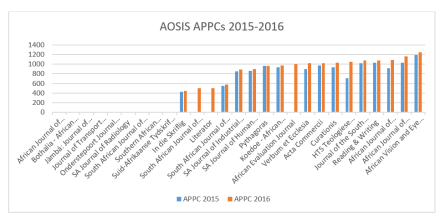
AOSIS is a smaller South African based open access publisher, with 26 journals listed in the Directory of Open Access Journals (DOAJ).  As of May 2016, the AOSIS website lists 28 open access journals. We found 27 matching journal titles when comparing our 2015 and 2016 data gathered from the AOSIS website.

The AOSIS website lists a per-page cost or Article Page Processing Charge (APPC) while the DOAJ’s Article Processing Charge (APC) figure is per-article.  The APC amount listed on DOAJ is likely based on an estimate of the average number of pages for an article.

From the AOSIS website in 2015, 11 out of 27 journals were sponsored by various organizations, therefore they did not require APPCs to be paid by authors.  Two of these titles are no longer sponsored in 2016.  18 out of 27 titles require APPCs to be paid by authors.  Most of these APPCs have increased since 2015.  The APPCs are listed in South African Rand (ZAR). The current conversion rate between ZAR and the US dollar (USD) is 1 ZAR equals 0.064 USD.  The average APPC in 2016 is about 617 ZAR, which equates to about 40 USD. The average AOSIS APC in DOAJ is 6050 ZAR or 388 USD.

The journal with the lowest APPC in 2015 and 2016 is In die Skriflig.  This journal charged 429 ZAR in 2015 and has increased to 44o ZAR in 2016.  The journal with the highest APPC in 2015 and 2016 is African Vision and Eye Health, which was charging 1191 ZAR in 2015 and is now charging 1250 ZAR. In 2015, only 4 journals charged over 1000 ZAR for APPCs.  In 2016, 10 out of 27 charge over 1000 ZAR.

According to AOSIS’ Copyright policy page, “The author(s) retain copyright on work published by AOSIS unless specified otherwise.” All individual journals titles were checked to see if there are any other specifications regarding copyright.  After clicking through each title, we found that all journals provided a link to the main About Scholarly Journals page, which states “Rest assured: you always retain copyright of your work.”

AOSIS Chart
References

AOSIS. (n.d.). Retrieved May 30, 2016, from http://www.aosis.co.za/

Directory of Open Access Journals. (Mn.d.). Retrieved June 1, 2016, from https://doaj.org/

Cite as:

Wheatley, S. (2016). AOSIS 2015-2016 Comparison. Sustaining the Knowledge Commons / Soutenir Les Savoirs Communs. Retrieved from https://sustainingknowledgecommons.org/2016/06/01/aosis-2015-2016-comparison/


Elsevier: now the world’s largest open access publisher

Elsevier: the world’s largest open access publisher as of May 2016

** draft ** by Heather Morrison

Summary

Elsevier is now the world’s largest open access publisher as measured by the number of fully open access journals published. Elsevier has 511 fully open access journals. De Gruyter is second with 435, Hindawi third with 405. These figures are based on data from the publishers’ own websites. 315 of the 511 journals (63%) have an APC of 0 and indicate “fee not payable by author”. Sampling of the open access journals indicates that a very large percentage (90%) of the fully open access journals are sponsored by actively involved societies and institutions with most owning copyright. I argue that society copyright ownership is not a bad thing; the alternative may not be vision of pure OA but rather Elsevier copyright.

In addition, 2,149 Elsevier journals have hybrid options at 2,149 journals. There is a marked difference in pricing patterns between hybrid and open access journals. Fully open access journals are clustered at the low end of the $0 – $5,000 USD price range while hybrids’ pricing is skewed toward the higher end.

A sampling of 50 journals from the full list of Elsevier journals found that 70% feature a “supports open access” button on the about the journal page; 38% have indications of society involvement, but clear indication of society copyright ownership is much less common. There is very limited historical information provided about Elsevier journals on the freely available website, making it difficult to assess past society or institutional involvement for a large percentage of journals.

Finally, an analysis is presented of the potential for Elsevier to achieve a full flip to open access APC while retaining current revenue. Reasonably realistic estimates range from a low of $5,000 USD to a high of over $11,000 USD to cover the 2015 Elsevier annual revenue of $3 billion USD from STM and enjoy the current 37% profit rate. These rates are not realistic. Libraries and those wishing to further the transition to open access should anticipate that Elsevier will seek to continue to receive subscriptions revenue, even with broad-based support for APCs, for a long time to come.

For full details see the draft in PDF:

Elsevier and open access publishing May 2016

Data from the study of 50 Elsevier journals can be downloaded from the dataverse.

Morrison, H. (2016). Elsevier: Now the world’s largest open access publisher. Sustaining the Knowledge Commons / Soutenir Les Savoirs Communs. Retrieved from https://sustainingknowledgecommons.org/2016/05/13/elsevier-now-the-worlds-largest-open-access-publisher/