DOAJ Added after March 2014, Has Charges: Preliminary Analysis

On May 16, 2015 I manually gathered APC and currency information for the 388 journals in DOAJ added after March 2014 that have publication fees, using a DOAJ Advanced Search / limit by journal then Article Processing Charges / Yes. The data for this subset has been posted in the OA APC dataverse (file name DOAJ Accepted after 2014 has charges). Some preliminary observations follow.

Highlights

Last year we found about 6% of journals actually had per-page rather than per-article charges; this model is not represented in DOAJ at all. This model has some logic to it, so this may be an unfortunate side-effect of the new DOAJ form and application process. The average APC in USD varies quite a bit by original currency, with journals charging in Great Britain Pounds (GBP) charging double journals charging in Euros. Could UK funders’ enthusiasm for paying APCs be a factor? The difference in APC by currency can help to explain the advantages of local publishing; it makes sense for an Indian scholar to pay an average equivalent of $32 USD rather than about 30 times this amount, the average for journals charging in USD. While the average APC of this subset is lower than we found last year, there are more journals at the top of the price range; 5 journals over the $4,000 mark as compared with only 1 from our sample last year.

Details

While the average APC in USD of this subset is lower than the average we found in 2014 ($933 vs. $964), the data seems to suggest several different tendencies happening at the same time.  Last year we found that about 6% of journals actually used a per-page rather than per-article cost. There is no way for journals to indicate this model today. This means that journals using this model either cannot participate in the DOAJ re-application process, or have to change their model. There is some logic to page charges as at least some of the costs of publishing (e.g. copyediting and proofreading) will vary depending on the length of the article. It would be unfortunate to drop this model simply because of the central importance of DOAJ for open access journals and the desire for simplicity in filling out the form.

The average may be lower, but there are more journals at the top of the price range. In 2014, of the 1,326 journals we looked at that had an APC, only one journal sampled had an APC of over $4000; only 6 had APCs of $3000 or higher. This May, out of a much smaller sample of 388 journals, 5 journals charge more than $4,000 and 10 have APCs of $3,000 or higher.

The average price in USD varies quite a bit by currency. The average price for journals charging in Great Britain Pounds (GBP) is double the amount for journals charging in Euros and 68% higher than journals charging in USD. Could the UK’s enthusiasm for paying APCs be a factor?

DOAJ accepted after 2015 has charges aver by currency

16 currencies are represented in this sub-sample, however 3 currencies dominate. 61% of these journals charge in USD, 21% in Euros and 9% in GBP, accounting for more than 90% of the total. Looking at the average amounts by currency may help to explain the advantages of local publishing. If you’re in India it’s probably a lot easier to come up with an average APC of 1,500 Indian rupees, the equivalent of $32 USD, rather than the average $969 of journals that charge in USD, roughly 30 times the amount.

DOAJ accepted after 2014 has charges currency percents

Method note: currency conversions were done using the Bank of Canada daily currency converter on May 17, 2015, in addition to the Central Banks of Khazakistan and the Ukraine (thanks to Wikipedia for the pointer to where to find this information). The Bank of Canada calculations can be verified at a later date using their 10-year currency converter. We may have more on this subset at a later date after the data is entered into the main spreadsheet with other DOAJ metadata and compared with our publisher website checks.

This post is part of the open access article processing charges project.

Cite as:

Morrison, H. (2015). DOAJ Added after March 2014, Has Charges: Preliminary Analysis. Sustaining the Knowledge Commons / Soutenir Les Savoirs Communs. Retrieved from https://sustainingknowledgecommons.org/2015/05/18/doaj-added-after-march-2014-has-charges-preliminary-analysis/
Libertas Academica: average 18% to 56% price increase 2015 over 2014

Update December 2019: in 2016 Sage acquired Libertas Academica. As noted on SKC in 2018, some of the Libertas Academica titles have ceased publishing. Titles that are still publishing are available via the Sage website; titles that have ceased publishing are available via CLOCKSS. These are good practices, but at the same time a good illustration of a danger that assuming that an OA publisher is “forever”. The Libertas Academic website per se is no longer available; any author, reader, or editor who goes to this site looking for content that used to be there might not find what they were looking for.

Libertas Academica posts APCs in three currencies, USD, Japanese Yen, and Euro, which results in 3 different average APC price increases: 18% for USD, 56% for Japanese Yen, and 21% for Euro. The only price decreases were in Euros; a few journals decreased 12% in price. In Japanese Yen, the range of price increases is from no increase to 249% of the 2014 price (i.e. more than double the 2014 price). In USD, the range is from no increase to a 79% price increase. The current inflation rate as calculated by Statistics Canada (may vary elsewhere) is 1.2%, so these average price rises are a very great deal higher than inflation. These are price increases that match or exceed the steep price increases of serials in the past century as recorded in the report of the Association of Research Libraries (ARL) Serials Pricing Project.

These are price increases on already substantial prices. For example, journals with APCs of $1,699 USD in 2014 are now $1,848 (9% increase). Journals that were $950 USD in 2014 are now $1,699 USD (79% increase).

Average APCs for Libertas Academica in 2015

1,848 USD
22,550 Japanese Yen
1,705 EUR

There are 76 titles listed on the Libertas Academica website today, down from 81 in 2014. It is not clear how readers would find articles published in the other 5 journals. This poses issues for readers and authors alike; discussion and recommendations are available in the title not found: room for improvement in maintaining access to content in ceased journals post.

Full data for the above has been posted in the OA APC dataverse.

50 of the Libertas Academic titles are listed in DOAJ. Another 32 OA APC Libertas titles are not listed in DOAJ. The titles are:

Advances in Tumor Virology
Bone and Tissue Regeneration Insights
Cell & Tissue Transplantation & Therapy
Cell Biology Insights
Cell Communication Insights
Clinical Medicine Insights: Psychiatry
Clinical Medicine Insights: Trauma and Intensive Medicine
Clinical Medicine Insights: Urology
Gene Expression to Genetical Genomics
Genomics Insights
Glycobiology Insights
Health Services Insights
Healthy Aging & Clinical Care in the Elderly
Human Parasitic Diseases
Immunology and Immunogenetics Insights
Immunotherapy Insights
Indian Journal of Clinical Medicine
Journal of Experimental Nuroscience
Journal of Genomes and Exomes
Lymphoma and Chronic Lymphocytic Leukemias
Medical Equipment Insights
Organic Chemistry Insights
Particle Physics Insights
Perspectives in Medicinal Chemistry
Primary Prevention Insights
Proteomics Insights
Rehabilitation Process and Outcome
Reproductive Biology Insights
Signal Transduction Insights
Tobacco Use Insights
Translational Oncogenomics

This post is part of the open access article processing charges project.

Cite as:

Morrison, H. (2015). Libertas Academica: Average 18% to 56% price increase 2015 over 2014. Sustaining the Knowledge Commons / Soutenir Les Savoirs Communs. Retrieved from https://sustainingknowledgecommons.org/2015/05/15/libertas-academica-average-18-to-56-price-increase-2015-over-2014/

Title not found: room for improvement in maintaining access to articles when journals disappear

Update July 3: 11 “titles not found” have been added, 9 for BioMedCentral and 1 for Springer Open, for a total of 15 titles so far.

Some open access journal publishers and services may not have much experience in the complexities of keeping track of journals and articles as journals change over time. The purpose of this post is to highlight the loss of ready access that occurs when a journal ceases publication and is removed from DOAJ, and sometimes from the publisher’s website as well. It is understandable that DOAJ wishes to focus on and encourage active open access journals, however removing content when journals cease is a disservice to readers and authors alike.

Recommendations

Authors: always post a copy of your article in an open access archive, even if you have published in an open access journal.

Open access journal publishers: if a title ceases to exist, do not remove the title from your website (unless it had no articles at all). If the journal has changed title, add a link to help the reader make the connection. If the title has ceased, include a note to that effect.

DOAJ: indicate that journals have ceased rather than removing them from DOAJ. Include a field to indicate whether journals are active or not. There is an “end date” in DOAJ which seems like a good candidate to use for that purpose.

Examples of title not found

These 9 titles were on the BioMedCentral website in 2014, but have disappeared as of May 2015:

BMC Medical Physics
Cough
Genome Integrity
International Archives of Medicine
Journal of Brachial Plexus and Peripheral Nerve Injury
Journal of Molecular Signaling
Longevity & Healthspan
Microbial Informatics and Experimentation
Nuclear Receptor Signaling

These titles were on the Libertas Academica website in 2014, but have disappeared as of May 2015:

      • Autism Insights
      • Cell Biology Insights
      • Clinical Medical Insights: Dermatology
      • Immunotherapy Insights
      • Particle Physics Insights

Sciedu Press

  • Journal of Haematological Malignancies – last issue appears to be 2013. Still listed in DOAJ, not included on publisher’s website.

From Springer Open, 1 title on the website in 2014 disappeared in 2015:

Scalable Computing

These 4 journals were from the sub-sample of 139 journals we surveyed last year published by publishers with 9 or fewer journals – a 3% attrition rate for this sub-group:

  • American Journal of Oil and Chemical Technologies
  • International Journal of Phytomedicine
  • International Journal of Marketing Practices
  • Journal of Emerging Trends in Economics and Management Sciences

This post is part of the Tech Tips series

Morrison, H. (2015). Title not found: Room for improvement in maintaining access to articles when journals disappear. Sustaining the Knowledge Commons / Soutenir Les Savoirs Communs. Retrieved from https://sustainingknowledgecommons.org/2015/05/15/title-not-found-room-for-improvement-in-maintaining-access-to-articles-when-journals-disappear/

OA APC survey May 2015 work-in-progress

Update December 2019: for the latest version of the OA APC longitudinal survey (which includes the 2015 data), see this post: https://sustainingknowledgecommons.org/2019/11/27/oa-apc-longitudinal-survey-2019/

Friday May 15, 2015 is the beginning of the 2015 data-gathering for the OA APC project. This post will report work-in-progress illustrating the open research approach.

The DOAJ metadata file was downloaded Friday May 15 at 8:00 a.m. EST, using the instructions on how to download and save the file without messing up the characters. I found the simplest way to do this was to save the .csv file then open in Open Office. Our internal shared Google Drive had no difficulty retaining the characters. I had no success with my version of Excel (mac user). The DOAJ metadata file has been posted to the OA APC dataverse.

Some basic facts and statistics as of today

From DOAJ metadata (csv file)

  • 10,532 journals listed in DOAJ
  • Publication fee and further information (for publication fee) columns are blank in DOAJ metadata (we have a saved file from Nov. 2013 where this information was still available which we’ll be using to find journals with APCs as the latest available)
  • Content in DOAJ column indicates “Yes” for all journals which is not correct

From the DOAJ website

  • 10,532 journals
  • 6,325 searchable at article level
  • 134 countries
  • 1,902,039 articles

What percentage of journals in DOAJ charge APCs? There is no up to date information on this question at this point in time. The best estimate is about 30 – 32%, based on historical data from DOAJ. The reason this information is not up to date: DOAJ has asked all journals to re-apply in order to provide better information and to date just over 10% have done this. The 30 – 32% is virtually identical to what we found last year, i.e. 26% of DOAJ journals at that time had charges and 5% were “conditional” with respect to charges. The “conditional” category has disappeared, so the 26% + 5% = 31%. The 1% difference could be a rounding error. This is not surprising as DOAJ has not updated this information since March 2014.

Now on to looking up publisher OA APC charges and getting the data into our spreadsheet and other files so that we can do some analysis. I’ll post updates from time to time.

Possibly of interest

Loyalty discount: Libertas Academica offers discounts to former authors as well as peer reviewers – their language on transparency / separation of payment and editorial functions may be of interest as well.

This post is part of the open access article processing charges project.

Cite as:

Morrison, H. (2015). OA APC survey May 2015 work-in-progress. Sustaining the Knowledge Commons / Soutenir Les Savoirs Communs. Retrieved from https://sustainingknowledgecommons.org/2015/05/15/oa-apc-survey-may-2015-work-in-progress/

Historical APC data from before the April upgrade

Historical OA APC data from the DOAJ website – reblogged from the DOAJ website and also copied below as not all of the data was copied.

The following is copied from the DOAJ News Service

In my post the other day, I promised to provide the APC information from the old site. Here it is as of today:

APC? Number of journals

N 6283 (67.6%)
Y 2999 (32.3%)
No info 9 (0.1%)
TOTAL 9291

Today there are 10,508 journals in DOAJ which leaves 1217 journals unaccounted for in the old APC data above. These are all journals that have been accepted into DOAJ under the new criteria. (We have accepted 1217 journals into DOAJ since March 2014.) We know from the new data that 364 of them do have APCs. Therefore 853 journals have NO APCs. Then we can work out the following TOTALS for ALL journals in DOAJ:

APC? Number of journals

N 7136 (67.9%)
Y 3363 (32%)
No info 9 (0.1%)
TOTAL 10,508

This also means that the APC facet on the new site should display:

APC? Number of journals

N 853 (8.1%)
Y 364 (3.5%)
No info 9291 (88.4%)
TOTAL 10,508

88.4% of all the journals in DOAJ have yet to reapply.

Cite as: Morrison, H. (2015). Historical APC data from before the April upgrade. Sustaining the Knowledge Commons / Soutenir Les Savoirs Communs. Retrieved from https://sustainingknowledgecommons.org/2015/05/15/historical-apc-data-from-before-the-april-upgrade/

How a flat APC with no price increase for 3 years can be a 6% – 77% price increase

by Jihane Salhab and Heather Morrison

The purpose of this post is to explain the impact of currency differences on article processing charges. Over the past few years megajournal PLOS ONE has been a good model in at least one way, maintaining the APC of $1,350 USD with no price increase over several years. However, if you happen to be paying in Euros, the PLOS ONE APC rose 14% from March to December of 2014, or 23% from March 20, 2014 to March 20, 2015. In South Africa, the price increased 58% in the same 3-year period; in Brazil, the price increase was 77%. Click on the following link to view the PLOS ONE price rises from March to December 2014 and from March 2012 to March 2015 in 8 currencies.

The PLOS ONE APC 8 curr

Any scholarly publishing system that involves cross-border payments, whether demand side (subscriptions / payments) or supply side (APC, journal hosting or other production services) has this disadvantage of pricing variability almost everywhere. In this case, US payers benefit from the flat fee, but anytime an APC is paid for a US scholar publishing in an international venue the same pricing variations based on currency will apply. In contrast, any scholarly publishing system that involves local payments (e.g. hosting of local journals, paying local copyeditors and proofreaders) has the advantage of relative pricing stability that comes with paying in the local currency.

This post is part of the open access article processing charges project.

Cite as:

Salhab, J., & Morrison, H. (2015). How a flat APC with no price increase for 3 years can be a 6% – 77% price increase. Sustaining the Knowledge Commons / Soutenir Les Savoirs Communs. Retrieved from https://sustainingknowledgecommons.org/2015/05/13/how-a-flat-apc-with-no-price-increase-for-3-years-can-be-a-6-77-price-increase/

Subject classification of DOAJ journals – data and documentation

Data for the subject classification of DOAJ journals is now available in the OA APC dataverse:

Morrison, Heather; Villamizar, César; Mondésir, Guinsly; Calvé-Genest, Alexis, 2019, “OA APC – Subject Analysis – Statistic Frequency & Coding”, https://doi.org/10.5683/SP2/4WKTZF, Scholars Portal Dataverse, V1

Documentation of the dataset:

Documentation – Subject Classification – OA APC – V1.3

Presentation of results:

Morrison, H., Villamizar, C., Salhab, J., & Calvé-Genest, A. (2015). Open access APC subject, content and impact factor correlational study. Presented at the Canadian Association of Information Studies annual conference, Ottawa, ON, Canada. Retrieved from https://ruor.uottawa.ca/handle/10393/32440

Cite as:

Villamizar, C., Mondésir, G., Calvé-Genest, A., & Morrison, Heather. (2015). Edit Post ‹ Sustaining the Knowledge Commons / Soutenir les savoirs communs. Sustaining the Knowledge Commons / Soutenir Les Savoirs Communs. Retrieved from https://wordpress.com/post/sustainingknowledgecommons.org/334


Which subjects are most likely to charge article processing charges?

Since the SKC team is studying article processing charges, it’s important to emphasize that the majority of fully open access journals do not use APCs; our studies of this method are not intended as an endorsement of this business model. The following data is from a follow-up analysis based on the May 2014 survey of a sample of the 2,567 journals listed in DOAJ at that time that had article processing charges, 26% of the 9,709 titles in DOAJ at that time. For details on the sample, see our article in MDPI’s Publications. César’s dataset and documentation explaining the preparatory analysis of subjects in DOAJ will be posted shortly. The following table illustrates the difference in the tendencies of journals from different subjects to charge APCs. Medicine is the discipline most likely to charge APCs; 47% of the journals in our APC sample were from medicine compared to 23% of journals listed in DOAJ at that time. The “subject tendency to charge APCs” is calculated by subtracting the percentage of journals in DOAJ from the % of journals from sample with APC. A positive result means a greater tendency to appear in DOAJ than to charge APCs, while a negative result means a greater presence in DOAJ as a whole than in the APC sample. For example, humanities includes 14% of the journals in DOAJ but only 1% of the APC journals.

Subject Number of journals in DOAJ Percentage of journals in DOAJ % of journals from sample with APC Subject tendency to charge APCs
Medicine 2,235 23% 47% 24%
Biology and Life Sciences 664 7% 14% 7%
Technology and Engineering 970 10% 13% 3%
Physical Sciences and Math 666 7% 9% 2%
Science General 134 1% 1% -1%
Agriculture 414 4% 3% -1%
Law 183 2% 0% -2%
General Works 502 5% 2% -3%
Education 596 6% 2% -5%
Social Sciences 1,984 20% 8% -13%
Humanities 1,360 14% 1% -13%

Reference

Morrison, H.; Salhab, J.; Calvé-Genest, A.; Horava, T. Open Access Article Processing Charges: DOAJ Survey May 2014. Publications 2015, 3, 1-16. http://www.mdpi.com/2304-6775/3/1/1

Cite as:

Morrison, H. (2015). Which subjects are most likely to charge article processing charges? Sustaining the Knowledge Commons / Soutenir Les Savoirs Communs. Retrieved from https://sustainingknowledgecommons.org/2015/05/05/which-subjects-are-most-likely-to-charge-article-processing-charges/

Who is served by for-profit gold open access publishing? A case study of Hindawi and Egypt

by: Jihane Salhab and Heather Morrison

Abstract

The highly successful Egypt-based open access publisher Hindawi is presented as a model of quality publishing and commercial success. However, this success is not accompanied by obvious benefits to Egypt’s own research and researchers. Even in the best-case scenario for academics in Egypt’s public university system, it would take three month’s salary for a full professor to pay the $1,500 USD OA APC of Hindawi’s high-end Disease Markers. Egypt’s largest public university, Cairo University, has no institutional repository. Fortunately for Egyptian researchers, there are open access journals that do not charge APCs, and not all open access repositories are institutional repositories. Open access may not be the most salient issue for Egyptian researchers at any rate. It is not clear that the pre-revolutionary state interference with research detailed in a 2005 Human Rights Watch report has been resolved, and the need to take on other work due to low salaries leaves many academics with little to no time to do research. In this instance, commercial success is not correlated with social benefit.

Details

Hindawi is an open access commercial publishing success story and an Egyptian business success story. Hindawi Publishing Corporation was founded by Ahmed Hindawi who, in an interview with Richard Poynder conducted in September 2012, confirmed a revenue of millions of dollars from APCs alone – a $3.3 net profit on $12 million in revenue, a 28% profit rate (Poynder, 2012). Hindawi is highly respected in open access publishing circles, and was an early leader in establishing the Open Access Scholarly Publishers’ Association (OASPA), an organization that takes quality in publishing seriously.

However, it seems highly unlikely that Egyptian researchers could afford to publish in the larger Hindawi journals. It would take three months’ salary for a full professor in today’s public university system to pay the $1,500 USD APC of Hindawi’s Disease Markers; this would take six months’ salary for a lecturer. This is the best-case scenario, assuming a university that has been able to implement the raise for academics decreed by Morsi in July 2012 to 3500 EGY monthly for a full professor ($579 USD) (1).

In addition to the financial factor, years of the pre-revolution regime’s interference with research subjects and methods formed a stagnant nature of contemporary scholarship where “the state restricts who can research what and severely punishes those who overstep their bounds” (Human Rights Watch, 46). Though there is a slight improvement after the revolution, still “economic, political, and physical insecurity in the country make it very difficult for serious changes to be made” (El-Awady, 2013).

There are other options for Egyptian researchers: the vast majority of open access journals do not charge article processing fees (Morrison et. al., 2015), there are subject as well as institutional open access repositories, and Egyptian researchers can read open access works of others. Still it might be reasonable to ask whether the most appropriate route to “open” in the short-term for researchers in Egypt involves opening up time to do the research through adequate salaries and opening up freedom to conduct and share research by building support for intellectual and academic freedom.

Note

1. In July 2012, more than a year after the revolution that ousted the Mubarak regime, elected president Morsi issued decree 84, amending the wages for academics that had not been changed since 1972. Published on July 14th in the Egyptian Official Journal (issue 28), Decree 84 (translated from Arabic by Jihane Salhab). lists the amendments of academics’ monthly wages as follows: 3500 EGY ($579 US) for professors, 3000 EGY ($497 US) for associate professors, 2500 EGY ($414 US) for lecturers, 1500 EGY ($248 US) for assistant lecturers and 1000EGY ($165 US) for teaching assistants respectively (using XE currency converter for that same date at a rate of $1=6.045 EGY). That raise was supposed to be only the first phase, but in February 2013 Egyptian minister of higher education Mas’ad confirmed in a statement that no other phases would follow (Bedewi, 2013).

References

Bedewi, M. (24 February 2013). Higher education: the country cannot endure the second phase of ‘academic wages.’ Al-Youm Al-Sabe’ [In Arabic]. Retrieved on 10 April 2015.

El-Awady, Nadia. (8 June 2013). Higher education still suffering after the revolution. University World News. Retrieved March 28, 2015 from http://www.universityworldnews.com/article.php?story=20130606161959301

Human Rights Watch (2005). Reading between the “Red Lines”: the repression of academic freedom in Egyptian universities. Human Rights Watch, 17(6): 1-109. Retrieved February 17, 2015 from http://www.hrw.org/reports/2005/egypt0605/egypt0605.pdf

Morrison H, Salhab J, Calvé-Genest A, Horava T (2015). Open Access Article Processing Charges: DOAJ Survey May 2014. Publications 3(1):1-16. Retrieved April 10, 2015 from http://www.mdpi.com/2304-6775/3/1/1

Poynder, R. (2012).The OA interviews: Ahmed Hindawi, founder of Hindawi Publishing Corporation. Retrieved March 10, 2015 from http://www.richardpoynder.co.uk/Hindawi_Interview.pdf

This post is the first in a series analyzing the actual or potential impact of APCs.

Cite as:

Salhab, J., & Morrison, H. (2015). Who is served by for-profit gold open access publishing? A case study of Hindawi and Egypt. Sustaining the Knowledge Commons / Soutenir Les Savoirs Communs. Retrieved from https://sustainingknowledgecommons.org/2015/04/10/who-is-served-by-for-profit-gold-open-access-publishing-a-case-study-of-hindawi-and-egypt/


Many small open access journals / publishers do not charge APCs

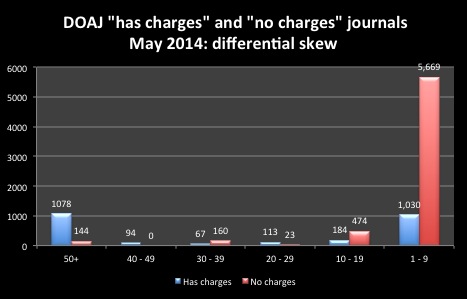
This chart illustrates the difference in skew between DOAJ charges that had charges or no charges in May 2014, as explained in the blogpost text.As we recently reported in MDPI’s Publications, our sample of DOAJ journals charging APCs showed a skew in size of publisher with journals in this category. Most journals were published either by publishers with 50+ journals using APCs, or 1- 9 journals using APCs, with not much in the middle. To prepare for our next study we are drawing a small sample of the much larger set of DOAJ journals with “no charges”. In preparing for this stratified / random sample we stumbled upon a different skew for this set of journals, that is, a very large skew towards the very small journals but no skew towards larger publishers. The chart above illustrates this difference in skew. To express this in plain language, what we are seeing here is a very large number of open access journals with no article processing charges (5,669 journals or 88% of no-charges journals) published by publishers with less than 10 journals in this category. The relatively small percentage of journals that do not fit in this category are spread somewhat evenly between the other size ranges.

Cite as:

Morrison, H. (2015). Many small open access journals / publishers do not charge APCs. Sustaining the Knowledge Commons / Soutenir Les Savoirs Communs. Retrieved from https://sustainingknowledgecommons.org/2015/02/20/many-small-open-access-journals-publishers-do-not-charge-apcs/