Common Pool Resource Theory introduction

The object of this series of posts on common pool resource theory is to generate discussion in the context of knowledge commons. Raising awareness about works on the commons is the ultimate intent.

Sharing resources as a group, is that possible without a catastrophe happening? Is the concept of knowledge commons viable?

Yes, and yes. In fact it is more or less how we function as human beings. We have tendencies to be selfish, of course, and we also hate each other. Despite our slightly narcissistic and xenophobic tendencies, through thousand of years we have always benefited from functioning as a group. How else would language, being cool or bravery mean anything to you?

  • You are able to read this, provided I do a good enough job at being intelligible (communication, information exchange).
  • You understand the social values of the society you live in (institutions).
  • You know people can be valued or ostracized based on their actions in relation to these values (regulation).

You already understand the basics of sharing a common pool resource.

Dare we explore it some more? We, as human beings, rely heavily on communication, information exchange, institutions, governance and rules to function as a group. How exactly do we successfully run a common pool resource (CPR) and how does that apply to a knowledge commons? This is what we will see in this entry.

The study of CPRs started gathering interest in California a few decades ago when Elinor Ostrom began work on her PhD dissertation through a case study on ground water basin management. She, along with her husband and workgroup went on to collect data for decades, culminating with a Nobel laureate a few years before her death. Some of these CPRs have endured for centuries, thus surviving generations of users while providing resources for hundreds of groups and countless number of people.

Ostrom’s studies were so large she and her colleagues had to devise a whole analysis model to incorporate the numerous case studies they were gathering. Once it was all done they were able to craft seven characteristics of a successful CPR, with an added eight in complex circumstances. In the process, they also helped redefine the notion of goods, now usually seen as four types instead of the common two that previously populated the economics literature.

We will explore some of these findings in other posts, but for the mean time let’s stay focused on the pervasive nature of the commons. While Ostrom may have been labeled a pure liberal, she was not providing an anti-government or anti-privatization discourse. The characteristics of the commons she constructed through inductive research, over several decades, are allowing groups to function aside and within governmental or private logics.

These groups preserve their common pool resource and have been for a very long time. This notion of enduring occurrence is important for people wishing to understand the extend at which CPRs exist around us.

Now that we know we have all the required knowledge to form a commons, and there is no waiting for government or private interests to form one, what about knowledge commons?

Though some of the characteristics of a successful commons are transferable to a knowledge commons, some adjustment are needed to apply commons logic to a knowledge commons. The zero cost of knowledge transfer (copying or sharing an idea for example) makes the idea of knowledge commons interesting to conceptualize. Motions of prestige for participation may help us understand how it may work. Ostrom expanded on this in a book on knowledge as a commons.

This is what we will see in future posts, and more, such as a more detailed review of successful commons characteristics, and a brief review of good types.

Cite as:

Calvé-Genest, A. (2014). Common Pool Resource Theory introduction. Sustaining the Knowledge Commons / Soutenir Les Savoirs Communs. Retrieved from https://sustainingknowledgecommons.org/2014/10/08/common-pool-resource-theory-introduction/

Fee complexity – an example

It is often assumed that article processing charges (APCs) are a single fee, and a straightforward approach to providing revenue to publishers to offset the costs of publication. However APCs can be a very complex affair. Take the Frontiers fee grid as an example. They publish peer-reviewed Gold OA journals in medicine, neuroscience, health, and related fields. A researcher wishing to submit a manuscript needs to navigate the fee grid to figure out what the APCs would be.  There are two tiers of articles (specialty-level and field-level). Within Tier 1, there are four types of articles, ranging in cost from free (e.g. book reviews, commentaries); to mini-review articles ( 575 euros); to original research articles as a research topic submission (960 euros, unless the corresponding author is a Frontiers Media associate or chief editor- 770 euros); a regular submission (1,600 euros unless the corresponding author is a Frontiers Media associate or chief editor – 1,280 euros); and lastly, clinical trial articles (2000 euros). In Tier 2, ie focused reviews or commentary, there are no fees. There are additional page charges in some categories.

This complexity speaks to the challenges of developing business models in an OA knowledge economy. As OA publishers experiment with new business models, it is interesting to observe the numerous levels, options, and discounts for scientific publishing fees  that are  emerging, such as in this example. We are living in a period of healthy and robust experimentation in publishing, and we can expect to see much more variety and nuance in fee models in the journal industry in the coming years. Researchers will need to carefully compare APC options and publishing venues- and what they are getting for their money.

About Frontiers – As described on their website:

“Frontiers was launched as a grassroots initiative in 2007 by scientists from the Swiss Federal Institute of Technology in Lausanne, Switzerland, out of the collective desire to improve the publishing options and provide better tools and services to researchers in the Internet age. Since then, Frontiers has become one of the largest and fastest-growing open-access scholarly publishers: over 20,000 high-quality, peer-reviewed articles have been published in 45 community-driven journals across more than 300 specialty niches in science, medicine and technology, and more than 40,000 high-impact researchers serve on the editorial boards and over 6 million monthly page views”

Articles are published with a fast turnaround time- three months after submission, on average.

Cite as:

Horava, T. (2014). Fee complexity – an example. Sustaining the Knowledge Commons / Soutenir Les Savoirs Communs. Retrieved from https://sustainingknowledgecommons.org/2014/09/09/fee-complexity-an-example/

Sustaining the Knowledge Commons (SKC) – Selected Bibliography on Open Access

Update December 2019: this bibliography is still available, but is no longer updated. Thanks to Jihane for her work on this. Keeping up with open access is challenging – the most comprehensive and ambitious effort to date is the crowdsourced Open Access Tracking Project. Please follow and join! ~ hm

Sustaining the Knowledge Commons (SKC) bibliography is a growing list of scholarly articles, books, book chapters, reports as well as primary publications. What began as a bibliographic list designated to the Open Access Article Processing Charges (APC), a project worked on by Heather Morrison, Tony Horava and Stephen Pinfield, has become a more general folder. It comprises the suite of projects under SKC, a concept aiming to remove barriers between all people, whether poor or rich, and the world’s scholarly knowledge. This  Zotero SKC folder will enable the users not only to access the metadata and abstracts of the sources, but also, when possible, provide links to sources that are freely available on the internet. Users will view, print, search by titles, authors, etc., export or generate a reference list to enable collaboration and knowledge-sharing.

This is a folder in progress and more reference recommendations are always welcomed. Please note that you are free to send us suggestions to improve the folder or to add to it.

June 30, 2014 Dramatic Growth of Open Access

The Dramatic Growth of Open Access series was updated June 30, 2014 by Heather Morrison and Jihane Salhab. In case you have technical difficulty accessing this link, the whole post is re-blogged here. Highlights this quarter include charts that demonstrate more than half a million items funded by the U.S. National Institutes of Health that are now freely available, and indications that the Public Access Policy is working – after 3 years, NIH funded items are more than twice as likely to be open access than any item regardless of funding.

Dramatic Growth of Open Access June 30, 2014

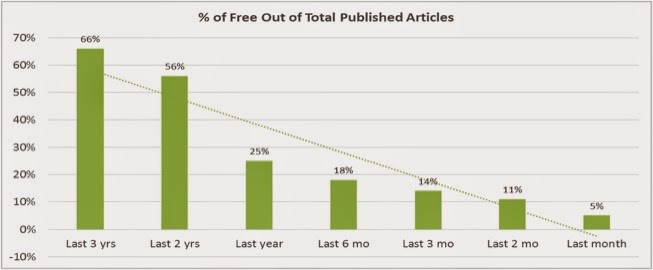
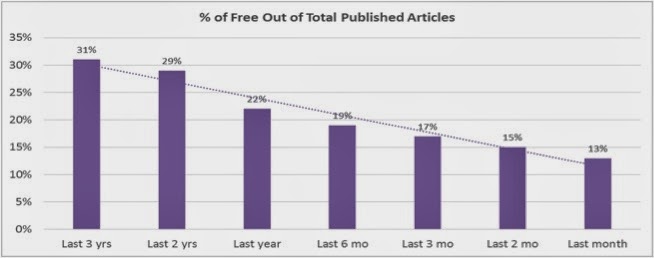
The June 30, 2014 Dramatic Growth of Open Access celebrates the milestone of more than half a million articles funded by the U.S. National Institutes of Health that are now freely accessible! After 3 years, the percentage of items found through a PubMed search funded by NIH rises to 71% (for NIH staff), 66% for NIH external funded research, and 31% for any article regardless of funding. At first glance, this looks a lot like evidence suggesting the NIH Public Access Policy is very effective, more than doubling the percentage of items freely available! Thanks to Jihane Salhab from the Sustaining the Knowledge Commons team for the charts, data gathering and analysis of PMC Free this quarter.

Research Support, N.I.H. Extramural + Intramural
Research Support, N.I.H., Intramural [pt]
 Research Support, N.I.H., Extramural [pt]
No Limits (No distinction based on researcher)

The Dramatic Growth of Open Access Series is a quarterly series (end of March, June, September, and December) of key data illustrating the growth of open access, with additional comments and analysis. The series is available in open data and blogpost (commentary) editions. The quarterly series began December 31, 2005, and is predated by a peer-reviewed journal article featuring data as of February 2005. To download the data or the rationale & method, see the Dramatic Growth of Open Access dataverse. Morrison, Heather, 2014-03, “Dramatic Growth of Open Access”, http://hdl.handle.net/10864/10660 Morrison, Heather [Distributor] V1 [Version].  The rationale and method has not been updated; March 31 is the latest. If you are using the June 30, 2014 PMC Free data, please Morrison, Heather and Salhab, Jihane.

More highlights this quarter

By the numbers, it’s usually the large, well-established and much used services that tend to impress. This quarter, the Bielefeld Academic Search Engine added 140 content providers and over 2 million documents for a total of over 3,000 content providers (illustrating the growth of the repository movement) and 62 million items (illustrating the growth of self-archiving). The Internet Archive gathered another 14 billion webpages for a total of 416 billion. The Electronic Journals library added another 958 journals that can be read free-of-charge for a total of over 45 thousand free journals. PubMedCentral added about 100 thousand free articles, for a total of over 3 million, and the number of journals actively contributing to PMC that now provide immediate free access grew by 63 to a total of 1,315. Searchable article growth in DOAJ was 75,000, bringing the total number of articles searchable by article in DOAJ to over 1.6 million.

By percentage growth, it’s the newest services starting off with nothing that have the greatest ability to impress. SCOAP3, the high energy physics full flip to open access global collaboration, started this January and nearly doubled the article count this quarter, to a total of over 2,000 articles. The Directory of Open Access Books added 6 publishers and 175 books for a total of 68 publishers and over 200 books.

Highwire Press added 8 completely free sites, for a total of 107 completely free sites, 8% growth this quarter (annual equivalent 32%).

Items of interest since March 31, 2014

  • June 4: the home page for Peter Suber’s MIT Press book Open Access passed the milestone of 100,000 page views (I highly recommend this as an excellent brief starting point for learning about OA).

This post is part of the Dramatic Growth of Open Access series.

Cite as:

Morrison, H., & Salhab, J. (2014). June 30, 2014 Dramatic Growth of Open Access. Sustaining the Knowledge Commons / Soutenir Les Savoirs Communs. Retrieved from https://sustainingknowledgecommons.org/2014/07/07/june-30-2014-dramatic-growth-of-open-access/