Most DOAJ journals using article processing fees charge under $1,000 US

This data from the May 2014 census of DOAJ journals identified as using the open access article processing fee method may be of interest. In brief: the majority (68%) of fully gold OA journals in this sample charge less than $1,000 USD. Only about 1% charge more than $3,000.

Of the minority of journals included in DOAJ at that time identified as using the OA APC approach (approximately 26% of journals in DOAJ) which were confirmed through sampling to be using APCs, a majority of journals charge less than $1,000 USD.

As these charts illustrate, 68% of journals sampled (adjusted for sampling factor, e.g. if one out of five titles by a publisher or in a particular publisher size range was sampled, the results were multiplied by 5) had APCs in the 0 – $999 USD range. Only 1 journal (10 adjusted for sampling factor) was over $4,000. Only 5 journals (18 adjusted for sampling) were over $3,000. That’s a combined total of less than 1% of the total in this price range.

Details forthcoming.

freq by price range 2freq by price range 1 corrected

Updated October 20, 2014: date correction – original post and charts showed May 2015, corrected to May 2014. hm

Update October 14, 2014: the pie chart was updated as the colour scheme in the original was misleading – the colours for low price range were identified as high price range and vice versa. hm

Cite as: Morrison, H. (2014). Most DOAJ journals using article processing fees charge under $1,000 US. Sustaining the Knowledge Commons / Soutenir Les Savoirs Communs. Retrieved from https://sustainingknowledgecommons.org/2014/10/09/most-doaj-journals-using-article-processing-fees-charge-under-1000-us/

OA APC variation: english language editing

MDPI provides a good example and explanation of a variation on article processing charges that reflect the work involved, that is, english language editing services. From the MDPI APC website (August 5, 2014):

For journals with an APC of 500 CHF or lower, a charge of 250 CHF will be applied to articles requiring extensive English language editing or formatting. To avoid surcharges, authors are recommended to carefully follow the instructions for authors and use the MS Word or LaTeX template files available on the instructions for authors page of the journal website. We encourage non-native English speaking authors to send their manuscripts to a professional English editing service prior to submission. If you use a service that provides a confirmation certificate, please send a copy to the Editorial Office. Authors from developing countries should consider registration with AuthorAid, a global research community that provides networking, mentoring, resources and training for researchers in developing countries.

This illustrates an important point about scholarly publishing when viewed as a service rather than as a good for sale: there is an inverse relationship between quality and the amount of work involved, i.e. the higher the quality, the less the work that is needed. This is because publishers do not pay for the largest portion of the work, conducting the research and writing the article. A well-researched and well-written article is less work for a journal at every step, as high quality articles make for easier editorial and peer review decisions as well as less work at the copyediting stage.

This approach provides an incentive for authors to submit articles in much better shape along with clear instructions about what that means, and also points to assistance for authors from developing countries.

One suggestion that fits with this approach is that it may be more effective to shift much of the support work of formatting and copyediting from publishers to the author’s institution. This way, institutions could hire local assistants and pay at rates appropriate for their own country and in their own currency, as well as creating local jobs, perhaps jobs for their own graduates in the case of universities.

For authors and copyeditors, there are advantages to working together over multiple projects. The copyeditor then has an opportunity to learn the terminology and approach preferred by the author, lessening the workload for both parties, as well as an opportunity to observe the growth of the author and research project over time. Perhaps a staff person in this position can help researchers with similar administrative tasks such as filing paperwork for grant proposals. This would free up the time of researchers to focus more on research. Where would the money come from? My suggestion is that in the process of transition to OA, we should not be looking to or funding publishers for services such as copyediting and formatting.

Of the 124 journals listed on the MDPI website, 124 or 85% offer english language editing services, generally at 250 CHF.

As a methodological note: while MDPI listed 124 journals, as of May 15, 2014 DOAJ listed 48 titles for MDPI. Correction August 5, 2014: note that DOAJ lists 104 journals for MDPI; the 48 titles are ones for which there are APCs. Many MDPI journals do not charge APCs, so the discrepancy is much less than I had thought.

I am finding that these large variations in title lists between websites of publishers relying on OA APCs and DOAJ are quite common. Simply collating these lists is proving to be a fair bit more challenging than anticipated.

Cite as:

Morrison, H. (2014). OA APC variation: English language editing. Sustaining the Knowledge Commons / Soutenir Les Savoirs Communs. Retrieved from https://sustainingknowledgecommons.org/2014/08/05/oa-apc-variation-english-language-editing/


Open access article processing fees: variation by type of article

One of the results emerging from the OA APC study is that behind the “APC” there is actually a variety of sub-models. An element of APC charges that makes sense when you think about is that sometimes the fee varies depending on the work involved.

One model that likely reflects the volume of work: some open access publishers charging varying fees depending on the type of article. Following are the fees charged by Bentham Open for their Group One journals (from the publisher’s website as of May 2014):

  • Letters: The publication fee for each published Letter article submitted is US $600.
  • Research Articles: The publication fee for each published Research article is US $800.
  • Mini-Review Articles: The publication fee for each published Mini Review article is US $600.
  • Review Articles: The publication fee for each published Review article is US $900.

For Group Two journals, there is a flat fee of $250 per article regardless of type.

BioMedCentral has a similar model, except that instead of differential fees, there is a standard 20% discount for certain types of articles (published protocols and case studies).

I argue that although these variations add complexity to calculating costs, these experiments are healthy and a better reflection of publication charges based on the service of publication than would be the case with a flat fee. Encouraging this approach may be wise to facilitate transparency and to work towards affordable pricing for full open access. Consider, for example, if we push publishers like BMC and Bentham Open to charge a flat fee per article, regardless of type, to simplify accounting. In this scenario, I would predict an APC at or near the highest current per-article price. What do you think?

Other examples of variations in pricing models that reflect the amount of work involved (blogposts to come):

  • page charges
  • flat fee up to a certain number of pages, page charges for overage
  • language editing services

Cite as: Morrison, H. (2014). Open access article processing fees: Variation by type of article. Sustaining the Knowledge Commons / Soutenir Les Savoirs Communs. Retrieved from https://sustainingknowledgecommons.org/2014/08/04/open-access-article-processing-fees-variation-by-type-of-article/

Genome Biology: not listed in DOAJ

Genome Biology, a well-established open access journal published by BioMedCentral with an impressive impact factor, is not listed in the Directory of Open Access Journals (DOAJ).  Presumably this is because one of DOAJ’s criteria for inclusion is “All content freely available”. In Genome Biology, the research articles are open access, but subscriptions are required for other content. Genome Medicine uses the same approach and is similarly not listed in DOAJ.

This is just one illustration of a methodological conundrum for the open access article processing fee research project. We are using DOAJ as the main source list for open access journals, however the DOAJ title lists for open access publishers using OA APCs do not quite match the publishers’ own lists, at least not the Hindawi and BioMedCentral title lists. In some cases this is likely due to recent changes at the publisher (new journals, older journals that have ceased to exist, changed titles or merged). However, the omission of a journal like Genome Biology is significant for this type of research because it is well-established, with an impact factor and a relatively expensive APC.

Traditional journals that use a hybrid approach (some articles open access while the journal as a whole continues as a subscription journal) are appropriately described as “double-dipping” by the open access movement. Are we giving publishers like Springer (the owner of BioMedCentral) an unwarranted free ride for doing exactly the same thing? Considering the high cost of publishing in Genome Biology or Genome Medicine ($2,835 US), this may be a question worth asking.

Cite as:

Morrison, H. (2014). Genome Biology: Not listed in DOAJ. Sustaining the Knowledge Commons / Soutenir Les Savoirs Communs. Retrieved from https://sustainingknowledgecommons.org/2014/08/01/genome-biology-not-listed-in-doaj/

Introducing the Open access article processing charges dataverse

The Open Access article processing charges dataverse is now open with two initial files that describe the sample of journals from DOAJ used for the May 2014 OA article processing fee census.

Files currently available

DOAJ publishers has charges 2014 05: this is a list of journals in DOAJ as of mid-May 2014 that “has charges” (sic – term used in DOAJ). This is the result of a screen scrape from a DOAJ Advanced Search screen as this field was not available in the DOAJ metadata on the census date.

DOAJ journals by APC pub size is a list of publishers in DOAJ that “has charges” in descending order by the number of journals using the article processing fee method. This analysis made it possible to identify the skewed distribution of this set of journals, with publishers tending to be large (50% APC journals) or small (1-9 journals, with 1 being the most common number by far).

DOAJ metadata files – the files downloaded from the DOAJ website for use in this study are posted. There are 3 csv files, from Nov. 2013 (used for the Nov. – Dec. 2013 pilot project); April 2014 (not used to date but retained as this dataset was downloaded before DOAJ removed APC information from the downloadable file) and May 14, 2014 (the dataset the 2014 census will focus on). If you are citing these files please note that you should cite DOAJ as well as this dataverse, and point readers to the current DOAJ metadata file for download.

Additional files will be released as time permits and as the work of collating results from various sources progresses. The files are in CSV format to permit for easy manipulation.

Thanks to the University of Ottawa Library and the Ontario Council of University Libraries’ Scholars Portal for the dataverse!

Housekeeping note: the dataverse URL changed with some technical work at Scholar’s Portal. It is now updated, but for some time the link would not have been working.

Cite as:

Morrison, H. (2014). Introducing the Open access article processing charges dataverse. Sustaining the Knowledge Commons / Soutenir Les Savoirs Communs. Retrieved from https://sustainingknowledgecommons.org/2014/07/21/introducing-the-open-access-article-processing-charges-dataverse/

Publishers using open access article processing charges are either big or small (skewed distribution)

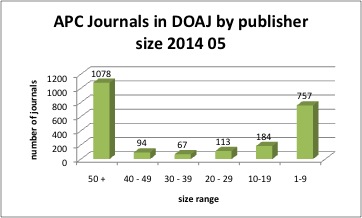
Of the minority of journals in DOAJ that have article processing charges (26 – 30%) , most (80%) are published either by publishers that have 50 or more journals that use APCs, or 1 – 9 journals that use APCs, with not much in the middle.

doajapcbypubsize

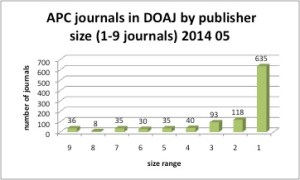
Of the publishers with 1 – 9 journals using APCs, by far the largest category of this group (83%) are one-off journals, i.e. the publisher has only one journal using APCs. This is a skewed distribution.

doajapcbypubsize1to9

This finding supports the distribution found by Frantsvåg (2010), although unlike Frantsvåg I do not see the large number of small publishers as a problem, but rather, as suggested by Edgar and Willinsky (2010), a possible indication of a renaissance of scholar-led publishing.  This distribution also fits the pattern for scholarly journal publishers overall described by Crow (2006).

This is very similar to the findings of Thompson (2005, p. 63),who found through a major study of scholarly monograph publishers in several English-speaking countries, a tendency towards concentration and larger publishers combined with a healthy system of very small publishers, but not much in the middle.

We hear a lot about the big publishers using APCs, like BioMedCentral and Hindawi, but not as much about the many small publishers. For this reason, it is the smaller  journals and publishers that I most want to highlight.

References

Crow, R. (2006). Publishing cooperatives: An alternative for not-for-profit publishers. First Monday, 11(9) Retrieved 2011 from http://131.193.153.231/www/issues/issue11_9/crow/index.html

Edgar, B. D., & Willinsky, J. (2010). A survey of the scholarly journals using open journal systems. Scholarly and Research Communication 1:2 Retrieved July 21, 2014 from http://www.src-online.ca/index.php/src/article/viewFile/24/40

Frantsvåg, J. E. (2010). The size distribution of open access publishers: A problem for open access? First Monday 15:2. Retrieved November 28, 2010 from http://firstmonday.org/htbin/cgiwrap/bin/ojs/index.php/fm/article/view/3208/2726

Thompson, J. B. (2005). Books in the digital age : The transformation of academic and higher education publishing in Britain and the United States. Cambridge: Polity.

Heather

Cite as: Morrison, H. (2014). Publishers using open access article processing charges are either big or small (skewed distribution). Sustaining the Knowledge Commons / Soutenir Les Savoirs Communs. Retrieved from https://sustainingknowledgecommons.org/2014/07/21/publishers-using-open-access-article-processing-charges-are-either-big-or-small-skewed-distribution/

OA APCs: discounts for quality and students, page charges for length

Thanks to Ian Song from Simon Fraser University for providing this information about the OA APC charged by Hans Publishers’ Hans Journal of Neurotechnology (in Chinese). This is published separately as a good illustration of the variety of models within the article processing fee approach.

Ian Song:

I looked at the web site about the processing fee at http://www.hanspub.org/journal/Fee.aspx?JournalID=582
The processing fee is 1,900 Chinese Yuan (about 328 Canadian dollars) for 8 pages. If an article is more than 8 pages, 100 Chinese Yuan per page will be added to the extra pages. For good quality articles (reviewed by the committee) from low income authors, the charge can be reduced (does not mention how much). If the first author is a student, the student can get 20% off.

Comments

This is the first time I’ve seen discounts specified for quality articles and student discounts, although clearly quality is a factor for other publishers as many offer such options as language (generally English) editing for an additional fee. The per-page charge for long articles is one that is used by other publishers. When you think about it, this makes sense; if we’re paying for the service of publishing, it makes sense that the amount varies depending on how much work is needed.

Cite as:

Morrison, H. (2014). OA APCs: Discounts for quality and students, page charges for length. Sustaining the Knowledge Commons / Soutenir Les Savoirs Communs. Retrieved from https://sustainingknowledgecommons.org/2014/07/09/oa-apcs-discounts-for-quality-and-students-page-charges-for-length/

June 30, 2014 Dramatic Growth of Open Access

The Dramatic Growth of Open Access series was updated June 30, 2014 by Heather Morrison and Jihane Salhab. In case you have technical difficulty accessing this link, the whole post is re-blogged here. Highlights this quarter include charts that demonstrate more than half a million items funded by the U.S. National Institutes of Health that are now freely available, and indications that the Public Access Policy is working – after 3 years, NIH funded items are more than twice as likely to be open access than any item regardless of funding.

Dramatic Growth of Open Access June 30, 2014

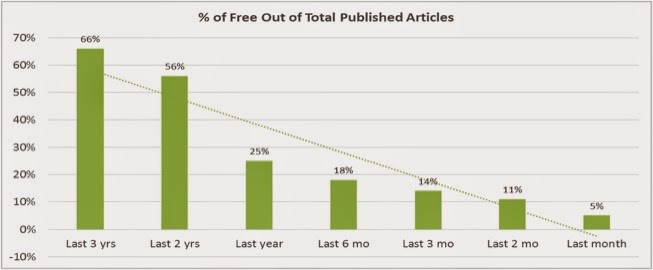
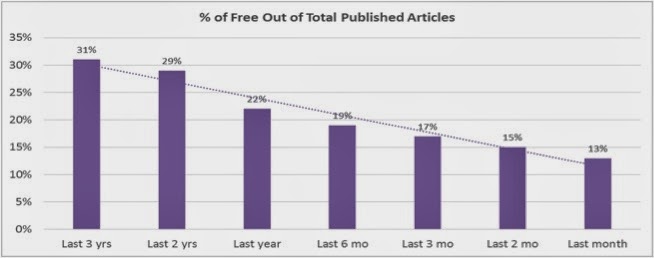
The June 30, 2014 Dramatic Growth of Open Access celebrates the milestone of more than half a million articles funded by the U.S. National Institutes of Health that are now freely accessible! After 3 years, the percentage of items found through a PubMed search funded by NIH rises to 71% (for NIH staff), 66% for NIH external funded research, and 31% for any article regardless of funding. At first glance, this looks a lot like evidence suggesting the NIH Public Access Policy is very effective, more than doubling the percentage of items freely available! Thanks to Jihane Salhab from the Sustaining the Knowledge Commons team for the charts, data gathering and analysis of PMC Free this quarter.

Research Support, N.I.H. Extramural + Intramural
Research Support, N.I.H., Intramural [pt]
 Research Support, N.I.H., Extramural [pt]
No Limits (No distinction based on researcher)

The Dramatic Growth of Open Access Series is a quarterly series (end of March, June, September, and December) of key data illustrating the growth of open access, with additional comments and analysis. The series is available in open data and blogpost (commentary) editions. The quarterly series began December 31, 2005, and is predated by a peer-reviewed journal article featuring data as of February 2005. To download the data or the rationale & method, see the Dramatic Growth of Open Access dataverse. Morrison, Heather, 2014-03, “Dramatic Growth of Open Access”, http://hdl.handle.net/10864/10660 Morrison, Heather [Distributor] V1 [Version].  The rationale and method has not been updated; March 31 is the latest. If you are using the June 30, 2014 PMC Free data, please Morrison, Heather and Salhab, Jihane.

More highlights this quarter

By the numbers, it’s usually the large, well-established and much used services that tend to impress. This quarter, the Bielefeld Academic Search Engine added 140 content providers and over 2 million documents for a total of over 3,000 content providers (illustrating the growth of the repository movement) and 62 million items (illustrating the growth of self-archiving). The Internet Archive gathered another 14 billion webpages for a total of 416 billion. The Electronic Journals library added another 958 journals that can be read free-of-charge for a total of over 45 thousand free journals. PubMedCentral added about 100 thousand free articles, for a total of over 3 million, and the number of journals actively contributing to PMC that now provide immediate free access grew by 63 to a total of 1,315. Searchable article growth in DOAJ was 75,000, bringing the total number of articles searchable by article in DOAJ to over 1.6 million.

By percentage growth, it’s the newest services starting off with nothing that have the greatest ability to impress. SCOAP3, the high energy physics full flip to open access global collaboration, started this January and nearly doubled the article count this quarter, to a total of over 2,000 articles. The Directory of Open Access Books added 6 publishers and 175 books for a total of 68 publishers and over 200 books.

Highwire Press added 8 completely free sites, for a total of 107 completely free sites, 8% growth this quarter (annual equivalent 32%).

Items of interest since March 31, 2014

  • June 4: the home page for Peter Suber’s MIT Press book Open Access passed the milestone of 100,000 page views (I highly recommend this as an excellent brief starting point for learning about OA).

This post is part of the Dramatic Growth of Open Access series.

Cite as:

Morrison, H., & Salhab, J. (2014). June 30, 2014 Dramatic Growth of Open Access. Sustaining the Knowledge Commons / Soutenir Les Savoirs Communs. Retrieved from https://sustainingknowledgecommons.org/2014/07/07/june-30-2014-dramatic-growth-of-open-access/

Bravo to India’s DBT / DST on their proposed open access policy!

One of the keys to building and sustaining a global knowledge commons is good public open access policy. This post is a response to the Open Access Policy Committee of India’s Department of Biotechnology and Department of Science and Biotechnology on a proposed open access policy that is very forward-thinking in many respects and might be considered a new standard for open access policy for the world.

The draft policy is posted here

Government of India Department of Biotechnology and the Department of Science and Technology (DBT / DST) Proposed Open Access Policy

Comments submitted by Heather Morrison to the Open Access Policy Committee and cross-posted to Sustaining the Knowledge Commons https://sustainingknowledgecommons.org/ and The Imaginary Journal of Poetic Economics http://poeticeconomics.blogspot.ca/

Congratulations to the Open Access Policy Committee for a proposed policy that can be considered a new model for the world in almost every respect!

My two suggestions to perfect this policy are as follows:

1. After this sentence on page 1: “Grantees can make their papers open-access by publishing in an open-access journal or, if they choose to publish in a subscription journal, by posting the final accepted manuscript to an online repository”, this sentence were added: “Grantees who publish in an open-access journal should post the final published manuscript to an online repository based in India”.

Rationale: journals and publishers are free to come and go and change business models as they please. A journal that is open access today could cease to exist, or be sold to a publisher that uses a toll access business model in the future. The only way to ensure ongoing open access to publicly funded research is through the use of repositories under the direct or indirect control of the funding agency.

2. p. 2: “Suggest that the period of embargo be no greater than one year” – change “Suggest” to “Insist”, and add this phrase: “Future revisions of this policy will look to decreasing and eventually eliminating accommodation for publisher embargoes”.

Rationale

“Suggest” to “Insist”: the experience of one early open access policy leader, the U.S. National Institutes of Health, illustrated very well that certain publishers will take every advantage of any policy loophole available. The 2004 policy merely requiring open access had a dismal compliance rate; this changed dramatically with the strong 2008 policy. If researchers have options, publishers will refuse open access or demand longer embargoes. If policies are strong, publishers adjust as can be easily observed through the Sherpa RoMEO Publisher Copyright Policies and Self-Archiving service, which illustrates the shifting landscape of scholarly publishing overall towards compliance with open access policy as well as concessions for specific policies.

“Decreasing and eventually eliminating publisher embargoes”: the purpose of permitting publisher embargoes is to give the industry time to adjust. Publishers have now had more than a decade to adjust to open access policies around the world, including many by the world’s largest research funders. There are now close to 10,000 fully open access peer-reviewed scholarly journals, employing a variety of business models, including commercial operations that are quite successful financially. There is no reason for publishers to continue to need the “training wheels” support of embargo periods indefinitely.

There is no reason to delay the advance of research by one year at every step. We need clean energy solutions and answers to tough questions like climate change today. Since scientific advance is incremental in nature, a one-year embargo at every step towards an advance can mean an actual delay of many years in achieving a breakthrough.

Particular strengths of this policy that I would like to highlight:

p. 1: “DBT/DST will not underwrite article processing charges levied by some journals”.

Bravo! The purpose of public funding of research is and should be to facilitate the conduct of research, not to subsidize secondary support services such as scholarly publishing. The priority for DBT/DST funding should be ensuring that India’s research facilities are state of the art and providing salaries for Indian researchers and support for Indian students.

Also, there are areas (with this policy being a good example) where government policy is the best approach, and other areas that are best left to the market. It is appropriate for governments to direct researchers benefiting from public funding to make their work openly accessible. However, there are reasons to leave business models to the market. One reason is that commercial companies employing the article processing fee method are likely to be subject to the same market forces that caused distortion in the subscriptions market, and targeted government funding in this area could easily exacerbate the problem.

Another is that currently many publishers using the open access article processing fee approach provide waivers for authors from developing countries; this may even be the default. This information is from my research in progress (my apologies that my data is not yet ready to share; it will be posted as open data as soon as it is ready). If governments provide funding for authors from developing countries for article processing fees, this concession may well disappear and have a severe impact on authors without the benefit of such funds.

p. 1: “The DBT/DST affirms the principle that the intrinsic merit of the work, and not the title of the journal in which an author’s work is published, should be considered in making future funding decisions. DBT/DST does not recommend the use of journal impact factors, as a surrogate measure of the quality of individual research articles, to assess an individual scientist’s contributions, or in hiring, promotion, or funding decisions”

Bravo! This is the approach recommended by the San Francisco Declaration on Research Assessment http://am.ascb.org/dora/, and an approach that I heartily support. Among other things, heavy reliance on the impact factor as surrogate for quality of academic work has been a factor in market distortion in scholarly publishing. Also, reliance on impact factor has been an incentive for scholars to focus on topics of interest to high impact factor journals generally based in developed countries. For scholars in the developing world, this is an incentive to redirect focus from problems and issues of local concern to topics of interest to the developed world. This has also been a disincentive to development of local scholarly publishing systems. The ease of publishing on the internet means that it is timely for scholars in India and elsewhere to consider growing local scholarly publishing initiatives, providing opportunities for local leadership, outlets for research on topics of particular interest to India, and taking advantage of local currency and economic conditions to get the best deal on publishing services.

Other strengths shared with previous open access policies:

• The policy is required, not just requested
• Strong incentives for compliance (compliance considered in future funding and promotion requests)
• Immediate deposit of final manuscript post peer review is required, even when access must be delayed due to publisher embargoes

In summary, India’s DBT/DST proposed open access policy is sound, innovative, and in my expert opinion, sets a new standard for the world. The two recommendations for improvement is to ensure that all articles are deposited in a local open access repository, including articles published in open access journals (which may in future cease to exist, change ownership or business model), and to insist on rather than suggest an embargo of no more than one year with language indicating eventual elimination of embargoes. Particular strengths highlighted are the refusal to provide funds for article processing fees and the direction to consider the quality of the work, not the impact factor of the journal in which it is published.

Respectfully,

Dr. Heather Morrison
Assistant Professor
École des sciences de l’information / School of Information Studies
Master of Information Studies (M.I.S.) program accredited by the American Library Association
Maîtrise en sciences de l’information (M.S.I.) accréditée par l’American Library Association
University of Ottawa
http://www.sis.uottawa.ca/faculty/hmorrison.html
Heather.Morrison@uottawa.ca

July 5, 2014

Cite as:

Morrison, H. (2014). Bravo to India’s DBT / DST on their proposed open access policy! Sustaining the Knowledge Commons / Soutenir Les Savoirs Communs. Retrieved from https://sustainingknowledgecommons.org/2014/07/05/bravo-to-indias-dbt-dst-on-their-proposed-open-access-policy/

Resource requirements call for participation

Following is the call for participation for Resource Requirements interviews (e-mail and social media).

Appel de participation : exigences de ressource pour libre accès pour les revues savantes à but non lucratif / Call for participation: resource requirements for small scholar-led not-for-profit open access scholarly publishing

L’anglais suit

Êtes-vous un(e) lettré(e) impliqué dans la publication libre accès à but non lucratif (d’une à trois revue(s) savante(s), des actes de conférence occasionnels, ou la publication à petite échelle de monographie)? Ou, voudrait votre maison d’édition à petite échelle changer à libre accès, si on peut changer le soutien pour les opérations? Si la réponse est oui, je vous invite à participer à un entretien (à peu pres la moitié de l’heure ou une heure) conçu pour déterminer plus des ressources nécessaires pour soutenir ce type de publication libre accès.

Les résultats des entrevues faire une base pour plus de recherche, incluant étude de cas et focus groupes, comme preparation pour un projet plus grand sur les économies d’une transition global ver libre accès. Il est probable que les résultats de cette recherche seront utile pour le développement des affaires pour publication libre accès, est que les résultats vont informer le bon politique libre accès. Les participants peuvent choisir si leurs contributions seront anonymes et confidentiels ou libre accès et reconnues.

Se porter volontaire ou pour des informations complémentaires contactent, s’il vous plaît Heather Morrison re: Titre du project: exigences de ressource pour libre accès pour les revues savantes à but non lucratif

Au plaisir,
Dr. Heather Morrison
Professeure Adjointe
École des sciences de l’information / School of Information Studies
University of Ottawa
http://www.sis.uottawa.ca/faculty/hmorrison.html
Heather.Morrison@uottawa.ca

Call for participation: resource requirements for small scholar-led not-for-profit open access scholarly publishing

Are you a scholar involved in small not-for-profit open access publishing (from one to three journals, occasional conference proceedings, or small-scale monograph publishing)? Or, would your small not-for-profit publishing operation  like to switch to open access if the economic logistics can be worked out? If so, you are invited to participate in an interview (half hour to an hour) designed to further flesh out the resource requirements needed to sustain this kind of open access publishing.

Results of these interviews will form the basis for further research, including case studies and focus groups, in preparation for a larger project on the economics of global transition to open access. It is anticipated that results of this study will be useful in the development of business practices for open access publishing, and inform open access policy. Participants can choose whether their contributions will be anonymous and confidential or open and acknowledged.

To volunteer or for further information, please contact Heather Morrison re: study title: resource requirements for small scholar-led not-for-profit open access

Best,

Dr. Heather Morrison
Assistant Professor
École des sciences de l’information / School of Information Studies
University of Ottawa
http://www.sis.uottawa.ca/faculty/hmorrison.html
Heather.Morrison@uottawa.ca

Cite as:Morrison, H. (2014). Resource requirements call for participation. Sustaining the Knowledge Commons / Soutenir Les Savoirs Communs. Retrieved from https://sustainingknowledgecommons.org/2014/07/04/resource-requirements-call-for-participation/